Money Spell Guide
Prosperity rituals, luck symbols & intention

Lucky Rabbit Foot: Meaning, History and Kinder Alternatives
Why the rabbit's foot became a famous good luck charm, the history behind it, and kinder, animal-free charms that carry a similar meaning.
Share your love
A lucky rabbit foot is a charm, traditionally the preserved foot of a rabbit, that people have carried for good luck, protection and fortune. It became especially well known in the United States, where it moved from folk belief into mass-produced key chains during the twentieth century.
Today many people are curious about the charm’s meaning but uncomfortable with the idea of carrying part of an animal. In this guide we explore where the tradition comes from, what it is said to mean, how it varies, how people relate to it today, a few misconceptions, and kinder, animal-free alternatives that carry the same hopeful spirit.
This is folklore and personal belief, not a predictor of money or events; nothing here guarantees luck or financial results. We share the history with respect for the communities who shaped it, and we encourage choosing charms that cause no harm.
Lucky rabbit foot at a glance
| Charm or variation | What it is commonly associated with | Tradition or setting | Kinder tip |
|---|---|---|---|
| Traditional rabbit’s foot | Good luck, protection, fertility | European and American folk belief | Choose a symbolic charm instead of an animal part |
| Dyed key chain version | General good luck, nostalgia | 20th-century novelty shops | Faux-fur or fabric versions exist |
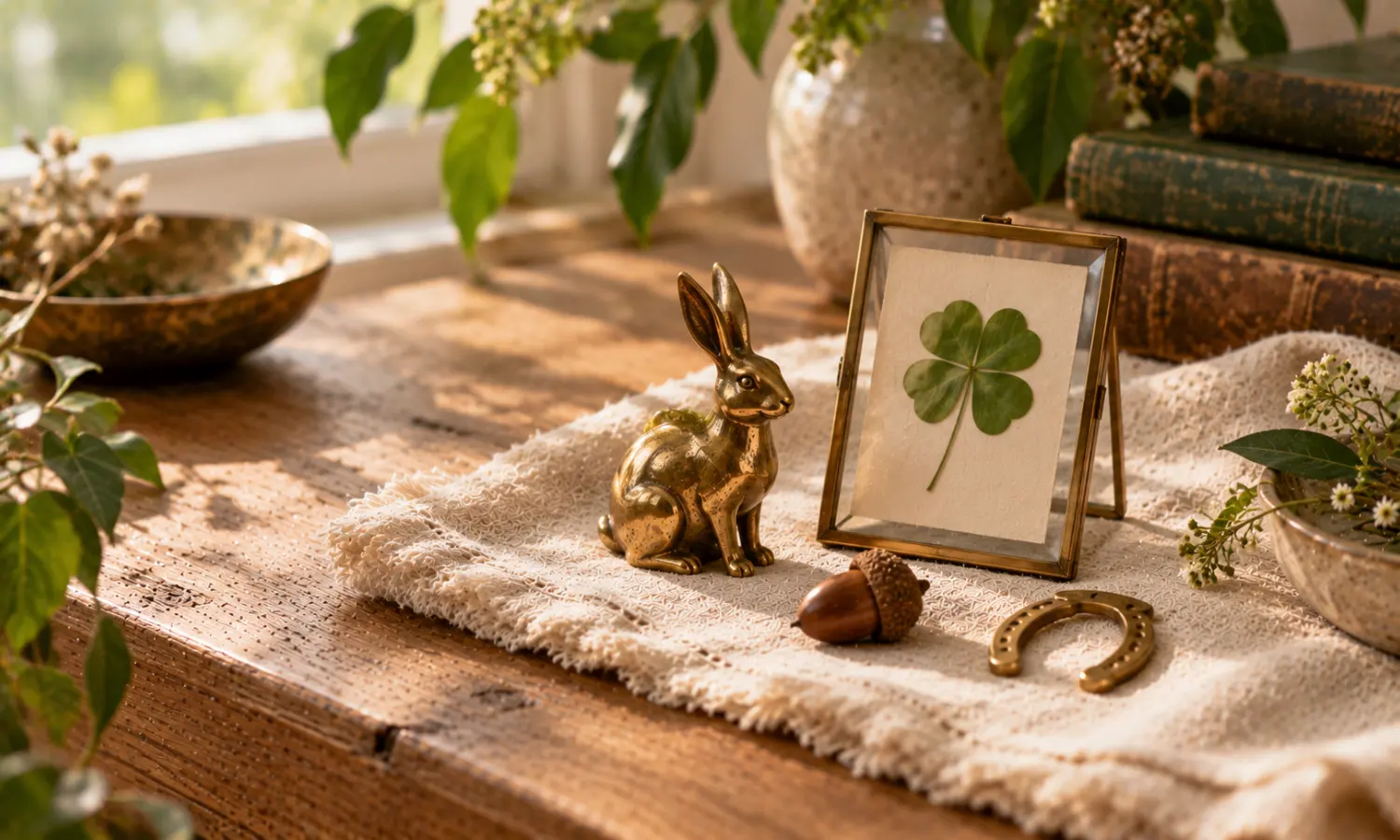
| Brass or silver rabbit charm | Luck, quickness, new beginnings | Modern jewelry and gifts | Durable, animal-free and easy to carry |
| Four-leaf clover | Rare good fortune | Irish and wider European folklore | Use a pressed clover or a metal charm |
| Horseshoe | Protection and luck at home | European and American folk custom | Hang a decorative one above a door |
| Acorn | Patience, growth, small beginnings | British and Northern European folklore | Carry a real acorn in a pocket |
Key takeaways
- The rabbit’s foot is a long-standing luck charm, especially well known in American folklore.
- Its meaning draws on the rabbit’s associations with speed, fertility and cleverness.
- Popular histories are often simplified, and some claimed origins are hard to verify.
- Many people now prefer animal-free charms such as metal rabbits, clovers, horseshoes and acorns.
- A charm is a reminder of hope; practical steps are what change real circumstances.
Where the lucky rabbit foot tradition comes from
Rabbits and hares appear in folklore across many cultures. They are often linked to fertility because they breed quickly, to the moon in several traditions, and to cleverness and escape because they are fast and hard to catch. It is easy to see how a part of such an animal might come to symbolize luck and protection.
The charm is sometimes traced to ancient Celtic beliefs, though the evidence for that link is thin, and it is best treated as a popular story. What is better documented is that the rabbit’s foot became an important charm in African American folk practice in the US South, where rabbits also feature as clever tricksters in storytelling traditions. Our article on hoodoo money work gives respectful context for that wider tradition.
Some folk accounts from the United States describe very particular conditions for a “true” lucky rabbit’s foot, such as using the left hind foot. These details vary from source to source. Over the twentieth century, the charm was commercialized as a cheap, often brightly dyed key chain, which spread it widely but stripped away much of its original context.
What the lucky rabbit foot means
At its simplest, the rabbit’s foot represents good luck. People have carried it hoping for fortune in gambling, travel, work, love and health. It is also associated with protection, a sense of being kept safe from harm or misfortune.
Because of the rabbit’s link with fertility and abundance, the charm is sometimes connected with growth and new life. In a money context, some people see it as a symbol of quick opportunities, echoing the animal’s speed.
For many people today, though, its meaning is largely nostalgic. A rabbit’s foot key chain may remind someone of a grandparent’s pocket, a childhood fair or an old car’s rearview mirror.
Variations and related charms
The charm has many cousins. In Irish and wider European folklore, a four-leaf clover is valued because it is rare. A horseshoe hung above a door is said to protect a home. In Japan, the beckoning cat is a familiar luck symbol for businesses, and in feng shui the money frog is placed near entrances for prosperity.
Rabbit imagery also appears in jewelry and decorative charms that carry the same hopeful meaning without using an animal. A small brass or silver rabbit, a ceramic figurine or an embroidered patch can all serve as a modern version of the old charm.
If you would like to explore more of these traditions, our guide to good luck symbols from around the world collects many of them in one place.
How people relate to the rabbit’s foot today
Attitudes toward the rabbit’s foot have changed. Many people now feel uneasy carrying part of an animal for luck, and some vintage charms were made under conditions we would not accept today. As a result, the traditional object has become less common, while symbolic versions have grown in popularity.
People who do own an old rabbit’s foot, often inherited, sometimes keep it as a family keepsake rather than as an active charm. Others choose to retire it respectfully and replace it with something animal-free that carries the same personal meaning.
Whatever you choose, the heart of the tradition is the same: carrying a small, tangible reminder of hope.
Kinder, animal-free alternatives
If you like the idea of a pocket charm but would rather not use an animal part, there are lovely options:
A metal rabbit charm
A small brass, silver or pewter rabbit keeps the original symbolism of speed, cleverness and abundance. It is durable and fits easily on a key ring or in a wallet.
A four-leaf clover
A pressed clover in a small locket or under clear resin, or a metal clover charm, is one of the most widely recognized luck symbols in the world.
A horseshoe
Decorative horseshoes, whether full size above a door or tiny on a bracelet, are a classic protective charm in European and American homes.
An acorn
In British folklore, the acorn symbolizes patience and growth from small beginnings. A real acorn costs nothing and slips easily into a coat pocket.
A faux-fur or fabric key chain
If what you love is the familiar look of the old novelty key chain, faux-fur versions recreate it without harming an animal.
Common misconceptions about the rabbit’s foot
Any rabbit’s foot brings luck. Even within folklore, accounts disagree about what makes a charm “lucky,” and none of them can be verified. The meaning has always come from belief.
The charm’s origin is simple and ancient. Popular histories often present a neat story, but the real development involves several traditions and plenty of uncertainty.
You need the real thing for it to count. Symbols work through meaning. A metal rabbit carried with intention is just as valid a reminder as a traditional charm.
A practical pairing
The site’s signature habit is to pair a symbol with one concrete action. Choose your charm and put it somewhere you will see daily, such as your wallet or keys. Each time you notice it this week, ask yourself one money question: “Did I spend on purpose today?”
At the end of the week, take one practical step based on what you noticed: cancel a subscription you forgot about, move a small amount into savings or pay a little extra toward one bill. The charm becomes a cue; the action becomes the luck you make.
Common questions
Is a rabbit’s foot good luck?
In folklore, yes. The rabbit’s foot has long been considered a good luck charm, especially in American tradition. Today many people prefer animal-free symbols that carry the same meaning.
Why is a rabbit’s foot considered lucky?
Rabbits are associated with fertility, speed and cleverness in many cultures, and the charm grew from those associations through European and American folk traditions.
What does a rabbit’s foot mean spiritually?
Spiritually, it is often read as a symbol of protection, abundance and quick opportunity. Its meaning lies in the hope and intention of the person carrying it.
What can I use instead of a real rabbit’s foot?
Good options include a metal rabbit charm, a four-leaf clover, a horseshoe, an acorn or a faux-fur key chain. All carry hopeful meaning without harming an animal.
Continue your practice
For more charms people carry every day, read lucky symbols for money and our guide to the most powerful good luck charms for money. To explore prosperity symbols across cultures, see symbols of prosperity.