
Money Spell Guide
Prosperity rituals, luck symbols & intention

The Most Powerful Good Luck Charms for Money (According to Tradition)
A calm guide to the money charms that have stayed in use for generations, what each one means, and how to keep one without expecting miracles.
Share your love
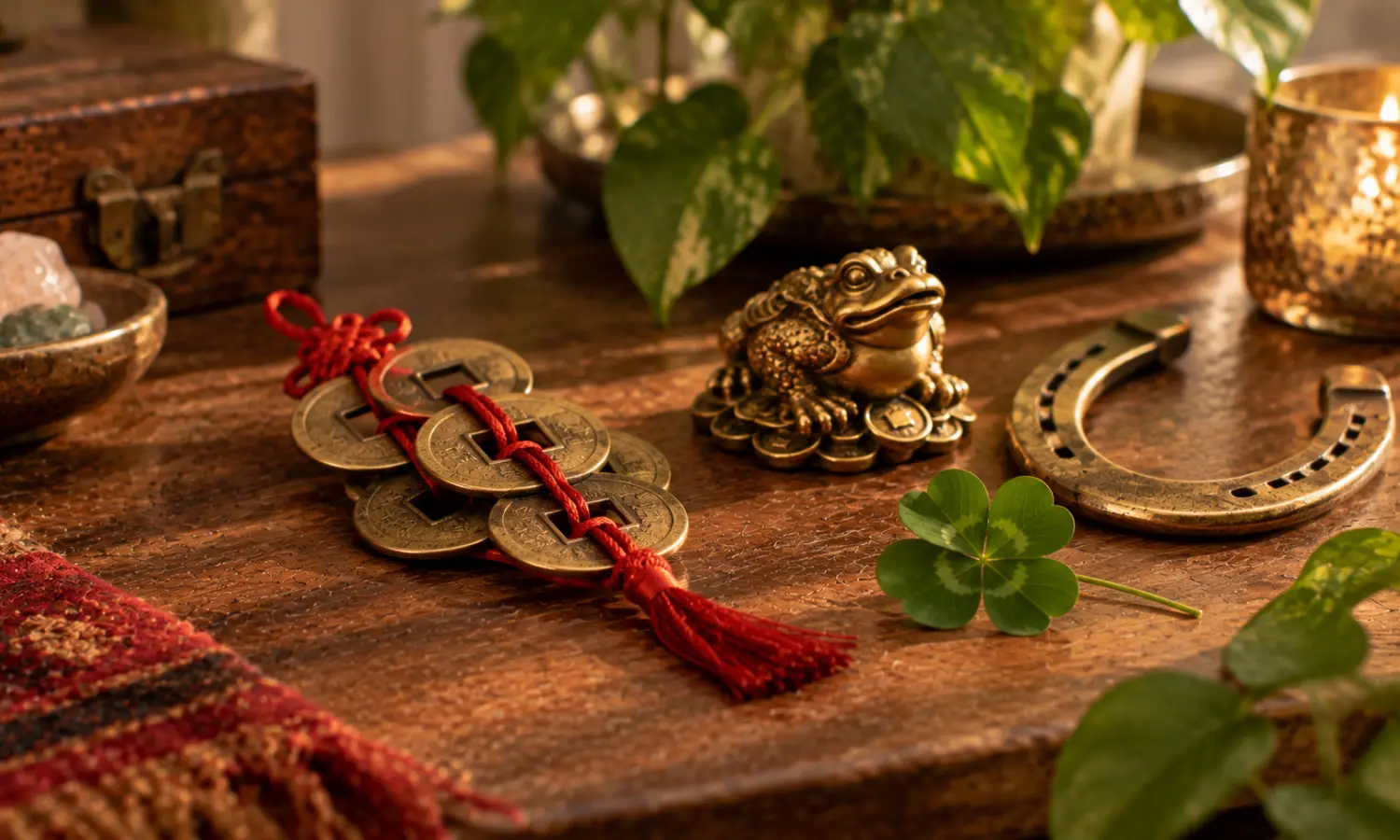
Ask ten people to name the most powerful good luck charms for money and you will get ten different answers, because every culture has its own. A Chinese coin on red thread, a horseshoe over the door, a small golden frog by the entrance, a four-leaf clover pressed in a wallet. Each one carries a story about why it is supposed to help.
This guide walks through the money charms that come up most often in folklore and in everyday practice, what each one is commonly associated with, and how people tend to use them. We have ranked nothing by effectiveness, because there is no honest way to do that. “Most powerful” here means most enduring: the charms that have stayed in use for generations.
These charms are symbolic objects rooted in folk tradition; they are not a proven method for producing money and nothing here guarantees financial results. What they can do is give you a small, physical reminder of what you are working toward.
Money luck charms at a glance
| Charm | Tradition | Commonly associated with | Where people keep it |
|---|---|---|---|
| Chinese coins on red thread | Chinese | Heaven and earth meeting; incoming money | Wallet, cash drawer, door handle, desk |
| Money frog (Chan Chu) | Chinese feng shui | Good news and wealth arriving | Inside the home, facing into the room |
| Maneki-neko | Japanese | Inviting customers (left paw) or money (right paw) | Shop window, shelf by the entrance, workstation |
| Horseshoe | European / American | Protection first, luck second | Above the front door, ends up or down |
| Four-leaf clover | Irish | Faith, hope, love and luck; rarity | Pressed in a wallet or planner |
| Pyrite and citrine | Crystal practice | Wealth (pyrite), confidence and abundance (citrine) | Pocket, or on the desk where finances are done |
Key takeaways
- These charms come from Chinese, European, Japanese, Middle Eastern and American folk traditions, and none is ranked above another by effectiveness because there is no honest way to do that.
- A charm works on attention: the moment you notice it, you remember the goal you tied to it.
- One charm you actually see beats a shelf of figurines you stop noticing; keep it where money is handled, such as a wallet, desk or entrance.
- No charm produces money or replaces budgeting, earning and saving, so pair it with a real action like an automatic transfer to savings on payday.
Why people keep a money charm at all
A charm works on attention. When you see the coin in your wallet or the frog by the door, you remember the goal you tied to it. That moment of noticing is the whole mechanism, and it is a real one, even if it has nothing to do with luck in the supernatural sense.
Practitioners in many traditions also describe charms as a way of showing respect to the idea of prosperity: treating money as something to be welcomed and handled with care, rather than something to be anxious about. Whether or not you share that belief, the habit of handling money calmly tends to lead to better decisions. Many of these objects also appear in our wider survey of good luck symbols from around the world.
The charms that come up most often
Chinese coins on red thread
Round brass coins with a square hole, often tied in threes with red cord, are among the most recognizable prosperity charms in the world. In Chinese tradition the circle is commonly associated with heaven and the square with earth, so the coin is described as a meeting of both. Red thread is said to activate the charm.
People keep them in a wallet, tape them inside a cash register drawer, or hang them on a door handle inside the home. The classic advice is to place them where money comes in: near the entrance or on the desk where you send invoices. They are also one of the most common lucky symbols people keep in their wallets.
The money frog (Chan Chu)
The three-legged toad with a coin in its mouth is a feng shui staple. Practitioners describe it as a creature that appears near households about to receive good news. It is usually placed inside the home, facing in, as if it had just arrived with its coin.
The common mistake is to point it toward the door, which in this tradition reads as money leaving. If you keep one, turn it to face the room. We cover placement in detail in our feng shui money frog guide.
Maneki-neko, the beckoning cat
The Japanese cat with a raised paw is a fixture in shop windows across Asia and far beyond. A raised left paw is often described as inviting customers, while the right paw is said to invite money and good fortune. Gold-colored cats are the ones most associated with wealth.
Shop owners place it facing the street. At home, people set it on a shelf near the entrance or at a workstation. It is one of the friendlier charms on this list, and it pairs well with a small business or a side income you are trying to grow.
The horseshoe
In European folklore the horseshoe is a protective charm first and a luck charm second. Iron was believed to ward off harm, and the crescent shape was associated with the moon. Hanging one above a door is an old custom in Britain, Ireland and much of the United States.
People disagree on direction. Ends-up is often described as holding luck in; ends-down as pouring it over everyone who passes beneath.
The four-leaf clover
Finding a four-leaf clover by chance is the original point: the rarity is the luck. Irish tradition assigns a meaning to each leaf, commonly given as faith, hope, love and luck. A pressed clover in a wallet or a planner is a quiet, personal charm.
Buying a laminated one is fine, but many people feel the charm belongs to the finding.
Pyrite and citrine
Two stones are closely associated with money in crystal practice. Pyrite, the metallic gold-colored mineral, is often called the stone of wealth because it looks like the thing it represents. Citrine, a warm yellow quartz, is commonly described as a stone of confidence and abundance.
People carry a small tumbled stone in a pocket or keep a chunk on the desk where they do their finances. We go deeper in our guide to crystals for money.
The elephant with a raised trunk
Across India and much of Southeast Asia, the elephant is associated with wisdom, strength and good fortune. In home decor traditions, a raised trunk is commonly read as a sign of luck and celebration. Figurines are often placed facing the entrance to welcome what is coming.
This charm is popular in offices and home workspaces because it suggests steadiness rather than windfalls. It suits long projects: a business you are building slowly, or a savings target years away. The elephant is one of many symbols of prosperity across cultures that signal steady wealth rather than sudden gain.
The acorn
The acorn is a Norse and British folk charm associated with potential: a tree waiting inside a small seed. Carrying one was said to bring good fortune and a long life. For money, the symbolism is about growth over time, which makes it a natural fit for savings and investing goals.
The first dollar earned
Framing the first dollar a business makes is an American tradition, and it is a charm in the truest sense: a physical reminder of a beginning. Freelancers do a version of this with a printed copy of their first invoice. The value is in the memory, not the paper.
How to choose one
Pick the charm whose story speaks to your situation. Starting a business? The beckoning cat and the first dollar are natural. Saving slowly? The acorn and the elephant fit. Worried about protecting what you already have? The horseshoe comes from a protective tradition.
One charm is better than five. A single object you actually notice beats a shelf of figurines you stop seeing after a week.
Where to keep it
Tradition and common sense agree: put the charm where money is handled. A wallet, a desk drawer, the shelf by the door where you drop your keys. Feng shui practitioners also point to the far-left corner of the home from the front door, which they describe as the wealth area. You can read more in our feng shui money corner guide.
Keep it clean and visible. A dusty charm behind a stack of mail has stopped doing its one job, which is to be seen.
A practical pairing
When you place a new charm, pair the moment with one concrete action. Our suggestion: open your bank app and set up an automatic transfer, even a small one, into savings on payday. Then tell the charm, out loud or in your head, what that transfer is for.
From then on, every time you notice the charm, you are also noticing the transfer that is quietly happening in the background. That is the pairing the site is built around: a symbol that points at a real habit.
Common questions
Which good luck charm is the most powerful for money?
There is no measurable answer. The Chinese coins, the money frog and the maneki-neko are the most widely used charms specifically for money, which makes them the most “powerful” in the sense of being most trusted across generations. The best charm for you is the one you will actually notice and connect to a goal.
Can I carry more than one charm?
You can, but each one dilutes the others. Most practitioners suggest one charm per purpose. If you want a wallet charm and a desk charm, choose two with different meanings, such as a coin for income and an acorn for savings.
Do I need to cleanse or activate a charm?
Many traditions include a small gesture when a charm comes into the home: wiping it with a clean cloth, holding it for a moment, stating what it is for. There is no required ritual. The gesture matters because it marks the beginning of your attention, not because the object changes.
What if I lose my charm?
Folklore varies, but the practical answer is simple: a lost charm is an invitation to choose a new one and restate the goal. Nothing bad has happened. The habit you built around it is still yours.
Continue your practice
If you would like a simple routine to go with your charm, start with our simple money ritual for beginners, or try a bay leaf intention ritual without burning. New here? The Start Here page explains how we approach all of this.



