Money Spell Guide
Prosperity rituals, luck symbols & intention

Lucky Symbols for Money: 15 Charms People Keep in Their Wallets
Fifteen lucky symbols for money that people tuck into wallets and purses, with the folk tradition behind each one and how to choose yours.
Share your love
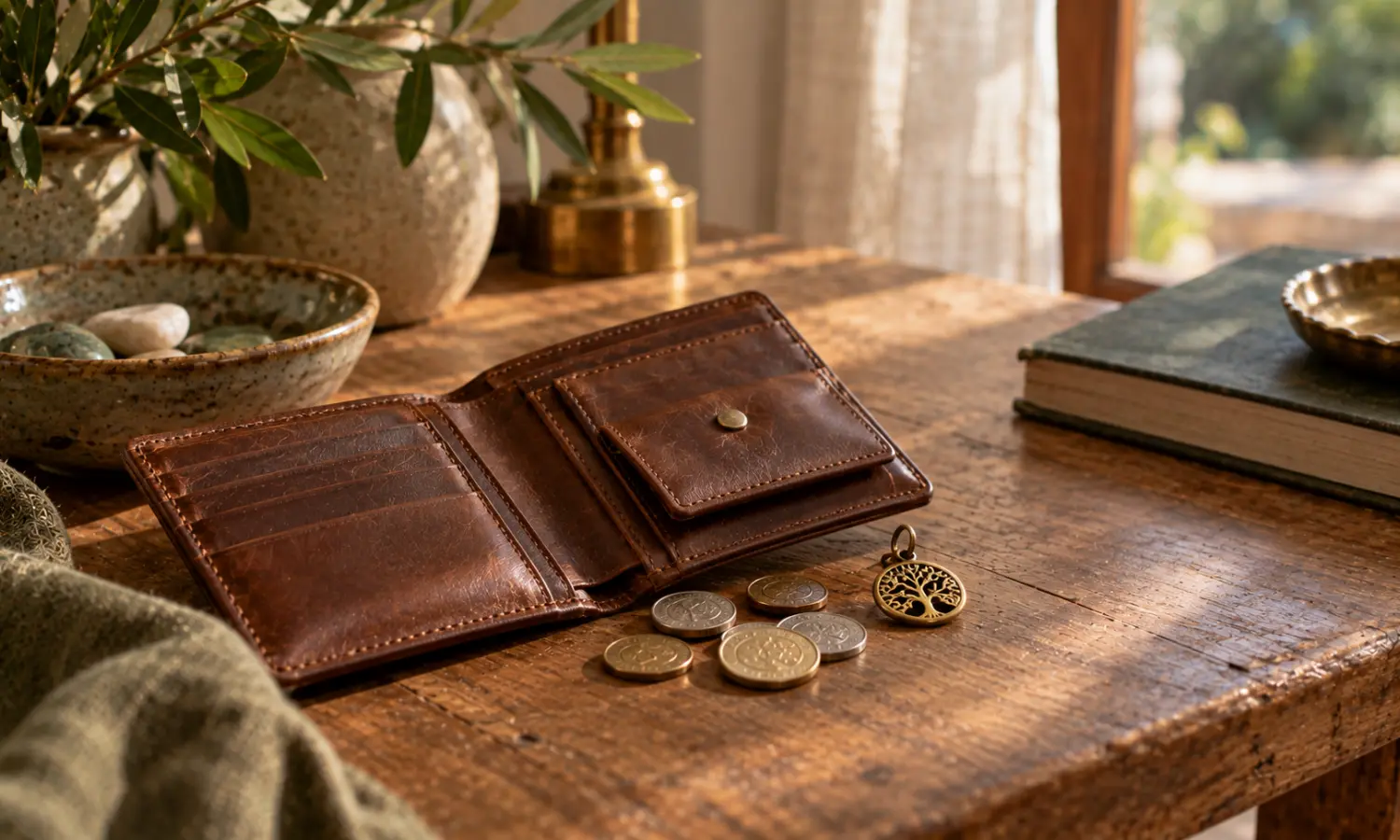
Lucky symbols for money are small objects or images that different cultures associate with wealth, good fortune and provision. Many people keep one in a wallet or purse as a quiet reminder of their goals: a Chinese coin, a bay leaf, a four-leaf clover, a tiny elephant with its trunk raised.
This list covers fifteen of the most common wallet charms, where each one comes from, and how people use it. Pick one that speaks to you rather than carrying all fifteen; the point is a single, meaningful reminder, not a bulging wallet.
These symbols belong to folklore and personal belief; carrying one is a reflective practice, not a proven method for producing money, and nothing here guarantees financial results.
Wallet charms at a glance
| Charm | Origin | Traditional meaning | Where people keep it |
|---|---|---|---|
| Chinese coins on red ribbon | Chinese feng shui | Heaven and earth; red ribbon is said to activate the coins | Bill compartment of the wallet |
| Lucky penny or two-dollar bill | American and British folklore | A wallet that is never empty | Folded behind the other bills, never spent |
| Money frog or beckoning cat | Feng shui; Japanese maneki-neko | Invited wealth and custom | Flat charm facing toward you |
| Bay leaf | European folk practice | Success and prosperity | Written on and tucked behind the cards |
| Citrine or pyrite chip | Crystal practice | The merchant’s stone; confidence | Coin pocket |
| Folded intention or an 888 card | Folk magic; Chinese numerology | Drawing a goal in; prosperity | Folded toward you three times, behind the cards |
Key takeaways
- These are small charms and images that Chinese, European, Hindu, Japanese, Latin American and American folk traditions associate with money and luck.
- People tuck one into a wallet, purse, phone case or desk drawer as a daily reminder of a specific goal.
- Choose one or two with a real story behind them; a collection blurs into background within a week.
- Keep organic charms clean and replace leaves or clovers when they break down, and empty the wallet of old receipts weekly.
- No charm produces money; let it prompt one question at each purchase and move the price of one skipped buy into savings each week.
Coins and currency charms
1. Chinese coins on red ribbon
Round coins with a square hole, often tied in threes with red thread, are among the most recognizable prosperity charms in feng shui. The round shape is commonly associated with heaven and the square with earth, and the red ribbon is said to activate the coins. People slip a set into the bill compartment of a wallet. Red’s role here is explained in our guide to what colors attract money.
2. A lucky penny
“Find a penny, pick it up” is American and British folklore, and many people keep the first coin they found on a meaningful day. Some traditions specify heads up. A penny from your birth year is another common choice.
3. A two-dollar bill
Because two-dollar bills are rarely seen in circulation, they have picked up a reputation as lucky in the United States. People keep one folded behind their other bills and never spend it, treating it as a seed that keeps the wallet from being empty.
4. A foreign coin
A coin from a trip, a parent’s home country, or a place you hope to visit carries personal meaning rather than a fixed folk tradition. It works as a reminder of where money can take you.
Animal charms
5. The money frog
The three-legged toad, often shown sitting on coins with one in its mouth, is a well-known feng shui figure. It is usually placed near a door at home, but small flat versions are sold for wallets. Practitioners generally advise facing it inward, toward you, rather than outward.
6. An elephant with a raised trunk
In Hindu tradition the elephant is linked with Ganesha, the remover of obstacles, and across South and Southeast Asia it is associated with strength and good fortune. A raised trunk is often described as a sign of luck being showered. Tiny metal elephants are easy to find.
7. The beckoning cat
Japan’s maneki-neko, the cat with one paw raised, is a staple of shop entrances. Folk explanations vary, but a raised left paw is commonly said to invite customers and a raised right paw to invite money. Wallet-sized charms usually show the right paw.
8. A pig
The pig is a symbol of plenty in German, Chinese and Korean folklore, which is why piggy banks exist. A small pig charm is a gentle reminder to save a little from every payment.
Plants and natural charms
9. A bay leaf
Bay leaves are widely associated with success and prosperity in European folk practice. People write a short intention on a dried leaf and tuck it behind their cards. It is kept, not eaten, and replaced when it crumbles. Our bay leaf spiritual meaning guide covers the tradition in depth.
10. A four-leaf clover
Irish folklore gives the rare four-leaf clover its luck. A pressed real one in a small laminate sleeve lasts for years. Many people associate each leaf with a quality: faith, hope, love and luck.
11. A cinnamon stick
Cinnamon is a common prosperity ingredient in hoodoo and kitchen-witch practice. A short piece of stick, or a pinch of ground cinnamon in a tiny sachet, is kept in a purse pocket. It is handled, never consumed, in these practices.
12. A small citrine or pyrite
Both stones are commonly called “merchant’s stones” in crystal practice. A tumbled citrine or a flat pyrite chip fits easily in a coin pocket. People describe them as reminders of confidence and clear thinking about money.
Written and symbolic charms
13. A folded intention
A slip of paper with one specific goal written on it is perhaps the simplest lucky symbol of all. Some people fold it toward themselves three times, a gesture from folk magic that represents drawing something in. Rewrite it when the goal changes.
14. The number eight
Eight is considered the luckiest number for wealth in Chinese culture because its pronunciation sounds similar to the word for prosperity. A small card with 888, or a bill whose serial number includes several eights, is a popular wallet keepsake. Eight also appears throughout our wider list of symbols of prosperity.
15. A saint or deity card
Many Catholics carry a card of Saint Cajetan, associated with work and providence, or Saint Expedite. Hindu households may keep an image of Lakshmi, goddess of wealth. These are devotional objects, so if you are not part of the tradition, approach them with respect and curiosity rather than as decoration.
How to choose and care for a wallet charm
Choose one that connects to something real in your life: your heritage, a trip, a person, or a goal. A charm with a story is one you will notice; a random one becomes clutter in a week. If you want a ranked view of which charms tradition favors most, see the most powerful good luck charms for money. Keep it clean and replace anything organic, like a leaf or clover, when it breaks down.
Keep the wallet itself tidy too. In feng shui and in plain common sense, a wallet stuffed with old receipts and expired cards does not reflect a clear relationship with money. Once a week, empty it out, keep what matters, and put the charm back in its place.
A practical pairing
Here is the habit that makes a wallet charm worth carrying. Every time you notice it, when you pay for coffee or pull out a card, let it prompt one small question: is this purchase in line with the goal I wrote down? You do not have to say no. You only have to notice.
Then, once a week, move the price of one skipped or reconsidered purchase into savings. Over a year, a five-dollar nudge a week becomes a real number. The charm did not produce it; your attention did, and the charm is what kept your attention awake.
Common questions
What is the luckiest thing to keep in your wallet?
There is no single answer across cultures. Chinese coins, a two-dollar bill and a bay leaf are the most frequently mentioned in English-language folklore. The most honest answer is that the luckiest thing is a charm you actually notice and that reminds you to make good choices.
Should a money charm face a certain way in the wallet?
Feng shui practitioners often suggest placing the money frog or coins facing toward you, and keeping bills facing the same direction and right side up. Those are matters of custom and tidiness rather than rules, so do what feels orderly.
Can I keep more than one lucky symbol for money?
You can, but one or two work better than a collection. A single charm stays meaningful; a handful of them blurs into background. If you want more, keep the rest in a money bowl at home rather than in your pocket.
Is it bad luck to have an empty wallet?
Several folk traditions say a wallet should never be completely empty, which is why the kept two-dollar bill or single coin is common. Practically speaking, a small emergency bill tucked away is simply a sensible habit.
Continue your practice
To turn a charm into a short routine, see our simple money ritual for beginners, and if you chose the bay leaf, the bay leaf intention ritual without burning shows one way to use it. For the bigger picture, browse good luck symbols from around the world or begin at Start Here.