Money Spell Guide
Prosperity rituals, luck symbols & intention

Chinese New Year Superstitions: Dos, Don’ts and Lucky Foods
The most common Chinese New Year superstitions, from cleaning and red envelopes to no sweeping and lucky foods, with the meaning behind each one.
Share your love
Chinese New Year superstitions are customs families follow during the Spring Festival to welcome good fortune and avoid bad luck for the year ahead. The best known include cleaning the house before New Year’s Eve, decorating in red, giving red envelopes, and avoiding sweeping, washing hair or breaking things on the first day.
Many of these customs rest on wordplay. In Chinese, words for fish, oranges and hair sound like words for surplus, luck and prosperity, so everyday actions become symbolic. Food plays a big role too, with dishes chosen for their lucky names and shapes.
Below we gather the most common dos, don’ts and lucky foods, explain the reasoning usually given for each, and note how practice differs by region and family.
These customs are folklore and personal belief, not predictors of money or events; nothing here guarantees luck or financial results. They are also living cultural traditions, so practices vary widely and every family has its own version.
Chinese New Year superstitions at a glance
| Custom | Do or avoid | Meaning usually given |
|---|---|---|
| Deep-cleaning the home | Do before New Year’s Eve | Sweeps away last year’s bad luck to make room for the new |
| Red decorations and clothes | Do | Red is associated with joy, protection and good fortune |
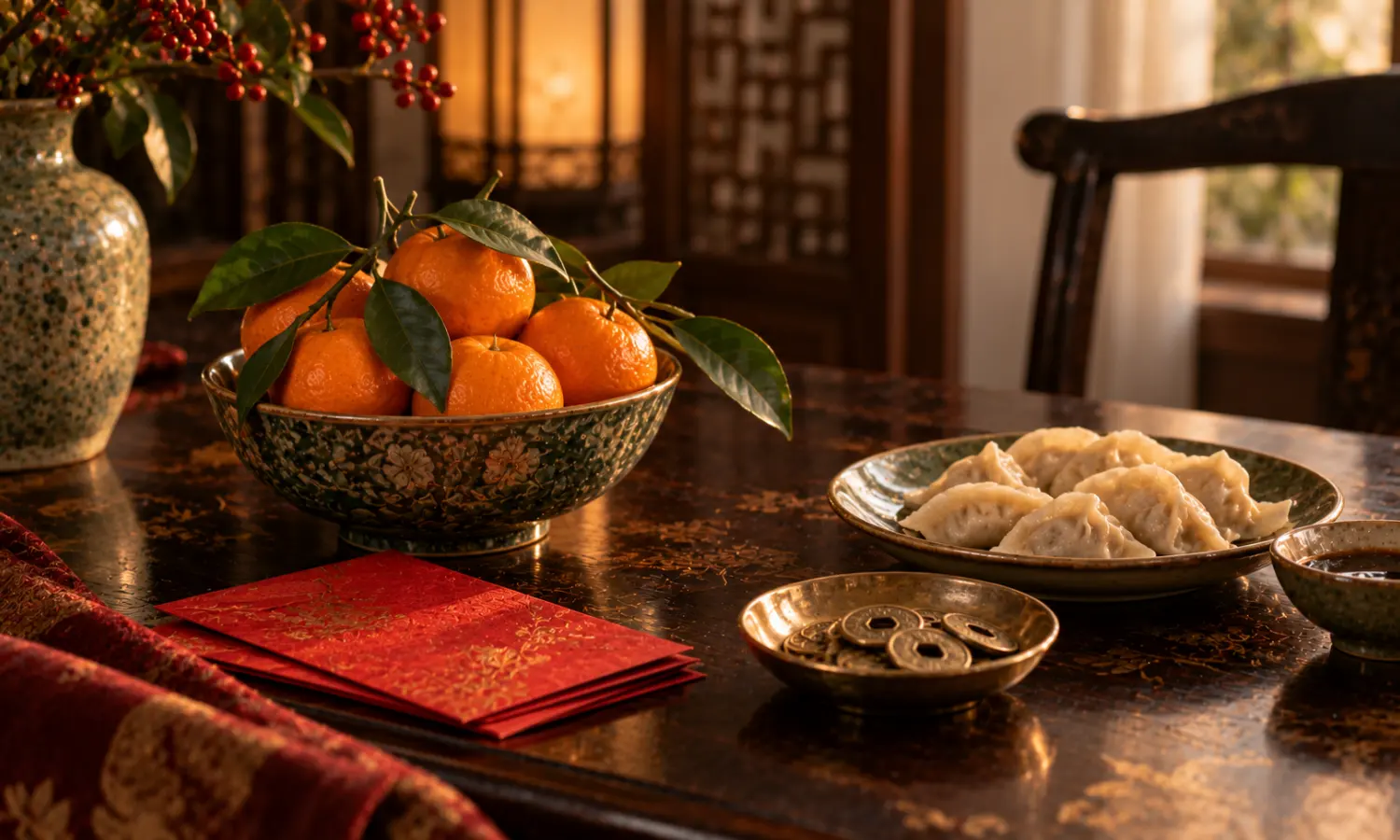
| Red envelopes with new bills | Do | A wish for prosperity and blessings, especially for children |
| Sweeping on the first day | Avoid | Good fortune might be swept out the door |
| Washing hair on the first day | Avoid | The word for hair sounds like the word for prosperity |
| Breaking dishes | Avoid | Breakage suggests loss; a blessing is said if it happens |
| Eating fish and leaving some | Do | The word for fish sounds like the word for surplus |
Key takeaways
- Chinese New Year superstitions focus on welcoming good fortune and not pushing it away in the first days of the year.
- Many customs come from wordplay, where a word sounds like luck, surplus or prosperity.
- Cleaning happens before New Year’s Eve, while sweeping on New Year’s Day is traditionally avoided.
- Lucky foods such as fish, dumplings, oranges and rice cake are chosen for their names and shapes.
- Practices differ by region and family, so asking hosts what they observe is the respectful approach.
Where these superstitions come from
The Spring Festival marks the start of the lunar new year and has been the most important festival in the Chinese calendar for many centuries. It is a time for family reunion, honoring ancestors and welcoming a fresh start.
Folk tradition holds that the first days of the year set the tone for the months that follow. So families take care to fill those days with symbols of abundance, harmony and good health, and to avoid actions associated with loss, conflict or misfortune. Many of the symbols used are explored in our guide to Chinese symbols for prosperity.
Things to do for good luck
Clean before New Year’s Eve
In the days before the festival, families clean the house from top to bottom. The idea is to sweep away the bad luck of the old year. Cleaning is then put away before New Year’s Eve, so the new luck is not disturbed.
Decorate in red
Red paper couplets around the door, red lanterns and paper cuttings fill homes and streets. Red is commonly associated with joy and protection, and folklore tells of the mythical beast Nian being frightened away by red and loud noise. Our guide to feng shui colors for money explains how red and gold are used more broadly.
Hang the fu character upside down
The character fu, meaning good fortune, is often hung upside down on doors. The word for upside down sounds like the word for arrive, so an inverted fu suggests that good fortune has arrived.
Give red envelopes
Elders and married couples give red envelopes, called hongbao or lai see, to children and unmarried relatives. Crisp new bills are preferred, and amounts containing the number four are commonly avoided because four sounds like the word for death.
Wear new clothes
Wearing new clothes, often in red, on New Year’s Day symbolizes a fresh start. Many people also get a haircut before the festival rather than during it.
Stay up late on New Year’s Eve
Staying up past midnight, a custom known as shousui, is often described as a wish for long life for one’s parents. Families share a reunion dinner, watch television specials and set off fireworks where permitted.
Things to avoid in the first days
No sweeping or taking out the trash
Sweeping or emptying the trash on the first day is traditionally avoided so that good fortune is not thrown away. If a mess must be cleaned, some families sweep toward the center of the room and wait a day to discard it.
No washing hair
The word for hair, fa, shares its sound with the fa in facai, to become prosperous. Washing hair on the first day is therefore said to wash away wealth.
No breaking things
Broken dishes or glasses suggest loss or separation. If something breaks, people often wrap the pieces in red paper and say a phrase wishing peace year after year, turning the accident into a blessing.
No lending or borrowing money
Lending money on New Year’s Day is commonly avoided, as it may suggest a year of money flowing out. Many people settle debts before the festival so they can start the year clear.
No sharp objects or unlucky words
Scissors and knives are often put away on the first day, so good fortune is not cut. People also avoid words linked to death, illness or loss, and try not to argue or cry.
No clocks as gifts
Giving a clock is avoided because the phrase for giving a clock sounds like a phrase connected with funerals. Fruit, tea and sweets are safer choices.
Lucky foods for Chinese New Year
Fish
The word for fish, yu, sounds like the word for surplus. A whole fish is often served at the reunion dinner, and some is left uneaten so there will be surplus in the year ahead.
Dumplings
Especially in northern China, families fold dumplings together on New Year’s Eve. Their shape is said to resemble old silver ingots, making them a symbol of wealth.
Nian gao
This sticky rice cake has a name that sounds like “higher year,” a wish for rising fortunes, promotions and growth.
Oranges and tangerines
Mandarin oranges and tangerines are given in pairs and displayed in bowls. Their golden color and names that echo words for luck and gold make them popular gifts. Their round shape echoes the coin imagery in our guide to symbols of abundance.
Long noodles and spring rolls
Long noodles symbolize long life and are traditionally served uncut. Golden spring rolls are said to look like gold bars.
Variations across regions and families
Customs differ between northern and southern China, between Hong Kong, Taiwan and Singapore, and among diaspora communities. Neighboring cultures celebrate the lunar new year with their own traditions too, such as Tet in Vietnam and Seollal in Korea.
Within a single family, some customs are kept strictly and others are treated with a smile. If you are a guest, simply asking your hosts what they observe is both polite and interesting.
Common misconceptions
One misconception is that breaking a rule brings real misfortune. Most families treat these customs as hopeful habits and shared fun, not as threats.
Another is that all Chinese New Year customs are about money. Many are about family harmony, respect for elders, health and long life. Wealth is one wish among several.
A note on safety: fireworks and firecrackers are restricted or banned in many places, so follow local rules. If you light candles or incense for the festival, use stable holders, keep them away from paper decorations and never leave them unattended.
A practical pairing
Many families settle debts before the new year begins, and that is a custom worth borrowing in a modern way. In the week before the festival, pick one bill or small debt and pay it down, or set up a payment plan for it. Then write a short list of what you will save toward in the coming year.
If you give red envelopes, budget for them in advance so generosity does not create stress. A gift given within your means carries the best wishes of all.
Common questions
What should you not do on Chinese New Year?
Common don’ts include sweeping, taking out the trash, washing hair, breaking things, lending money, using scissors and giving clocks as gifts. Customs vary by family and region.
Why can’t you wash your hair on Chinese New Year?
The word for hair sounds like the word for prosperity, so washing it on the first day is said to wash away good fortune. Many people wash their hair the day before instead.
What are the luckiest foods to eat for Chinese New Year?
Fish, dumplings, nian gao, oranges, long noodles and spring rolls are among the most popular, each chosen for a lucky name or shape.
Is it bad luck to sweep on Chinese New Year?
In folk tradition, sweeping on the first day is avoided so that good luck is not swept away. Cleaning is done thoroughly before New Year’s Eve instead.
Continue your practice
To bring prosperity symbolism into your home year-round, read our guide to the feng shui money tree. You may also enjoy learning what goes into a feng shui money bowl and where it sits.