
Money Spell Guide
Prosperity rituals, luck symbols & intention

The Feng Shui Money Tree: Meaning, Care and Where to Place It
What the feng shui money tree symbolizes, how to keep a Pachira aquatica healthy, and where practitioners suggest placing it at home or at work.
Share your love
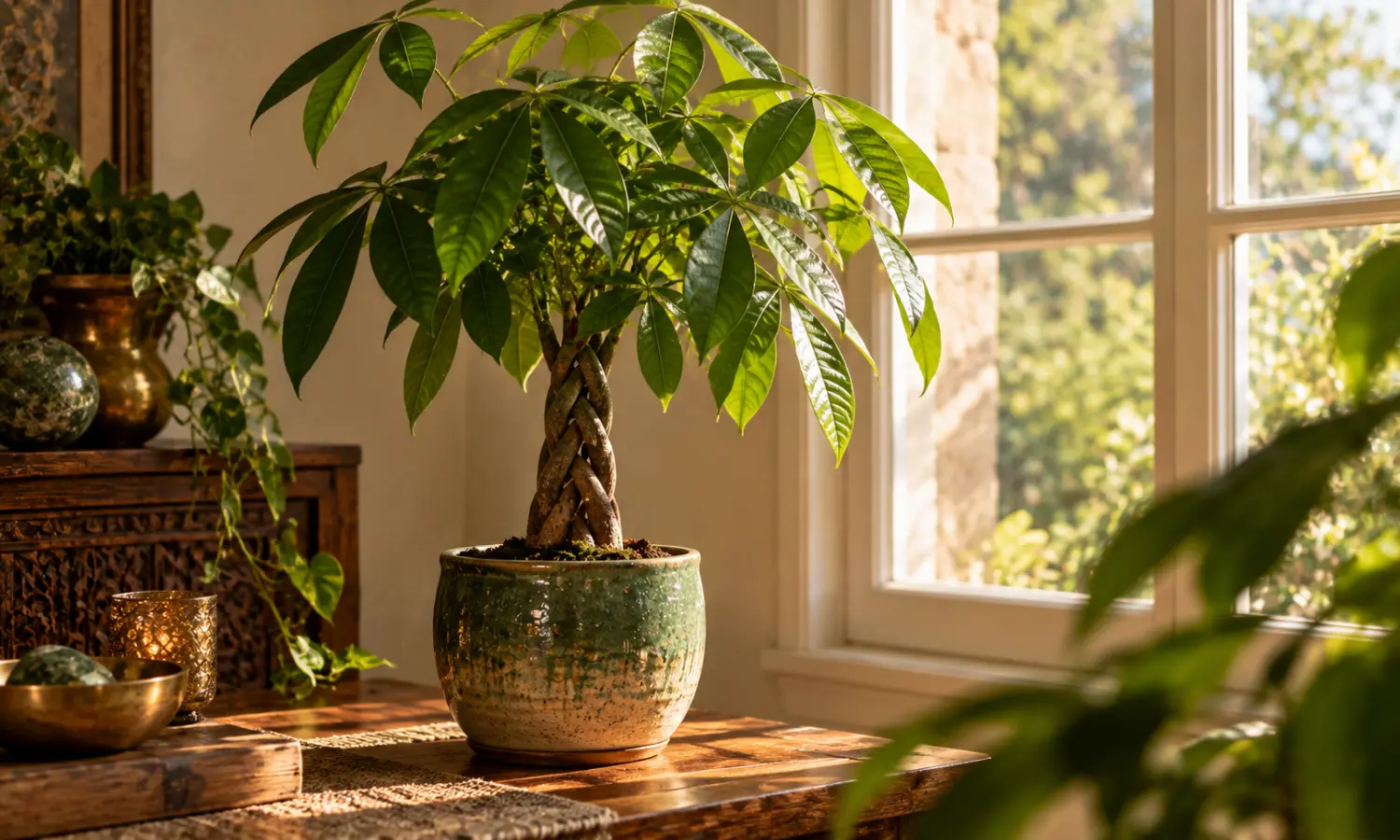
The feng shui money tree is a houseplant, usually Pachira aquatica, grown with a braided trunk and a canopy of glossy five-fingered leaves. In feng shui practice it is commonly associated with wealth, growth and good fortune, which is why you see it in bank lobbies, restaurants and home offices across Asia and increasingly in the United States.
Quick answer: a money tree is said to do best in the southeast area of a home or room, in bright indirect light, watered only when the top inch of soil is dry. The symbolism comes from its leaves (often five per stem, linked to the five elements) and its braided trunk, which is described as holding good fortune in place.
Below we cover the meaning, the care routine that keeps the plant alive, and the placement guidelines practitioners most often recommend.
Keeping a money tree is a symbolic practice rooted in feng shui tradition and folk belief. It is not a proven method for producing money, and nothing here guarantees financial results.
The feng shui money tree at a glance
| Spot | What the tradition says | Practical check |
|---|---|---|
| Southeast area of the home or room | The bagua’s wealth and abundance area; the traditional placement | Use a phone compass; make sure the light is bright but indirect |
| Inside the front entrance | The first thing to greet anyone arriving is a symbol of growth | Avoid cold drafts from the door |
| Home office or desk | Where money decisions are actually made | A few feet from an east- or south-facing window is ideal |
| Living room | Often described as the heart of the home’s energy | Rotate the pot a quarter turn each week so it grows evenly |
| Bathroom or bedroom | Avoid: money draining away, or active energy disturbing rest | Humidity and low light also make these poor spots for Pachira |
Key takeaways
- The money tree is usually Pachira aquatica, a braided-trunk houseplant that feng shui practice links to wealth, growth and good fortune through its five-leaf clusters and locked-in trunk.
- It needs about five minutes a week: a pot with drainage, well-draining soil, a bright spot away from direct sun, and water only when the top inch or two of soil is dry.
- It is best for people who want a living, low-maintenance reminder of growth in a home or workspace, and a wilting plant is said to reflect stagnant energy, so care is part of the practice.
- Its purpose is a daily visual cue for prosperity goals, paired with the small discipline of caring for something; a plant does not produce money.
- Link each watering to a fixed savings transfer so the plant and the balance grow together.
What the money tree means in feng shui
Pachira aquatica is native to Central and South America, not China, and the braided-trunk houseplant form is often described as a Taiwanese innovation from the 1980s. The plant became popular in East Asia quickly, and the feng shui associations grew around it.
Practitioners point to several features. The leaves usually grow in clusters of five, which is linked to the five elements of Chinese philosophy: wood, fire, earth, metal and water. A stem with seven leaves is considered especially fortunate because seven is a lucky number in many cultures, as our guide to good luck symbols from around the world shows. The braided trunk is commonly said to “lock in” fortune, and the plant’s quick growth makes it a natural symbol of rising wealth.
Some people distinguish between the Pachira money tree and the jade plant (Crassula ovata), which is also called a money plant. Both are used in feng shui, and both appear in our list of feng shui plants for money. This article focuses on the Pachira.
Where to place a money tree
Feng shui offers a map, called the bagua, that divides a space into nine areas. The southeast area is commonly associated with wealth and abundance, and it is the traditional spot for a money tree. If you are not sure which way is southeast, a phone compass will tell you in seconds.
A few other placements practitioners describe as helpful:
- Near the front entrance, on the inside, so the first thing that greets anyone arriving is a symbol of growth.
- In the home office or near your desk, where money decisions are actually made, often alongside a feng shui money bowl.
- In the living room, which is often described as the “heart” of the home’s energy.
Spots to avoid, according to the same tradition: bathrooms (associated with money “draining away”), directly facing the front door, bedrooms (where the plant’s active energy is said to disturb rest), and anywhere it will be crowded or forgotten. The last one is practical as much as symbolic. A money tree in a corner you never look at is a plant that will die of neglect.
For a room-by-room walkthrough, see our guide to money tree placement.
How to care for a money tree
A healthy plant is the whole point. In feng shui, a wilting or dying money tree is said to reflect stagnant energy, so the care routine is part of the practice. Fortunately, Pachira is forgiving.
- Light. Bright, indirect light is ideal. A few feet from an east- or south-facing window works well. Direct afternoon sun can scorch the leaves; deep shade causes leggy growth and leaf drop.
- Water. Water thoroughly, let it drain, then wait until the top inch or two of soil is dry. Overwatering is the most common way these plants die. In most homes that means every one to two weeks.
- Soil and pot. Use a well-draining mix (a cactus or succulent mix with some regular potting soil is fine) and a pot with drainage holes. Never let it sit in a saucer of standing water.
- Humidity and temperature. It prefers moderate humidity and temperatures between about 65 and 80°F. Keep it away from heating vents and cold drafts.
- Feeding. A diluted balanced houseplant fertilizer once a month in spring and summer is plenty. Skip it in winter.
- Rotation and pruning. Turn the pot a quarter turn each week so it grows evenly. Trim yellow leaves and pinch back long stems to keep the canopy full.
Common problems and what they mean
Yellow leaves that drop. Usually overwatering. Let the soil dry out fully and check that the pot drains.
Brown, crispy leaf edges. Usually too much direct sun or very dry air. Move it back from the window and mist occasionally.
Soft, mushy trunk. Root rot from sitting in water. Repot into fresh dry soil and trim any black roots. This one is serious, so act quickly.
Leaning or sparse growth. Not enough light. Rotate the pot and move it closer to a window.
Adding to the tradition
Many people tie a red ribbon around the trunk or place a few Chinese coins on the soil surface. Red is associated with luck and celebration in Chinese tradition, and coins reinforce the wealth symbolism. Some households set a feng shui money frog beside the pot as well. Some practitioners add a small citrine or pyrite stone to the pot. None of this is required, but it can make the plant feel more like a deliberate part of your space rather than just decor.
If you receive a money tree as a gift, that is traditionally considered even more auspicious than buying one, which makes it a thoughtful housewarming or new-business present.
A practical pairing
A money tree grows slowly and steadily, which makes it a natural companion for a savings habit. Here is the pairing we suggest.
Each time you water the plant, move a fixed amount into a savings account. It can be $5 or $50; what matters is that the two habits are linked. If you water every ten days, that is roughly three transfers a month. Set up the transfer in your banking app so it takes thirty seconds.
After a year you will have a bigger plant and a savings balance that grew alongside it. That is the kind of result a money tree can actually be part of.
Common questions
Where is the best place to put a money tree in the house?
The southeast area of the home or of a main room is the traditional feng shui choice. Near the entrance (inside) or in a home office are also common. Avoid bathrooms and bedrooms.
Is a money tree the same as a jade plant?
No. The feng shui money tree is usually Pachira aquatica, a tropical tree with a braided trunk. The jade plant is a succulent, Crassula ovata, which is also called a money plant. Both are used for prosperity symbolism but need different care.
How often should I water a money tree?
Only when the top inch or two of soil feels dry, which is typically every one to two weeks indoors. Water less in winter. If in doubt, wait another day or two; underwatering is far easier to fix than root rot.
Is a money tree safe for pets?
Pachira aquatica is generally listed as non-toxic to cats and dogs by the ASPCA, though chewing any plant can cause mild stomach upset. Jade plants, by contrast, are considered toxic to pets, so check which plant you have.
Continue your practice
If you would like to pair your plant with a short monthly practice, our simple money ritual for beginners is a gentle start, and intention journaling for work and opportunity gives you a place to track your savings transfers. Our Start Here page explains how we think about all of this.



