
Money Spell Guide
Prosperity rituals, luck symbols & intention

The Feng Shui Money Frog: Meaning, Placement and Common Mistakes
The feng shui money frog explained: the Jin Chan legend, where practitioners place it, and the common mistakes that undermine the symbol.
Share your love
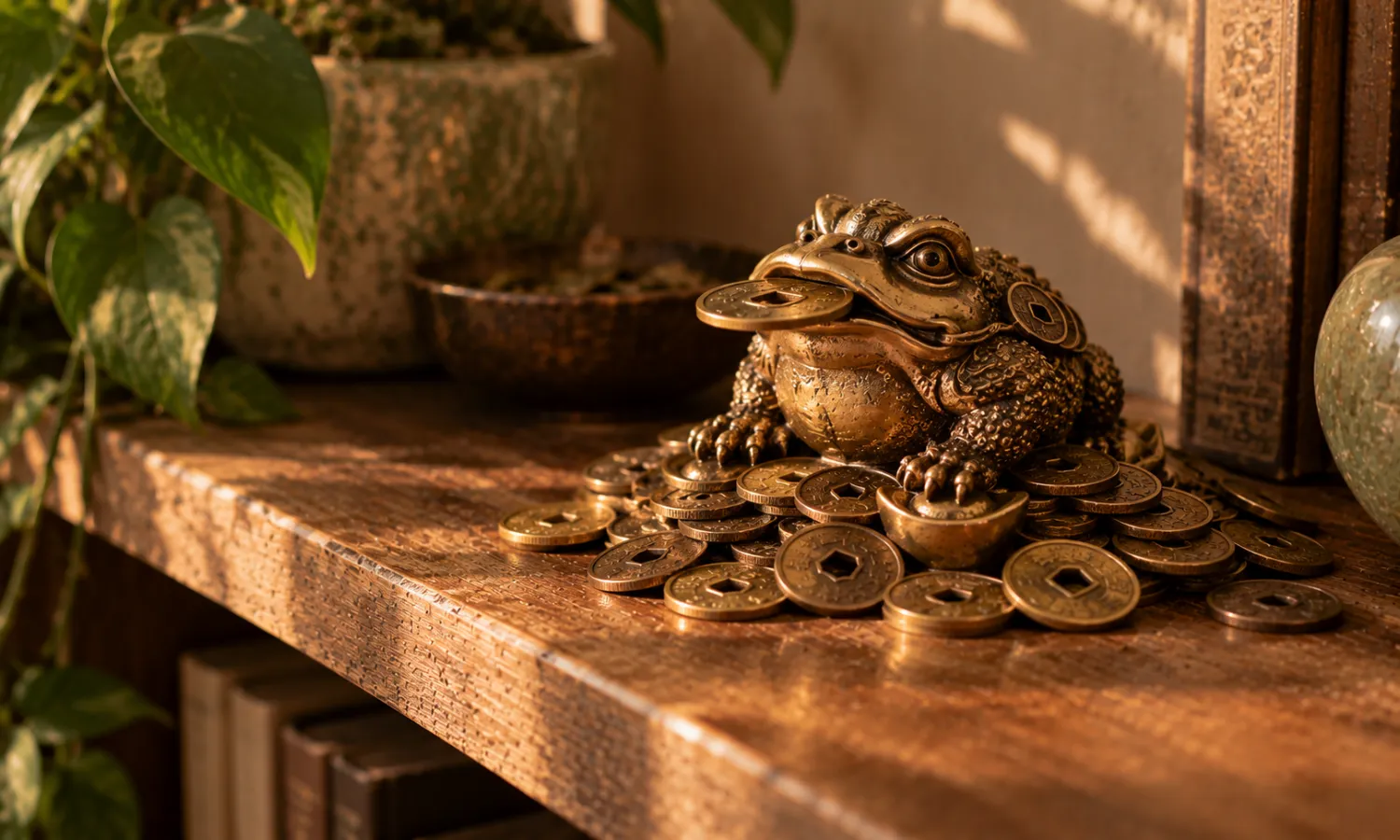
The money frog in feng shui is a three-legged toad, usually cast in brass or resin, shown sitting on a bed of coins with another coin held in its mouth. Known in Chinese as Jin Chan, the “golden toad,” it is one of the most recognizable wealth symbols in East Asian homes and businesses.
Practitioners place it near the front door, facing into the room, as a symbolic gesture of welcoming prosperity inside. The rules around placement are simple once you understand the story behind the figure, and most of the “mistakes” people worry about come down to a few points of orientation and respect.
Keeping a money frog is a symbolic, cultural practice rooted in feng shui tradition; it is not a proven method for producing money and nothing here guarantees financial results.
Money frog placement at a glance
| Placement | Which way it faces | Why practitioners suggest it | What to avoid |
|---|---|---|---|
| Diagonally inside the front door, on a low table or shelf | Into the room | The toad has just hopped in with its coin | Facing the door, which reads as money leaving |
| Wealth corner (far left of the home from the front door) | Inward | Sits with a jade plant or a bowl of coins | On the floor or facing a wall |
| Office desk | Toward you or the room | A reminder where the work happens | Above eye level or under a pile of papers |
| Shop, near the register | Into the shop | Close to where money changes hands | A cluster of frogs, which reads as clutter |
| Bathroom, kitchen or bedroom | Not recommended | Draining, burning and rest are the wrong associations | Any placement in these rooms |
Key takeaways
- The money frog is a three-legged toad, usually with a coin in its mouth, tied to the legend of Liu Hai.
- Keep it facing inward, raised off the floor and below eye level.
- Never place it in the bathroom, kitchen or bedroom, never facing out, never on the floor.
- One well-placed, dusted frog is traditional; more than that looks like clutter.
- No figurine produces money; pair the evening turn-inward with a two-minute spending log.
The legend behind the money frog
The money frog is commonly linked to Liu Hai, a figure in Chinese folk religion who is often shown playing with a three-legged toad. In one widely told version, the toad was a greedy creature that Liu Hai tamed or reformed, after which it used its ability to find gold for the benefit of others. In another, the toad lost a leg in the process and has been faithful ever since.
Because of this story, the toad is usually described as a reformed hoarder: a creature that once took wealth and now brings it. Some versions say it appears near homes that are about to receive good news. Whether or not you take the folklore literally, the image of something that turns greed into generosity is a thoughtful one to keep by the door.
What the details on the figurine mean
Most money frogs share a few features, and each one has a traditional reading:
- Three legs: the mark of a mythical toad rather than an ordinary one, tied to the Liu Hai legend.
- Coin in the mouth: often described as wealth being carried into the home. Some figures come with a removable coin.
- Bed of coins or ingots: abundance already present, the toad resting on what it has gathered.
- Red eyes or a red thread: red is the color of good fortune and activation in Chinese tradition.
- Seven stars or a Big Dipper pattern on the back: associated with heavenly protection.
Brass and bronze are the traditional materials because metal is one of the five elements and is associated with wealth. Resin, jade and ceramic versions are also widely sold and treated the same way in practice. Color matters as well, and we break down which shades practitioners favor in feng shui colors for money.
Where to place a money frog
Placement is where most of the tradition lives. The guidance below reflects what feng shui practitioners most commonly recommend.
Near the front door, facing in. The classic spot is on a low table or shelf diagonally across from the main entrance, positioned so the toad looks into the room. The idea is that it has just “hopped in” with its coin. A frog facing the door is often read as money hopping back out.
In the wealth corner. In the Western Bagua approach, this is the far-left area of the home as you stand at the front door looking in. Here the frog sits alongside other prosperity symbols such as a jade plant or a bowl of coins. If you go the plant route, our guide to the feng shui money tree covers care and placement.
In an office or shop. On a desk, facing you or facing the room, or near the register in a store. Many business owners place one close to where money changes hands.
Height matters. Keep it raised off the floor, but not above eye level. A side table, bookshelf or desk is ideal.
Common mistakes practitioners warn about
Facing it outward. This is the mistake people search for most. A toad pointed at the door is traditionally read as carrying wealth away. Turn it to face inside.
Bathrooms, kitchens and bedrooms. Feng shui associates bathrooms and kitchens with draining and burning, and the bedroom with rest rather than striving. Living areas, entryways and offices are the recommended rooms.
On the floor or facing a wall. Both are considered disrespectful placements that “ground” the symbol or block it. The same goes for stacking things on top of it.
Too many frogs. One well-placed frog is traditional. Some guides allow up to nine, but a cluster of them tends to look like clutter, which feng shui treats as stuck energy.
Neglect. A dusty toad with a missing coin is not a symbol anyone is paying attention to. Dust it when you dust the shelf.
Caring for and “activating” the frog
Some practitioners describe a short welcome when the frog first arrives: wiping it clean, placing the coin in its mouth, and stating out loud what it is there to remind you of. Others tie a red ribbon around it or set it on a red cloth. None of this is mandatory, but it turns the purchase into a small, deliberate moment.
A popular daily custom is to turn the frog to face the door in the morning, as if sending it out to work, and to face inward in the evening, as if welcoming it home. Many people find the two-second gesture a surprisingly good bookend for the workday. If that feels like too much, simply leave it facing in.
A practical pairing
Because the frog sits by the door, pair it with something you do on the way in or out. A good one: every evening when you turn the frog inward, log that day’s spending in a notes app or budgeting tool. It takes under two minutes and it is the single habit most financial coaches recommend first.
Over a month you end up with a complete record of where your money went, which is far more useful than any figurine. The frog just makes sure you remember to do it.
Common questions
Which direction should a money frog face?
Inward, toward the center of the room or the home. Practitioners describe an outward-facing frog as sending wealth away. In an office, facing you or the room is fine.
Where should I not put a money frog?
Avoid the bathroom, kitchen and bedroom, the floor, and any spot where it faces a wall or the front door. These are the placements most consistently discouraged in feng shui guidance.
Does the money frog need a coin in its mouth?
Traditionally yes, with the coin’s characters or “heads” side facing up. If yours arrived without one, an old Chinese coin or any coin you like can be placed in the mouth or just in front of it.
Is the money frog the same as the lucky cat?
No. The beckoning cat (maneki-neko) is Japanese and invites customers or luck with a raised paw. The money frog is Chinese and is specifically about wealth. Many shops keep both, and there is no conflict in doing so. Both belong to the wider family of good luck symbols we cover elsewhere.
Continue your practice
To find the right spot for your frog, read our guide to the feng shui money corner, and for more figures like this one, see symbols of prosperity across cultures. If you would like a short routine to go with the symbol, start with the simple money ritual for beginners or intention journaling for work and opportunity. New to the site? Start Here.



