Money Spell Guide
Prosperity rituals, luck symbols & intention

Good Luck Symbols From Around the World (and What Each One Means)
A calm tour of good luck symbols across cultures, from the four-leaf clover to the maneki-neko, and the meaning behind each one.
Share your love
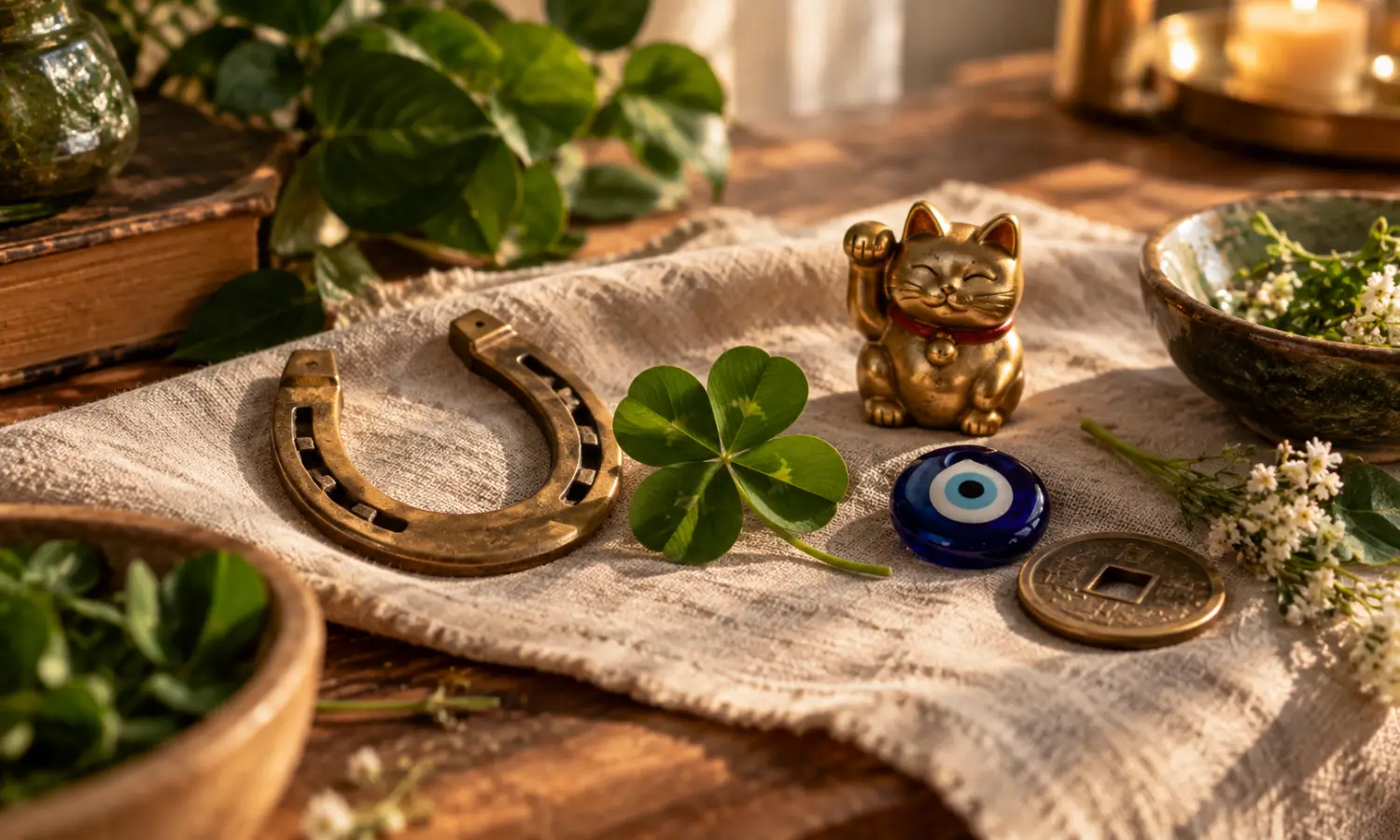
Good luck symbols are objects, animals, plants and shapes that a culture has come to associate with fortune, protection or prosperity. A horseshoe over a door, a four-leaf clover pressed in a book, a waving cat in a shop window: each one carries a story that has been handed down for generations, and each one tells you something about the people who kept it.
This guide collects the most widely recognized good luck symbols from around the world and explains, as accurately as we can, where each comes from and what it is commonly said to mean. We have grouped them by region so you can see how different cultures arrived at similar ideas in very different ways.
Good luck symbols are cultural and symbolic objects rooted in folklore and personal belief. They are not a proven method for producing money or fortune, and nothing here guarantees financial results.
Good luck symbols at a glance
| Symbol | Origin | Commonly said to mean | Where people keep it |
|---|---|---|---|
| Four-leaf clover | Ireland and wider Europe | Faith, hope, love and luck; rarity is the charm | Pressed in a book or carried |
| Horseshoe | Britain, Ireland, Europe | Protection through iron; luck held or poured out | Over a doorway |
| Maneki-neko | Japan | Left paw invites customers, right paw invites wealth | Shop windows and counters |
| Chinese coins | China, feng shui practice | Wealth in circulation | Wallet, cash drawer, inside the front door |
| Hamsa | North Africa and the Middle East | Protection and blessing on a home | Entrance wall or worn as jewelry |
| Cowrie shell | West Africa, Asia, the diaspora | Literal wealth; once used as currency | Jewelry and decoration |
Key takeaways
- Good luck symbols are everyday objects and images that cultures have linked to fortune, protection and abundance.
- They come from folklore across Europe, East Asia, the Middle East, Africa and the Americas, often rooted in older religious or agricultural practice.
- People keep them in homes, wear them as jewelry, carry them in wallets or place them near entrances and workspaces as reminders.
- Meanings vary by region and family, so learn a symbol’s story before you display it, and treat it as a reminder rather than a guarantee.
- No charm changes your luck or your income; give the symbol a job, such as marking one unfinished task that would bring money in.
Symbols from Europe
Four-leaf clover
Most closely associated with Ireland, the four-leaf clover is rare, which is where its luck comes from. Each leaf is often described as standing for faith, hope, love and luck. Finding one by chance is considered the real charm; buying one is a different experience.
Horseshoe
Hung over doorways across Britain, Ireland and much of Europe, the horseshoe is linked to iron, which folk tradition held could ward off harm. There is a long-running debate over whether the open end should point up (to hold luck in) or down (to pour luck onto those who pass beneath). Both versions are traditional.
Ladybug
In many European farming communities, a ladybug landing on you is read as a sign of good fortune. The association likely grew from the insect’s role in protecting crops, which made it a welcome guest in any field.
Acorn
Carried as a pocket charm in English and Norse folk tradition, the acorn is associated with potential and growth, since a small seed becomes an oak. It is a quiet symbol, well suited to long-term goals.
Symbols from East Asia
Maneki-neko (the beckoning cat)
The Japanese waving cat sits in restaurant windows and shop counters worldwide. A raised left paw is commonly said to invite customers, while a raised right paw invites wealth. Different colors carry different associations, with gold often linked to prosperity. Color carries its own meaning here; our guide to what colors attract money explains the associations behind gold, red and green.
Koi and goldfish
In Chinese tradition, the word for fish sounds like the word for surplus, so fish images are commonly associated with abundance. Koi are additionally linked to perseverance because of the legend of a carp swimming upstream to become a dragon.
Chinese coins and the red envelope
Round coins with a square hole, often tied together with red thread, appear in feng shui practice as a symbol of wealth in circulation. Red envelopes given at Lunar New Year carry the same idea: money shared is money that keeps moving. We cover more of these in our guide to Chinese symbols for prosperity.
Daruma doll
A Japanese round doll bought with blank eyes. You paint one eye when you set a goal and the other when you reach it. It is less a luck charm than a commitment device, which is why we like it.
Symbols from the Middle East and Mediterranean
Hamsa (hand of Fatima, hand of Miriam)
An open palm, often with an eye in the center, used across North Africa and the Middle East in Jewish, Muslim and Christian households alike. It is primarily a protective symbol, and practitioners describe it as a way to invite blessing into a home.
Nazar (blue eye bead)
The blue and white glass eye seen throughout Turkey, Greece and the Levant. It is traditionally hung to deflect envy. People often keep one near a business entrance or on a key ring.
Cornicello
The small twisted horn worn in southern Italy, usually in red coral or gold. It is a protective and good-fortune charm that many families pass down, and it remains common in Italian-American communities.
Symbols from Africa and the Americas
Cowrie shell
Used as currency across parts of Africa and Asia for centuries, the cowrie shell is one of the most literal symbols of wealth in the world. It appears in jewelry, divination and decoration throughout West Africa and the African diaspora. It also features in our ranking of the most powerful good luck charms for money.
Rabbit’s foot
A North American folk charm with roots in African American hoodoo tradition and older European beliefs. Its popularity peaked in the early twentieth century. Many people today prefer a symbolic version, such as a charm shaped like a rabbit, for ethical reasons.
Hummingbird
In several Indigenous traditions of the Americas, the hummingbird is associated with joy, lightness and good news. In Mexican and Central American folk belief it is often described as a messenger of love and luck.
Symbols that crossed borders
A few symbols belong to nearly everyone. The number seven is considered fortunate in many cultures, from Western dice games to Japanese folklore’s seven lucky gods. Elephants with raised trunks are placed near doors in Indian, Thai and later Western homes as a sign of strength and good fortune. Keys, especially old ones, are commonly associated with opportunity and new doors opening. For a longer list focused on wealth, see our 25 symbols of prosperity across cultures.
When a symbol spreads this widely, its meaning softens into something general: welcome, hope, a fresh start. That is not a loss. It is often what makes the symbol useful as a daily reminder.
A practical pairing
A good luck symbol works best when it points at something you are actually doing. Choose one from this list, place it where you make decisions about money, and give it a job.
Our suggestion: put the symbol next to your laptop or on your desk, and let it mark one unfinished task that would bring money in. That might be an invoice you have not sent, a resume you have not updated, or a quote you have been meaning to follow up on. When you see the symbol, send the invoice. Then move it to the next task.
The symbol does not change the outcome. It changes how often you notice the task, and that is enough to matter.
Common questions
What is the most common good luck symbol in the world?
The four-leaf clover and the horseshoe are probably the most widely recognized in Western countries, while the maneki-neko and Chinese coins are the most visible across East Asia and in businesses worldwide. The number seven is arguably the most universal.
Is it disrespectful to use a symbol from another culture?
Not inherently, but it helps to learn what the symbol means to the people who created it and to use it in that spirit. A hamsa treated as a thoughtful protective object is different from a hamsa treated as a trendy pattern. When in doubt, ask someone from that tradition or read a source written by one.
Which good luck symbols are specifically for money?
Chinese coins, the money frog, the cowrie shell, the maneki-neko with its right paw raised and the pyrite stone are the ones most directly tied to wealth. Our guide to lucky symbols for money goes deeper on charms people keep in their wallets.
Do good luck symbols actually work?
There is no evidence that an object changes your luck. There is reasonable evidence that reminders and rituals can improve focus and confidence, and that may be why these symbols have lasted so long. We suggest enjoying them as culture and using them as cues.
Continue your practice
If you want to turn a symbol into a small routine, our simple money ritual for beginners is a good first step, and intention journaling for work and opportunity shows how to track what you actually do with it. New to the site? Our Start Here page explains our approach.