Money Spell Guide
Prosperity rituals, luck symbols & intention

Money Spells Explained: What They Are, How People Use Them, and What to Expect
An honest, grounded guide to money spells: their folk roots, the common forms people practice, and realistic expectations.
Share your love
A money spell is a symbolic practice in which someone focuses an intention about income, savings or opportunity through a small ritual: lighting a candle, writing on a bay leaf, filling a jar with coins and herbs, or speaking a short set of words. The form changes from tradition to tradition, but the core is always the same. You name what you want, you give it a physical shape, and you commit to it.
If you searched for “money spell” hoping for a secret formula, we want to be upfront. There is no spell that deposits cash into an account. What these practices offer instead is a structured moment of clarity, a sense of agency, and a reminder to follow through in the ordinary world. For many people, that is genuinely useful.
This guide explains where money spells come from, the common forms you will encounter, what practitioners say they get from them, and how to try one at home without spending money or taking risks.
A money spell is a symbolic and reflective exercise rooted in folk tradition. It is not a proven method for producing money, and nothing in this article guarantees financial results.
Money spells at a glance
| Form | What you need | Typical timing | How to close |
|---|---|---|---|
| Candle work | Green, gold or white candle, stable holder, a little oil or dried herb | One sitting of 10–15 minutes | Snuff the flame; keep the written intention |
| Jar or bowl | Coins, a written goal, basil, bay or cinnamon, a visible spot | Set up once; glance at it daily | Empty and refresh at month’s end |
| Written intention | Paper or a bay leaf, a pen, a wallet or notebook | Five minutes, any day you can repeat | Reread and rewrite monthly |
| Spoken words or chant | Nothing but a quiet minute | Daily, often morning | Follow with one small money task |
| Placement and symbols | A money corner, jade plant or bowl of coins by the door | Ongoing, part of how the space is arranged | Keep the spot tidy and visible |
Key takeaways
- A money spell gives a financial intention a physical form (candle, jar, written note or spoken words) and takes about fifteen minutes with items most kitchens already have.
- The forms come from several folk traditions, including European folk magic, American hoodoo, Wicca and Chinese feng shui, so name the tradition rather than treating any one as the only way.
- People use it as a focusing practice at the start of a month, a new job, a sales push or a savings goal, and the monthly cadence is the most valuable part.
- No ritual guarantees money; pair every spell with a real action such as a thirty-minute budget review, and be wary of anyone selling guaranteed or overnight results.
- Never leave a candle unattended; the written intention works on its own if you cannot supervise a flame.
Where money spells come from
Nearly every culture has folk practices around prosperity, and most of them predate the word “spell” as we use it today. In European folk tradition, coins were placed under thresholds and herbs were hung in kitchens for good fortune. In the hoodoo tradition of the American South, practitioners describe money work using roots, oils and candles, often combined with prayer. In Chinese households, symbols such as the money tree and the three-legged toad are commonly associated with welcoming wealth into a home. Our beginner’s guide to money magic covers these traditions in more depth.
Modern Wicca and eclectic witchcraft, which grew during the twentieth century, brought many of these threads together and gave them a shared vocabulary: correspondences, moon phases, candle colors and written intentions. That is the language most online money spells use today, even when the practice itself is much older.
We mention this because it matters for respect. When you borrow a practice, it helps to know whose it is. We try to say “in this tradition” rather than presenting any single approach as the only correct one.
The common forms of a money spell
Most money spells fall into a handful of shapes. Once you recognize them, the hundreds of variations online become much less confusing.
Candle work
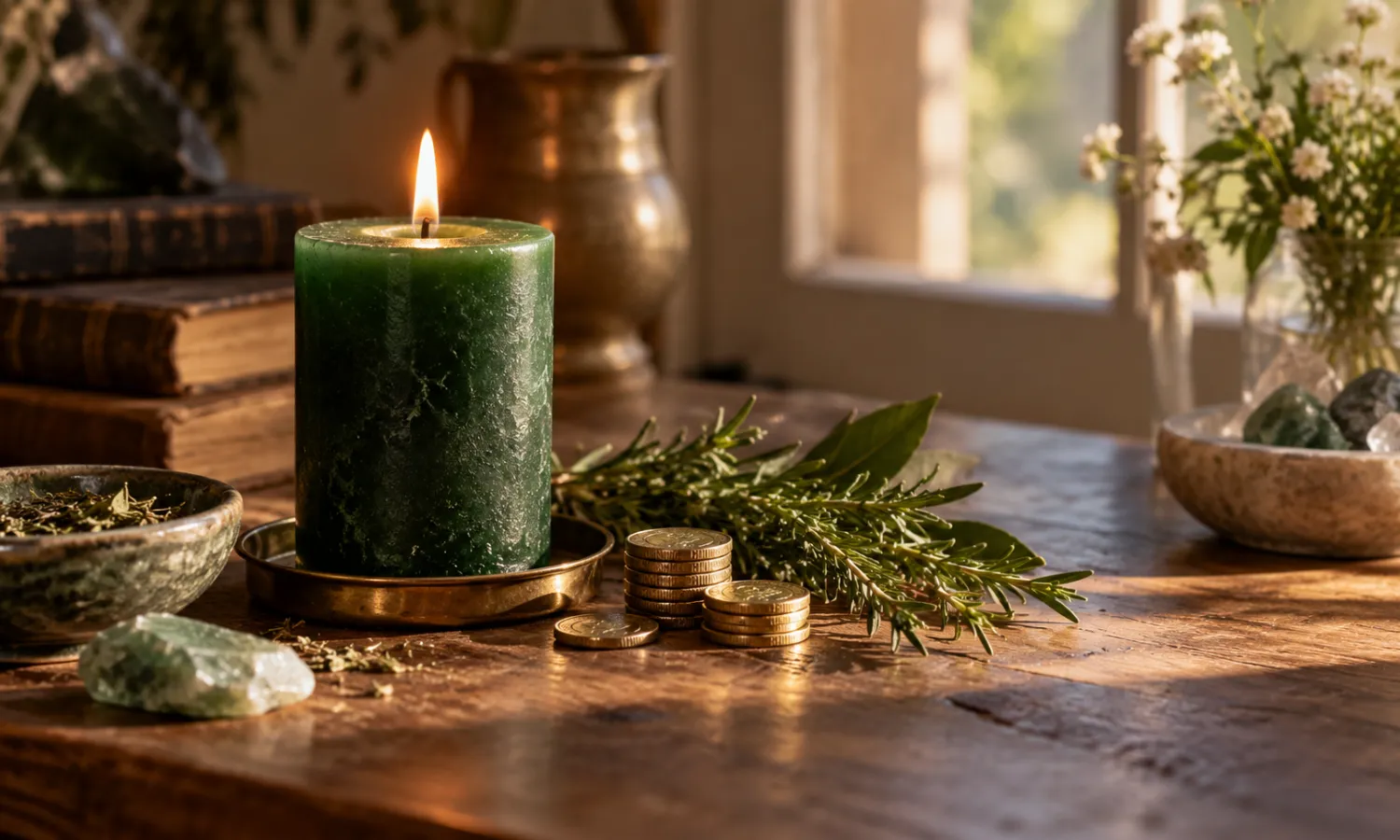
A green or gold candle is dressed with a little oil or dried herb, an intention is spoken, and the candle burns for a set time. Green is commonly associated with growth and money in American folk practice. A candle spell for money is probably the most recognizable form.
Jars and bowls
Coins, a written goal, and herbs such as basil, bay or cinnamon are layered in a jar or bowl and kept somewhere visible. The container becomes a daily reminder. The money jar spell and the money bowl are both versions of this idea.
Written intentions
A goal is written on paper or a bay leaf and then kept, folded, carried in a wallet or burned. Writing forces you to be specific, which is why this form works so well as a reflective tool.
Spoken words and chants
Short rhymes, affirmations or prayers repeated daily. These require nothing but a quiet minute, which makes them the easiest to sustain. The “Money Come to Me” chant is a typical example.
Placement and symbols
Feng shui practices such as a money corner, a jade plant or a bowl of coins by the door. These are less about a single moment and more about shaping the space you live in.
What practitioners say they get from it
When we talk to people who keep a regular money practice, the benefits they describe are rarely about sudden windfalls. They tend to describe three things.
The first is clarity. Writing “I want more money” on a leaf feels empty, so people end up writing “I want to clear my credit card by March.” The ritual sharpens the goal.
The second is a feeling of agency. Money worries can feel passive and heavy. A small, deliberate act, even a symbolic one, shifts the mood from “this is happening to me” toward “I am doing something about this.”
The third is rhythm. A monthly practice, often on the first of the month or the new moon, becomes a check-in. People review where they are, adjust the goal, and start again. That cadence is the part we think is most valuable. Our roundup of money rituals people practice at home shows how varied that rhythm can be.
A simple money spell to try at home
Here is a gentle version that uses things most kitchens already have. It takes about fifteen minutes.
- Clear a small space on a table and sit down with a pen, a slip of paper, a coin and a green or white candle in a stable holder.
- Write one specific financial intention in plain language. Include a number and a date if you can.
- Light the candle. Read the intention aloud once, slowly, then place the coin on top of the folded paper.
- Sit for a few quiet minutes. Picture the first concrete step you will take tomorrow, not the end result.
- Snuff the candle. Keep the paper and coin somewhere you will see them daily, such as your desk or wallet.
- At the end of the month, reread the paper, note what happened, and decide whether to keep or rewrite the intention.
A note on fire safety: never leave a burning candle unattended, keep it away from curtains, papers and hair, and use a holder on a heat-safe surface. If you cannot supervise a flame, skip the candle entirely. The written intention works on its own.
A practical pairing
This is the part most spell guides leave out, and it is the part we care about most. Pair every money spell with one ordinary action that moves the same goal forward.
For this article, we suggest a thirty-minute budget review. Open your bank or card statement for the last month, list your fixed costs, and find one subscription, fee or habit you can cut or renegotiate. Then write the number you saved on the back of your intention paper.
The ritual gives the goal a shape. The review gives it a foothold in reality. Over time, the two reinforce each other: the practice reminds you to act, and the action makes the practice feel honest.
What to expect, honestly
Expect a calmer relationship with money and a clearer sense of what you are working toward. Expect the occasional moment where an opportunity appears and you notice it faster because you have been thinking about it. Do not expect a check in the mail.
Be cautious with anyone selling guaranteed results, “overnight” spells, or expensive services that promise to remove blockages. Those claims are marketing, and they tend to target people under financial stress. A good practice costs little or nothing and asks you to do the real work alongside it.
Common questions
Do money spells really work?
Not in the sense of causing money to arrive. There is no evidence that a ritual changes your bank balance by itself. Many people do find that the practice improves focus, motivation and follow-through, and those things can affect income over time. We think that is the honest way to describe it.
What is the best day to do a money spell?
Traditions vary. Many practitioners prefer the new moon for beginnings, Thursday for its association with growth in Western astrology, or the first day of the month. In practice, the best day is one you can repeat. Consistency matters more than timing.
Do I need special ingredients?
No. A coin, a pen and a piece of paper are enough. Candles, herbs and crystals are traditional additions, but they are optional. If a guide tells you a spell will fail without a rare oil, treat that as a sales pitch.
Is it safe to try if I follow a religion?
That is a personal decision. Some people practice within their faith by framing the same intention as a prayer; others keep ritual and religion separate. If a practice conflicts with your beliefs, a written intention or a budgeting ritual carries the same practical benefit without the symbolic layer.
Continue your practice
If you are new to all of this, our simple money ritual for beginners walks through a first session step by step, and the bay leaf intention ritual without burning is a good flame-free option. For the bigger picture, our Start Here page explains how we approach every practice on this site. If you want a gentle first practice, try our prosperity spell for beginners.