Money Spell Guide
Prosperity rituals, luck symbols & intention

The Money Jar Spell: Ingredients, Steps and a Realistic Mindset
A step-by-step money jar spell with everyday ingredients, plus the honest framing and practical habit that make the jar worth keeping.
Share your love
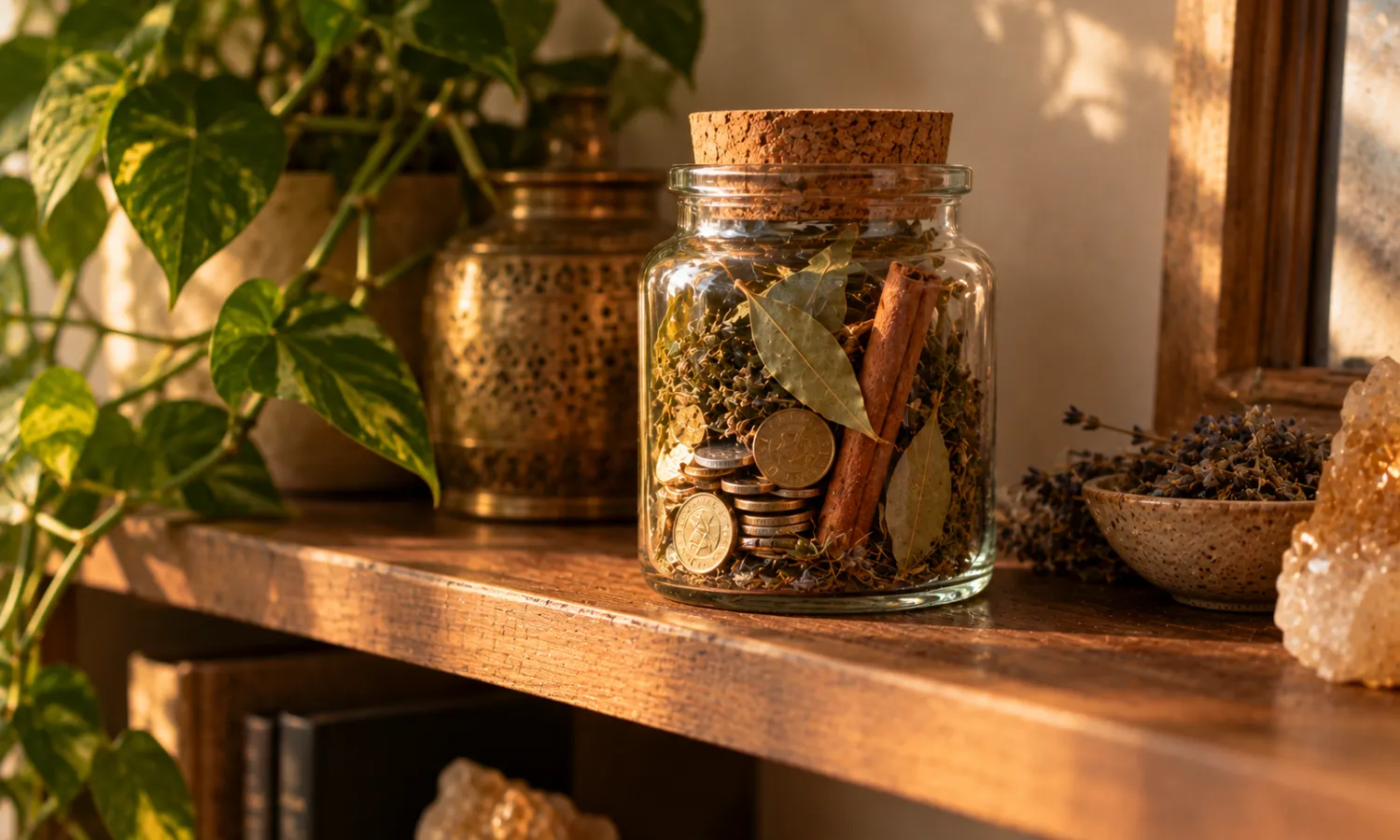
A money jar spell is a small container filled with coins, a written intention and a few herbs or objects associated with prosperity, sealed and kept somewhere you will see it. It is one of the most common folk practices for money because it is cheap, quiet and easy to keep going: you add a coin, you glance at the note, you move on.
Versions of the jar appear in hoodoo, in European kitchen magic and in modern witchcraft, and the ingredients vary by tradition and by what is in the cupboard. What stays constant is the shape of the practice: gather, name the goal, seal, tend.
This guide gives you a straightforward recipe, the steps to assemble it, and the realistic mindset that keeps the jar from turning into a wish you forgot about.
This practice is a symbolic, reflective exercise rooted in folk tradition. It is not a proven method for producing money, and nothing here guarantees financial results.
Money jar ingredients at a glance
| Ingredient | Commonly associated with | How much | Note |
|---|---|---|---|
| Coins | Money itself; weight and presence | A small handful, added one at a time | Use coins from your own wallet so the jar ties to your real finances |
| Written intention | The goal, named in a few words | One slip of paper, one or two sentences | Present tense, specific, folded toward you and placed on top |
| Basil or mint | Wealth, good fortune, freshness | A pinch of dried leaves | Spice-rack herbs are fine |
| Bay leaf | Success and protection | One whole leaf | Write a single word on it and add it beside the paper |
| Cinnamon | Warming or “quickening” an intention | A stick or a pinch of ground | Handled, not eaten, in this practice |
| Salt or rice | Salt for clearing and protection; rice for plenty | A thin base layer | Also keeps the herbs from clumping |
Key takeaways
- Assembly takes 20 to 30 minutes with a small lidded glass jar, coins, paper and pen, dried herbs and an optional green or gold candle; tending takes a minute a day.
- Best for an ongoing savings goal, a new job or business, or simply a steadier feeling around money.
- Three or four ingredients are enough; there is no single correct recipe, and anyone who insists otherwise is selling something.
- The jar is a visible, physical anchor for a financial intention; it does not generate income.
- Pair every coin you add with a real transfer to savings or one concrete action, so the jar becomes a record of effort.
What a money jar is and where it comes from
Container spells are old and widespread. The idea of putting written words, symbolic objects and something from the person into a sealed vessel appears in many folk traditions. In hoodoo, “money jars” and the related honey jar are commonly described as ways to “draw” prosperity or sweeten a situation. In European household custom, a jar of coins by the door or on the mantel was often simply a savings pot with a bit of luck attached.
Modern practitioners tend to blend these sources. The jar you will see online usually contains coins, a handwritten intention, a mix of kitchen herbs and sometimes a candle dripped over the lid to seal it. There is no single “correct” recipe, and we would be wary of anyone who says otherwise. Our beginner’s guide to money magic explains how these folk sources overlap.
Unlike a candle that burns down, the jar stays on the shelf, which makes it a natural companion to a savings habit.
Ingredients and what each one means
You do not need everything on this list. Three or four items are plenty. Here is what practitioners commonly include and why.
Coins. The obvious one. Coins represent money itself and give the jar weight. Many people use coins from their own wallet rather than new ones, so the jar is tied to their actual finances.
A written intention. A slip of paper with a clear, short statement. “A steady income that covers my needs with room to save.” Fold it toward you, which practitioners describe as drawing the intention inward.
Basil. Commonly associated with wealth and good fortune in European and American folk practice. Dried basil from the spice rack is fine.
Bay leaf. Associated with success and protection. Many people write a single word on the leaf and add it alongside the paper.
Cinnamon. Often described as “quickening” or warming an intention. A stick or a pinch of ground cinnamon both work. It is handled, not eaten, in this practice.
Mint. Associated with freshness and money in several folk traditions. A few dried leaves are enough.
Salt or rice. Salt is commonly used for protection and clearing; rice for abundance and plenty. Either can form a base layer in the jar.
Something personal. A business card or a small item from your work, optional, to link the jar to you.
How to make a money jar spell, step by step
- Choose and clean the jar. A small jam jar or spice jar is ideal. Wash it, dry it completely and, if you like, wipe the inside with a pinch of salt as a symbolic clearing.
- Write your intention. One or two sentences, specific and in the present tense. Avoid “I want” and avoid round numbers you do not believe. “I am paid on time and I save something every month” is a good shape.
- Add a base layer. A thin layer of rice or salt in the bottom, if using. This is both symbolic and practical: it keeps the herbs from clumping.
- Add the coins. Drop them in one at a time. Some people say a word with each coin (“rent,” “savings,” “food”), naming what the money is for.
- Add the herbs. A pinch of basil, a bay leaf, a small piece of cinnamon, a few mint leaves. Say what each one stands for as you add it, if that feels natural.
- Add the paper. Fold the intention toward you three times and place it on top.
- Close and seal. Screw on the lid. If you want to seal it with wax, light a green or gold candle in a holder on a heat-safe surface, let a few drops fall on the lid edge, then snuff the candle. Keep water nearby and never leave the flame unattended.
- Place it. Put the jar where you will see it daily: a desk, a kitchen shelf, the spot where you keep your wallet. Some feng shui readers prefer the southeast corner of a room, but visibility matters more than direction.
- Tend it. Once a day or once a week, add a coin, give the jar a gentle shake, and read the paper. This is the part that makes it a practice rather than a decoration.
Where to keep the jar and how to tend it
The jar should live where your money decisions happen. For most people that is a desk, a kitchen counter near the mail, or beside the place keys and wallet land at the end of the day. If you prefer an open container you can see into and top up, the money bowl works on the same principle.
Tending can be as light as adding spare change. Some people shake the jar each morning and say the intention once. Others add a coin only when they do something toward the goal: send an invoice, skip an impulse purchase, finish a shift. That second approach ties the jar directly to behavior, which we think is the strongest version.
When the jar is full, or when the intention has changed, open it. Spend or bank the coins. Compost the herbs. Keep or burn the paper safely in a fireproof dish. Then start fresh with a new intention.
The realistic mindset
A money jar does not generate income. What it does is give a financial goal a physical presence in your home, which is harder to ignore than a number in an app. The herbs and coins are a language for the goal; the daily glance is the actual mechanism.
If you notice yourself hoping the jar will “do” something while you avoid the budget or the awkward phone call, that is a sign to rebalance. The jar is there to point you at the task, not to carry it for you. For more on pairing mindset with concrete steps, see how to manifest money fast, which takes the same no-shortcuts view.
A practical pairing
Turn the jar into a real savings trigger. Every time you add a coin to the jar, move the same number of dollars, or ten times the coin’s value, into a savings account from your phone. A quarter in the jar becomes $2.50 in savings. Over a few months the jar on the shelf becomes a visible record of money you actually set aside.
If savings are not the goal, pair each coin with one action instead: one job application, one client message, one listing posted. The jar tracks the effort, and the effort is what changes the balance.
Common questions
What do you put in a money jar spell?
Most versions include coins, a written intention and one or more herbs commonly associated with prosperity, such as basil, bay leaf, cinnamon or mint. Salt or rice is sometimes added as a base, and the jar may be sealed with candle wax. Three or four ingredients are enough.
How long does a money jar spell take to work?
Folk sources vary and we would not put a timeline on it, because the jar is a symbolic practice rather than a cause of income. What you can expect fairly quickly is a stronger daily awareness of your goal. Paired with a savings or work habit, that awareness is where any real change comes from.
Can I open my money jar?
Yes. Traditions differ on whether a jar should stay sealed, but for a practical, ongoing version it makes sense to open it when it is full or when your goal changes. Use the coins, refresh the herbs and write a new intention. For a jar that stays closed and is placed for its symbolism alone, see our feng shui money bowl guide.
Does the jar need to be sealed with wax?
No. Wax sealing is a visual way of “closing” the intention, and many people enjoy it, but a screw-top lid is enough. If you do use a candle, keep it in a holder on a heat-safe surface and snuff it as soon as you are done.
Continue your practice
If you want an even simpler starting point, our simple money ritual for beginners takes five minutes and no ingredients, and intention journaling for work and opportunity is a good way to refine the sentence you put in the jar. For a related container practice with a sweeter focus, read about the honey jar money spell, or visit Start Here for how we approach all of this.