Money Spell Guide
Prosperity rituals, luck symbols & intention

A Candle Spell for Money: Colors, Setup and Safety
A step-by-step candle spell for money with color meanings, a simple setup, honest framing and the safety rules every candle practice needs.
Share your love
A candle spell for money is a short, focused practice in which you choose a candle, often green or gold, mark it with an intention, light it in a safe holder and spend a few minutes picturing a specific financial goal while it burns. It is one of the most widely used folk practices for prosperity because the setup is simple and the flame gives you a natural time limit.
Versions appear in hoodoo, Wicca, folk Catholicism and general kitchen witchcraft. The details vary, but the shape is consistent: color, intention, flame, focus, close.
This guide covers what the colors mean, how to set up and “dress” a candle, what to say, and the safety rules we put ahead of everything else. Candles are the one practice on this site that can genuinely cause harm if done carelessly, so please read the safety section even if you skip the rest.
This practice is a symbolic, reflective exercise rooted in folk tradition. It is not a proven method for producing money, and nothing here guarantees financial results.
Money candle colors at a glance
| Color | Commonly associated with | Best for | Note |
|---|---|---|---|
| Green | Growth, plants, American currency | Any money goal; the default if unsure | The most common choice in Western folk practice |
| Gold | Wealth, success, recognition | Career goals, raises, visibility | Often paired with green |
| White | All-purpose | Any goal when no other color is at hand | Stands in for any color in most traditions |
| Orange | Opportunity, momentum, attraction | Job searches, new ventures | Sometimes combined with a luck intention |
| Brown | Stability, home, steady work | Keeping a job, regular income | Grounding rather than ambitious |
| Red | Energy and courage | A difficult negotiation | Use when the goal needs a push, not a plan |
Key takeaways
- A sitting takes 15 to 30 minutes with one candle, a sturdy heat-safe holder, a pin or pen, optional olive oil and a pinch of basil or cinnamon, matches, a snuffer and water nearby.
- Best for a specific financial goal you want to think clearly about: a sale, a raise, a savings target or a bill to clear.
- Fire safety comes first: a proper holder on a heat-resistant surface, a foot of clearance, never unattended, snuffed rather than blown out.
- Color is a helpful language, not a requirement; a plain white tea light with a clear intention is just as suitable, and an LED candle works if you cannot burn one.
- No candle produces money; the practice ends with the next step written down, and a candle earns a second lighting only after that step is done.
Fire safety first
Place the candle in a holder designed for it, on a flat, heat-resistant surface such as a ceramic plate or a stone tray. Keep it at least a foot away from curtains, paper, books, plants and anything that hangs. Keep hair and sleeves back.
Never leave a burning candle unattended, and never fall asleep with one lit. If you need to leave the room, snuff it. Keep a glass of water or a damp cloth within reach. Keep candles out of reach of children and pets.
Use a snuffer or a lid to put the candle out rather than blowing, which can scatter hot wax. Let the holder cool before moving it. If a candle flares, smokes heavily or the glass cracks, put it out and do not relight it.
If you cannot safely burn a candle where you live, a battery LED candle works for the focus and timing, and loses nothing important. The symbolism is in the attention, not the heat.
Candle colors and what they mean
Green is the most common choice for money in Western folk practice, commonly associated with growth, plants and American currency. It is the default if you are unsure. We have a dedicated guide to the green candle money spell.
Gold is associated with wealth, success and recognition. People often choose it for career goals, raises and visibility.
White is the all-purpose candle. In most traditions a white candle can stand in for any color, and many practitioners prefer it for its simplicity.
Orange is commonly linked to opportunity, momentum and attraction, and is sometimes chosen for job searches and new ventures. Brown is associated with stability, home and steady work. Red is used when the goal needs energy and courage, such as a difficult negotiation. If you want to combine prosperity with general good fortune, see our spell for money and luck.
If you only have a plain white tea light, use it. Color is a helpful language, not a requirement. For how color is read in a different tradition, see feng shui colors for money.
Setting up and dressing the candle
“Dressing” a candle means preparing it with an intention before lighting. The simplest version is to carve a word or symbol into the wax with a pin: “steady,” “paid,” a dollar sign, or a short goal. Carve gently so the candle does not crack.
Some practitioners rub a very thin film of olive oil onto the candle, then roll it in a pinch of dried basil or ground cinnamon. If you do this, use the smallest amount possible and keep herbs away from the wick, because loose herbs can flare. Many people skip the oil and herbs entirely, and the practice is no weaker for it.
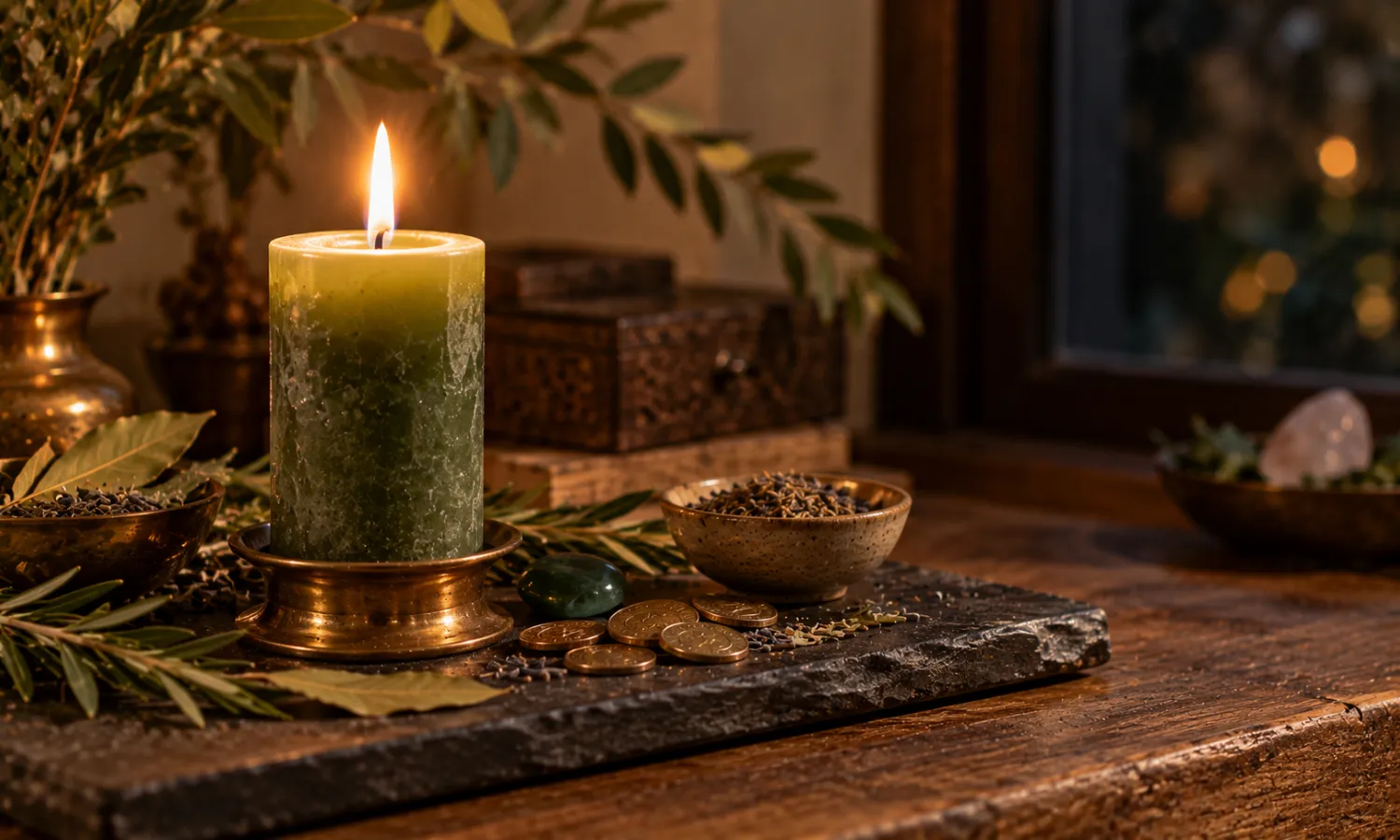
Set the dressed candle in its holder. Place a few coins, a bay leaf with a word written on it, or a slip of paper with your intention beside the holder, not touching it. Have your notebook and pen ready.
A simple candle spell for money, step by step
- Choose one goal. Write it in one sentence at the top of a notebook page. “I close the Henderson contract this month.” “I save $300 by the 30th.” Specific beats grand.
- Dress and place the candle. Carve a word, optionally add a trace of oil and herb, set it in the holder on the heat-safe surface. Check the surroundings.
- Light it and sit. Strike a match, light the wick, and sit where you can see the flame comfortably. Take three slow breaths.
- Say the intention. Read your sentence aloud once. Some people add a traditional line such as “As this candle burns, so my work bears fruit.” Keep it honest.
- Picture the goal as done. Spend two to five minutes imagining the specific moment: the signed contract, the balance on the screen, the paid bill. Notice how it feels, and notice what you did to get there.
- Write the next step. While the candle is still burning, write down the single most useful action you can take tomorrow toward this goal. This is the heart of the practice.
- Close. Say a short closing line such as “It is done, with thanks.” Snuff the candle. Do not blow it out.
- Let it cool. Leave the holder in place until the wax is solid. You can relight the same candle on following evenings for the same goal, repeating steps 3 to 7 until it burns down.
Timing and repetition
Practitioners often time candle work to the moon: the waxing moon or new moon for drawing things in, the full moon for gratitude and release. Friday, associated with Venus, and Thursday, associated with Jupiter, are commonly named as money days in Western correspondence tables. Sunday is sometimes used for success and recognition. A Wiccan money spell builds a fuller rite around these same correspondences.
None of this is required. A Tuesday at 9 p.m. because that is when you have ten quiet minutes is a fine time. What helps more than astrology is repetition: lighting the same candle for the same goal on several evenings in a row, each time ending with the next step written down.
A practical pairing
Do the next step you wrote before the candle has fully burned down. If you lit it on Monday and wrote “send the revised proposal,” send it by Wednesday. If you wrote “move $100 to savings,” do it from your phone while the wax is still soft.
A good rule: a candle earns a second lighting only after the step from the first one is done. That keeps the practice attached to action. If you find yourself relighting without acting, shrink the step until it is something you will actually do tonight.
Common questions
What color candle is best for a money spell?
Green is the traditional choice in Western folk practice, with gold a close second for career and success. White is a universal substitute. The color is a symbolic language, and a plain white candle used with a clear intention is considered just as suitable in most traditions.
How long should a money candle burn?
Fifteen to thirty minutes per sitting is plenty. Many people relight the same candle over several evenings until it burns down. Never let a candle burn unattended or overnight, and never burn a pillar or jar candle for longer than its label recommends.
Can I use a scented candle for a money spell?
Yes. A cinnamon, orange or basil-scented candle fits the symbolism well. Avoid adding loose herbs or oil to a scented jar candle, since the glass can overheat. The scent is a bonus, not a requirement.
What do you say during a candle spell for money?
One specific sentence about your goal, said aloud, is enough. Traditional lines such as “As this flame grows, so does my prosperity” are common, but we prefer honest, concrete wording: “I close this contract” or “I save this amount by this date.” See our money spell chants for more phrasing you can adapt.
Continue your practice
If a candle feels like a lot, our simple money ritual for beginners needs no flame, and the bay leaf intention ritual without burning carries the same focus with no fire at all. For the notebook side of this practice, see intention journaling for work and opportunity, and read Start Here for how we frame all of it.