Money Spell Guide
Prosperity rituals, luck symbols & intention

A Wiccan Money Spell: Correspondences, Timing and a Simple Rite
A plain-language Wiccan money spell with the correspondences, lunar timing and a ten-step green candle rite, framed honestly and paired with real action.
Share your love
A Wiccan money spell is a small, structured rite built from correspondences: colors, herbs, moon phases and days of the week that practitioners associate with prosperity. The usual form is a green candle, a few herbs, a spoken intention and a moment of focus, performed during a waxing moon. It is less about the ingredients than about doing something deliberately.
Wicca is a modern religious tradition with its own ethics, and money work within it is generally framed as asking for enough, through honest means, without taking from anyone else. This guide explains the correspondences practitioners commonly use, offers a simple rite you can do with kitchen supplies, and keeps the explanation respectful of a tradition we are describing rather than speaking for.
This practice is a symbolic, reflective exercise rooted in folk and religious tradition; it is not a proven method for producing money and nothing here guarantees financial results. Think of it as a ritual way of making a decision about your finances and marking it.
Wiccan money spell correspondences at a glance
| Correspondence | Common choice for prosperity | Why practitioners use it | Simple substitute |
|---|---|---|---|
| Candle color | Green (growth, money); gold (wealth, sun) | The color keeps the intention in view | White candle, or a bowl of water |
| Herbs | Basil, bay leaf, cinnamon, mint, chamomile | Long folk association with prosperity; placed or carried, not eaten | A single bay leaf or pinch of basil |
| Moon phase | Waxing moon, new to full | Described as the time for drawing things in | Do it anyway; timing is a preference |
| Day of the week | Thursday (Jupiter, expansion) or Sunday (sun, success) | Planetary associations with growth and achievement | Any evening you can be undisturbed |
| Direction | North (earth, material matters) | Orients the working surface toward the element of money | Face wherever is practical |
| Closing words | “As I will it, so it grows”; “so mote it be” | Marks the end of the rite and the start of ordinary work | A plain “thank you” |
Key takeaways
- The rite takes 20 to 30 minutes and uses a green candle, a heat-safe holder, a coin, a bay leaf or pinch of basil, paper and pen, and an optional dish of salt.
- It is best for people drawn to structured ritual who want timing and symbolism to be part of the practice.
- Wiccan money work is phrased as an opening that harms none, through your own hands, never as a demand on someone else’s money.
- Its purpose is to state a prosperity intention within a traditional framework and then carry it into ordinary work, so no spell guarantees money.
- Use the two-week waxing window to complete one concrete task, such as researching your market rate and sending the email that asks for it.
What makes a spell Wiccan
Wicca emerged in mid-twentieth-century England and draws on older European folk practice, ceremonial magic and nature reverence. Its rituals typically involve creating a sacred space, calling on natural forces or deities, stating an intention, raising and releasing focus, and closing the space. Many Wiccans also follow the Wiccan Rede, often summarized as “harm none,” which shapes how money spells are worded.
In practice, this means Wiccan money work avoids asking for a specific person’s money or for a windfall at someone else’s expense. Practitioners describe asking for “abundance that harms none” or “prosperity through my own hands.” The intention is phrased as an opening, not a demand.
Correspondences practitioners use
Correspondences are the symbolic associations that give a spell its texture. They vary between traditions and teachers, but the ones below are commonly described for prosperity work.
Colors. Green is the color most associated with money in Western practice, through its link to growth and to US currency. Gold is associated with wealth and the sun. Some practitioners use a white candle as an all-purpose substitute. The green candle money spell is the plainest version of this correspondence in action.
Herbs. Basil, bay leaf, cinnamon, mint and chamomile are commonly associated with prosperity. In spellwork they are handled, placed or carried, not eaten. Our guide to herbs for money spells covers each one.
Moon phase. The waxing moon, from new to full, is described as the time for drawing things in. Spells for growth and gain are usually set then. The waning moon is for release and banishing. If you would like to mark the start of the cycle before the money rite, a simple new moon ritual sets the tone.
Day of the week. Thursday is associated with Jupiter and expansion. Sunday is associated with the sun and success. Either is commonly recommended for money work.
Direction. Many practitioners associate north with earth and material matters, so the altar or the working surface is sometimes oriented that way.
A simple Wiccan money rite
This version is deliberately plain. It uses the structure of a Wiccan rite without requiring any formal training, deity names or tools you do not own. Adapt it freely.
- Choose your timing. Pick an evening during the waxing moon, ideally a Thursday or Sunday. If the calendar does not cooperate, do it anyway; timing is a preference, not a rule.
- Prepare the space. Clear a small surface. Some practitioners sprinkle a thin line of salt around the working area or set a dish of salt on the table as a symbol of cleansing and boundary. Wipe the surface clean. Turn off screens.
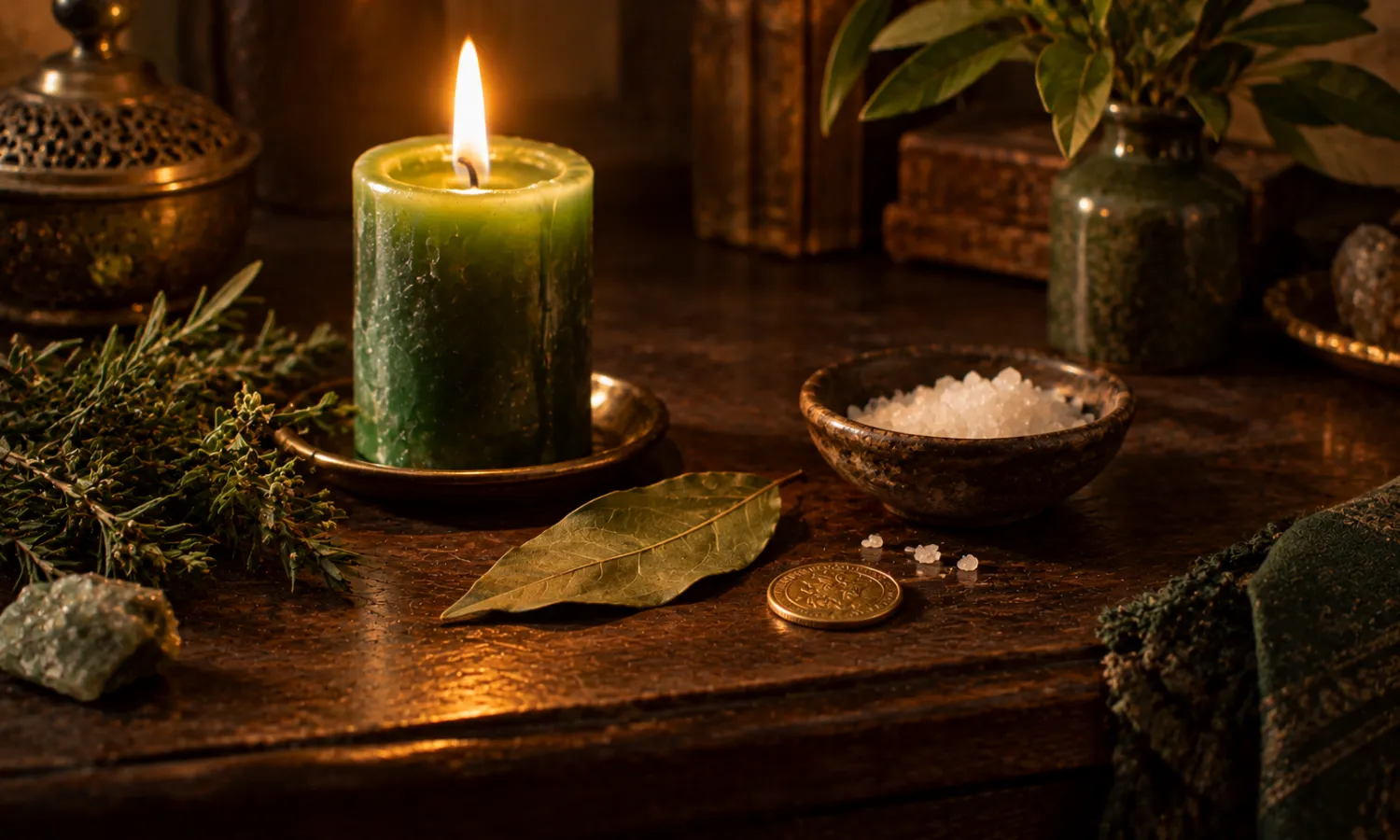
- Set out your items. Place the green candle in its holder at the center. Put the coin in front of it and the bay leaf or basil beside the coin. Keep paper and pen within reach.
- Open the rite. Stand or sit quietly. Take three slow breaths. If it suits you, say something simple: “I set this space apart for a few minutes of clear intention.” Wiccans may call the quarters or invoke a deity here; a general reader can simply mark the start.
- Write your intention. On the paper, write one sentence in the present tense that harms no one: “I am paid fairly for work I do well.” “My savings grow steadily each month.” Read it over. Change any word that feels like a stretch.
- Light the candle. As the flame catches, read the sentence aloud three times. Hold the coin in your hand while you speak. Picture the situation as if it were already settled, calmly rather than dramatically.
- Place the herb. Set the bay leaf or basil on top of the folded paper, and set the coin on top of both. Say: “As I will it, so it grows.” Many Wiccans close with “so mote it be.”
- Let the candle burn while you sit. Five to ten minutes is enough. Use this time to think about the first real step toward the sentence you wrote. Never leave the candle unattended, keep it away from anything that can catch, and snuff it rather than blowing it out if that feels right to you.
- Close the rite. Extinguish the candle. Say thank you, to whatever you address or simply to the moment. Keep the paper, coin and leaf together somewhere you will see them: a wallet, a small box on your desk, a corner of a shelf.
- Return to it. You can relight the same candle for a few minutes on following evenings until the full moon, repeating the sentence. When the candle is finished, the working is finished.
Wording that fits the tradition
Wiccan intentions are usually positive, present-tense and bounded. “I have enough” rather than “I am not broke.” “Opportunities find me” rather than “I want that job.” Many practitioners add a closing clause such as “for the good of all, harming none” to keep the request within the ethics of the Rede.
Rhyming couplets are traditional and make the words easier to hold in memory, but a plain sentence spoken with attention does the same work. If you enjoy writing in verse, our money spell chants collection has starting points.
A practical pairing
A spell set during the waxing moon gives you a natural two-week window. Use it. Before the full moon, complete one concrete money task that matches your written sentence: if you wrote about being paid fairly, research the market rate for your role and draft the email asking for a raise or a higher day rate.
Keep the draft next to the coin and the leaf. When the full moon arrives and the candle is spent, send the email. The ritual gave the decision a beginning and an end; the email is what actually changes something.
Common questions
Do I have to be Wiccan to do a Wiccan money spell?
No, but it is worth being honest about what you are doing. If you are not Wiccan, you are borrowing a structure, and the respectful approach is to say so, skip the deity names you do not have a relationship with, and keep the ethics of harming none. Many people use the correspondences without adopting the religion. Our overview of money spells explains how Wiccan rites sit alongside hoodoo, kitchen-witch and other folk approaches.
What moon phase is best for a Wiccan money spell?
The waxing moon, between the new moon and the full moon, is the period most practitioners recommend for drawing in prosperity. The full moon itself is often used for gratitude and completion. If you need to release a money habit rather than attract something, the waning moon is the traditional time.
Which candle color is best for money?
Green is the standard choice in Wiccan and broader Western folk practice. Gold is used for wealth and success, and white works as a substitute for any color. The candle’s color is a reminder of the intention; it does not change what the candle does.
Can I do the spell without a candle?
Yes. Replace the candle with a bowl of water or simply a coin held in your hand, and speak the intention the same way. The structure of opening, stating, focusing and closing is what makes the rite, not the flame. This is the safer choice in shared housing or around pets.
Continue your practice
If you are new to ritual, our simple money ritual for beginners is a gentler starting point, and the bay leaf intention ritual without burning uses the same herb without any flame. For timing, see our new moon money spell. The Start Here page explains how we approach every practice on the site.