Money Spell Guide
Prosperity rituals, luck symbols & intention

New Year Superstitions for Good Luck and Money
Twelve New Year superstitions people follow for luck and money, where they come from, and how to enjoy them without expecting miracles.
Share your love
New Year superstitions are small customs people follow at midnight or on January 1 in the hope of good luck, love and money in the coming year. The best known include eating twelve grapes at midnight, cooking black-eyed peas and greens, keeping cash in your pocket, and welcoming a lucky first visitor through the door.
Almost every culture has its own version, and many families mix several. Below we gather twelve of the most popular, explain where each is commonly said to come from, and share how people practice them today.
We also offer one practical money step for the first week of January, because a fresh calendar is a genuinely useful moment for real-world planning.
These customs are folklore and personal belief, not predictors of money or events; nothing here guarantees luck or financial results. Enjoy them as ways of marking a new beginning with family, food and a little playfulness.
New Year superstitions at a glance
| Custom | Region or tradition | What people do |
|---|---|---|
| Twelve grapes | Spain and much of Latin America | Eat one grape at each stroke of midnight, one per month |
| Black-eyed peas and greens | Southern United States | Cook peas for luck and greens for money on New Year’s Day |
| First-footing | Scotland and northern England | A visitor brings small gifts as the first guest after midnight |
| Cash in your pocket | Many cultures | Start the year with money in your wallet so it stays |
| Lentils | Italy | Eat lentils after midnight, their coin shape hinting at prosperity |
| Round fruits and polka dots | Philippines | Display round fruits and wear dots to suggest coins |
| No sweeping on January 1 | Several Asian and European folk traditions | Leave the broom alone so good luck is not swept out |
Key takeaways
- New Year superstitions usually use food, colors, doors and money as symbols for a hopeful start.
- Many customs focus on coins and round shapes as images of prosperity.
- Several superstitions are about what you avoid on January 1, such as sweeping or lending money.
- These are cultural and family traditions, best enjoyed for connection rather than results.
- The first week of January is a natural time to pair a symbolic custom with a real budget step.
Where New Year superstitions come from
Many of these customs grew out of a simple idea that the first day sets the tone for the rest of the year. If you begin with food on the table, money in your pocket and friends at the door, the hope is that the year will follow suit.
Agricultural calendars, religious feasts and local food traditions all shaped which symbols took hold where. Round shapes, the color green and gold, and anything that swells when cooked turn up again and again. Our overview of symbols of prosperity across cultures shows how widely these images travel.
Twelve New Year superstitions for luck and money
1. Eating twelve grapes at midnight
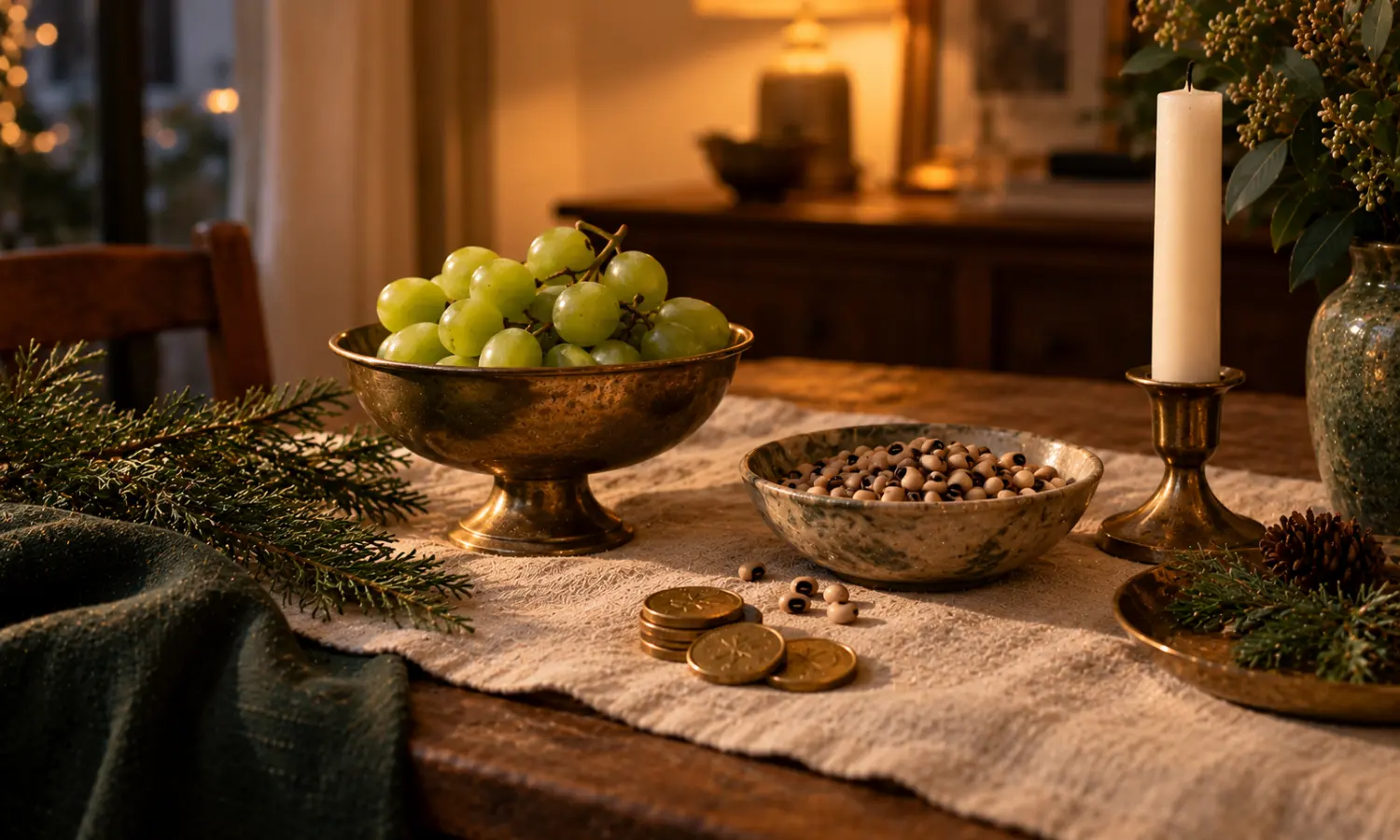
In Spain, and in many Latin American countries, people eat twelve grapes as the clock strikes twelve, one grape per chime. Each grape stands for a month of the coming year. Finishing them in time is said to bring a lucky year, and the laughter of trying is half the fun.
2. Black-eyed peas and collard greens
In the Southern United States, a New Year’s Day meal often includes black-eyed peas, greens and cornbread. The peas are associated with coins and luck, the greens with folded money, and the cornbread with gold. Many families eat them together as a traditional supper.
3. First-footing
In Scotland and northern England, the first person to cross your threshold after midnight is called the first-foot. Traditionally they bring small gifts such as coal, bread, salt or a drink, standing for warmth, food and good cheer for the year ahead.
4. Keeping cash in your pocket
A widespread belief holds that if your wallet is empty on New Year’s Eve, it may stay lean all year. Many people tuck a crisp bill into a pocket or wallet before midnight as a hopeful gesture.
5. Not paying out money on January 1
The flip side of the cash custom is avoiding spending, lending or paying debts on New Year’s Day, so money does not flow out at the start of the year. In practice, most people simply pay bills a day early or the day after.
6. Lentils in Italy
Italian families often serve lentils after midnight, frequently alongside sausage. Small, round and coin-like, lentils are commonly associated with wealth, and they swell when cooked, which adds to the image of growth.
7. Round fruits and polka dots in the Philippines
In the Philippines, many households display a collection of round fruits on the table, often twelve or thirteen varieties, and people wear polka dots. Both suggest coins and abundance for the new year.
8. Colorful underwear
In parts of Latin America, the color of your underwear on New Year’s Eve is linked to your wishes. Yellow is often worn for luck and prosperity, red for love. If you are curious about color symbolism more broadly, see our guide to colors associated with money.
9. Walking with an empty suitcase
Another Latin American custom involves grabbing a suitcase at midnight and walking around the block, or just around the house. It expresses the wish for a year full of travel.
10. Opening doors and windows at midnight
In some traditions, people open doors and windows at midnight to let the old year out and the new one in. It is often paired with a quick tidy before the clock strikes.
11. No sweeping or taking out the trash
Several folk traditions advise against sweeping or emptying the trash on New Year’s Day, so that good fortune is not swept or thrown out with the dust. Many families clean thoroughly on December 31 instead.
12. Making noise at midnight
Banging pots, ringing bells and setting off firecrackers are found in many cultures. Noise is often said to chase away bad luck and welcome a lively year. If fireworks or candles are involved, follow local laws and basic fire safety, and keep children and pets at a safe distance.
How people use these customs today
Most families treat New Year superstitions as a playful ritual rather than a strict rule. A household might eat grapes at midnight, cook black-eyed peas the next day and keep a bill in a wallet, all in the same twenty-four hours. Customs travel with migration and marriage, and mixing them is part of the joy.
Some people also add their own small rituals, such as writing intentions for the year or performing a cleansing gesture. Our list of money rituals people practice at home includes gentle options that fit easily into a New Year’s Eve.
Common misconceptions
The biggest misconception is that a missed superstition means a bad year. Forgetting the grapes or sweeping the floor on January 1 does not change your finances. Luck, in these traditions, is a hope, not a debt to be paid.
Another is that a custom belongs to just one culture. Black-eyed peas, for instance, have roots that reach across the Atlantic world, and coin-shaped foods appear in many kitchens. It is respectful to name the tradition you are borrowing from and learn a little about it.
A practical pairing
The first week of January is one of the best times of the year to look at your money with fresh eyes. Alongside your favorite custom, do one concrete thing: open your bank app, list your fixed monthly costs, and set up an automatic transfer, however small, into savings on payday.
If you kept a bill in your pocket at midnight, let it be a reminder. When you find it on January 2, deposit it into that savings account as the first contribution of the year.
Common questions
What should you not do on New Year’s Day for good luck?
Common folk advice includes not sweeping, not taking out the trash, not lending money and not starting the year with an empty wallet. These are traditions, not rules, and ignoring them carries no real penalty.
What is the luckiest food to eat on New Year’s Day?
It depends on the tradition: grapes in Spain, lentils in Italy, black-eyed peas and greens in the American South, and round fruits in the Philippines. Choose the one that speaks to your family or heritage.
What New Year superstitions bring money?
Customs linked to money include keeping cash in your pocket, eating coin-shaped foods such as lentils and peas, eating greens, and wearing yellow. They are symbolic gestures rather than financial strategies.
Why do people open the door at midnight on New Year’s Eve?
In many homes it is a symbolic way of letting the old year leave and welcoming the new one. It often goes together with first-footing or a final tidy of the house.
Continue your practice
To explore more of the charms behind these customs, read our guide to good luck symbols from around the world. For a first-of-the-month habit that carries the spirit of January into the rest of the year, try the cinnamon money ritual.