
Money Spell Guide
Prosperity rituals, luck symbols & intention
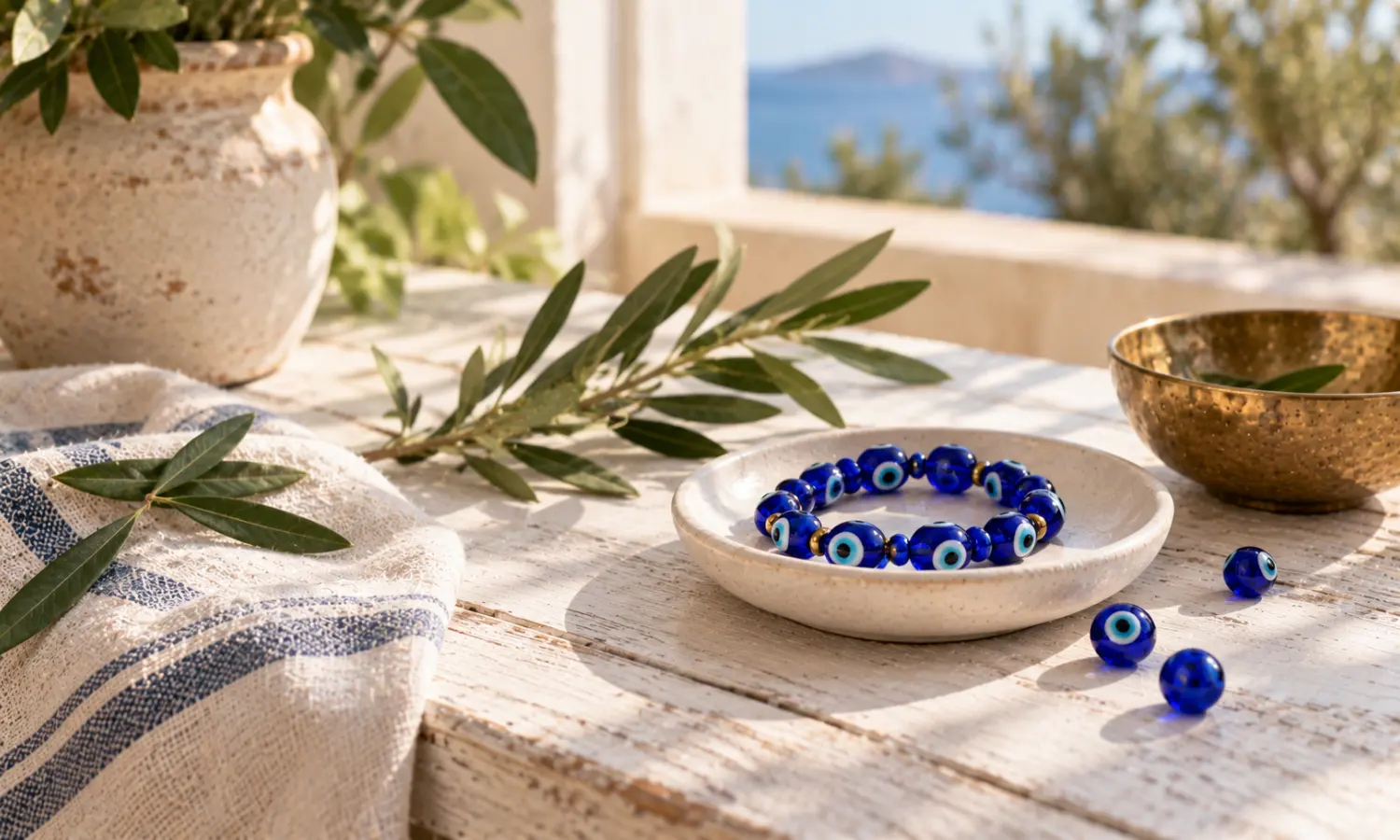

Evil Eye Bracelet Meaning: Colors, Wrist and When It Breaks
The evil eye bracelet is a protective charm against envy. Here is what it means, what the colors stand for, which wrist to use and what a break means.
Share your love
An evil eye bracelet is a protective charm. The evil eye bracelet meaning comes from an ancient and widespread belief that envious or ill-wishing looks can bring misfortune, and that an eye-shaped amulet, usually blue, can deflect that gaze back to where it came from.
You will see these bracelets everywhere from Istanbul bazaars to Greek island shops to jewelry stores in Los Angeles. Some people wear them for tradition, some for faith, some for style and many for a mix of all three.
In this guide we explain where the belief comes from, what the different colors are commonly said to mean, which wrist people choose and what it is said to mean when the bracelet breaks.
This is folklore and personal belief, not a predictor of money or events; nothing here guarantees luck or financial results. We describe the evil eye as it is understood across many cultures and treat each tradition with respect.
Evil eye bracelet meaning at a glance
| Color or detail | Commonly said to mean | Tip |
|---|---|---|
| Dark blue | Classic protection, calm, clear perspective | The traditional choice if you want just one |
| Light blue | Peace, solitude, broad protection | Popular as a gentle, everyday charm |
| Green | Balance, success, new ventures | Often chosen around new jobs or businesses |
| Red | Courage, energy, protection in love | Sometimes paired with a red string |
| Gold or yellow | Focus, health, confidence | Works well on fine chain bracelets |
| Broken bracelet | Said to have absorbed negativity | Thank it, set it aside and replace it |
Key takeaways
- The evil eye is the belief that envy or a harmful glance can cause bad luck; the eye charm is meant to deflect it.
- The blue glass eye, known as a nazar in Turkish, is the most recognized form.
- Color meanings are modern additions that vary by seller and should be read loosely.
- There is no single rule about which wrist to wear it on; people follow family custom or personal preference.
- In folk belief, a bracelet that breaks has done its protective job and should be replaced.
Origins of the evil eye
Belief in the evil eye appears across the Mediterranean, the Middle East, North Africa, West and South Asia and Latin America, under many names. In Greece it is often called mati, in Turkey nazar, and in many Spanish-speaking communities mal de ojo. The core idea is remarkably consistent: admiration or envy, even unintentional, can carry harmful energy.
Eye-shaped amulets to ward off that harm have a very long history in the region, and the familiar blue glass eye bead is especially associated with Turkish and Greek glassmaking. Traditionally the charm is hung in homes, pinned to babies’ clothing, placed in cars and shops and, of course, worn as jewelry.
The evil eye is now one of the best-known protective entries among good luck symbols from around the world. Some people also pair it with the hamsa, the open-hand charm, which appears in several Middle Eastern and North African traditions.
What the evil eye bracelet means
At its simplest, the bracelet means protection. Wearing it is said to shield you from envy, gossip and ill wishes, especially during times when you are visible or successful: a new job, a wedding, a pregnancy, a new home or a business launch.
Many people also see it as a reminder to stay humble and private about good news, which is an interesting parallel. In several traditions, boasting is thought to attract the evil eye, so the charm sits alongside a cultural habit of modesty.
It is also simply a meaningful gift. Grandparents give them to newborns, friends give them before travel and coworkers give them at a launch. In that sense the bracelet means “I wish you well and I want you protected.”
Colors and their meanings
Traditionally, the evil eye is blue, and many families would not consider any other color the “real” charm. In modern jewelry, though, sellers offer a rainbow of options, each with a suggested meaning. These meanings are not ancient and they differ from shop to shop, so treat the following as common associations rather than rules:
- Dark blue: protection, calm and good karma; the classic.
- Light blue: peace and broad protection.
- Green: balance, happiness and success in new projects.
- Red: courage, energy and protection in love.
- Yellow or gold: focus, health and confidence.
- Pink: friendship and affection.
- White: clarity and fresh starts.
- Purple: imagination and spiritual growth.
If you are choosing a bracelet with money goals in mind, green and gold are the colors most often linked with prosperity. You might keep it alongside other lucky symbols for money as a set of personal reminders.
Which wrist should you wear it on?
There is no universal rule. One popular idea, drawn from some energy-healing traditions, says the left hand “receives” energy, so a protective bracelet belongs on the left wrist to guard what comes in. Others say the right wrist, the hand you act with, sends protection outward.
In practice, most families follow their own custom, and many people simply wear it where it is comfortable and visible. If you cannot decide, choose the wrist where you will notice it most, since the point is to remember the intention behind it.
When the evil eye bracelet breaks
Perhaps the most common question is what it means when an evil eye bracelet breaks or the bead cracks. In folk belief, this is usually taken as a sign that the charm has absorbed negativity and done its job. It is not considered a bad omen for you.
The traditional response is to thank it, remove it and replace it with a new one. People dispose of the old charm respectfully, for example by wrapping it in a cloth or burying it, according to their family’s custom. Some like to pair the replacement with a small cleansing practice; our money blockage removal ritual offers a gentle, fire-free way to mark a fresh start.
Of course, bracelets also break because cords wear out. Both explanations can live side by side.
Common misconceptions
“The evil eye charm is itself a curse.” No. The charm is protective; the “evil eye” refers to the harmful glance it is meant to deflect.
“Wearing it guarantees you will be safe or successful.” It is a symbol of protection and a cultural tradition, not a guarantee.
“Every faith embraces it.” Views differ. Some religious communities see the charm as cultural, while some scholars and clergy discourage relying on amulets. It is worth respecting those differences.
A practical pairing
The evil eye is about protecting what you have worked for. Pair it with one concrete step to protect your finances this week. Turn on two-factor authentication for your bank and email accounts, set up alerts for card transactions over a small amount and check that your emergency savings sit somewhere separate from your daily spending.
Each time you notice the bracelet, let it remind you that real protection includes good habits. It takes about twenty minutes and genuinely reduces risk.
Common questions
Is it bad luck to buy your own evil eye bracelet?
There is a saying in some families that the charm works best as a gift, but there is no widespread rule against buying your own. Many people do, and choosing it yourself can make it more personal.
What does an evil eye bracelet mean spiritually?
Spiritually, it represents protection from envy and negative energy, as well as watchfulness and awareness. Many people also see it as a prompt to stay humble and grounded.
What does it mean when an evil eye bracelet falls off?
If it falls off or breaks, folk belief usually says it has absorbed harmful energy and fulfilled its purpose. The custom is to replace it rather than repair it.
Can anyone wear an evil eye bracelet?
Yes. The charm is shared across many cultures and is widely worn and gifted. Wearing it with an understanding of its history is the most respectful approach.
Continue your practice
To explore related signs, read our guide to symbols of prosperity across cultures and our list of the most powerful good luck charms for money. For a simple cleansing practice without fire, see our salt ritual for money.



