Money Spell Guide
Prosperity rituals, luck symbols & intention

Money Magic: A Beginner’s Guide to Folk Practices for Prosperity
A beginner's guide to money magic: the folk traditions it draws from, the simple tools involved, and how to start a grounded practice at home.
Share your love
Money magic is the umbrella term for folk practices that use symbols, herbs, candles, written words and simple rituals to focus a person’s attention on prosperity. It is not one tradition but many, drawn from kitchen witchcraft, hoodoo, Wicca, feng shui and ordinary household superstition. What they share is the idea that giving an intention a physical form helps you hold onto it.
If you are a beginner, the good news is that money magic asks for very little. Most of the tools are already in your kitchen. The harder part is approaching it with the right mindset: curious, respectful and realistic.
This guide explains the main traditions, the tools people use and why, and how to set up a simple first practice that you can actually keep.
Money magic is a symbolic and reflective practice rooted in folk tradition. It is not a proven method for producing money, and nothing here guarantees financial results.
Money magic at a glance
| Tradition | Typical tools | What it emphasises | Beginner version |
|---|---|---|---|
| European folk magic and kitchen witchcraft | Basil, bay leaf, coins, doorway charms | Household habits around prosperity | A bay leaf in the notebook and a coin in the wallet |
| Hoodoo | Roots, oils, candles, psalms | A living African American tradition with its own teachers | Learn from practitioners rather than generic spell lists |
| Wicca and modern witchcraft | Green candles, moon phases, correspondences | A system of colors, planets and elements | A green or white candle lit at the new moon |
| Feng shui | Money tree, coins by the door, the wealth corner | Arranging space to support flow | Tidy the southeast corner and keep a coin bowl there |
Key takeaways
- Money magic is an umbrella term for folk practices that give a prosperity intention a physical form; it draws on kitchen witchcraft, hoodoo, Wicca and feng shui.
- A first session takes ten to twenty minutes and a few minutes a day after that, using a notebook, a coin, a candle and one or two kitchen herbs such as basil, bay or cinnamon.
- It is best for beginners who want a calm, low-cost way to focus on a financial goal; be specific, be modest and be regular.
- The purpose is clarity, consistency and a reminder to take the next real step, so pair each session with one phone call or email that could bring money in.
- No practice guarantees money; skip kits, rare oils and anyone promising it works overnight.
The traditions behind money magic
It helps to know where ideas come from, both out of respect and because it makes the practice easier to understand.
European folk magic and kitchen witchcraft. Herbs grown and used at home, coins kept in specific places, and charms hung in doorways. Basil in the window and bay in the cupboard are old habits that later became “money herbs.” The basil money spell is the most direct descendant of that kitchen habit.
Hoodoo. An African American folk practice from the American South that blends African spiritual traditions, Indigenous plant knowledge and Christian prayer. Practitioners describe money work with roots, oils, candles and psalms. It is a living tradition with its own teachers, and we recommend learning about it from them rather than from generic spell lists.
Wicca and modern witchcraft. A twentieth-century religious movement that organized many folk ideas into a system of correspondences: colors, planets, moon phases and elements. Much of the money magic vocabulary online, such as “green candle” and “new moon,” comes from here.
Feng shui. The Chinese practice of arranging space to support the flow of energy. Money trees, coins by the door and the “wealth corner” come from this tradition.
The basic tools and what they stand for
Each tool in money magic is a kind of shorthand. You do not need all of them, and you do not need expensive versions of any of them.
Candles. A flame marks the beginning and end of a focused moment. Green is commonly associated with growth and money in American practice; gold with success; white with any purpose. Always use a stable holder on a heat-safe surface, keep the flame away from anything that can catch, and never leave it unattended.
Herbs. Basil, bay leaf, cinnamon, mint and chamomile are the usual prosperity herbs in Western folk practice. They are handled, placed, carried or (carefully) burned, not eaten, in these practices. Our guide to herbs for money spells explains each one.
Coins. The most literal symbol. Old coins, foreign coins or the first coin from a new job are all traditional choices.
Paper and pen. Writing an intention is the single most useful part of any practice because it forces you to be specific.
Crystals. Citrine, pyrite and green aventurine are commonly associated with abundance. They are optional, and a smooth stone from a walk works just as well as a reminder.
The mindset that makes it useful
Beginners often approach money magic with one of two attitudes, and both get in the way. The first is desperation: treating the ritual as a last resort that must work. The second is embarrassment: doing it half-heartedly because it feels silly.
A better frame is to treat it the way you might treat a morning walk or a journaling habit. It is a deliberate pause that helps you think clearly about money, which is something most of us avoid. The ritual is the container; the thinking is the content.
Be specific, be modest and be regular. “I will save $200 this month by cooking at home four nights a week” is a far better intention than “I want to be rich,” both as a piece of magic and as a plan.
A first money magic practice, step by step
This session takes about fifteen minutes and uses only common items. Do it on an evening when you will not be interrupted.
- Tidy a small surface. A clear space signals to your mind that something deliberate is starting.
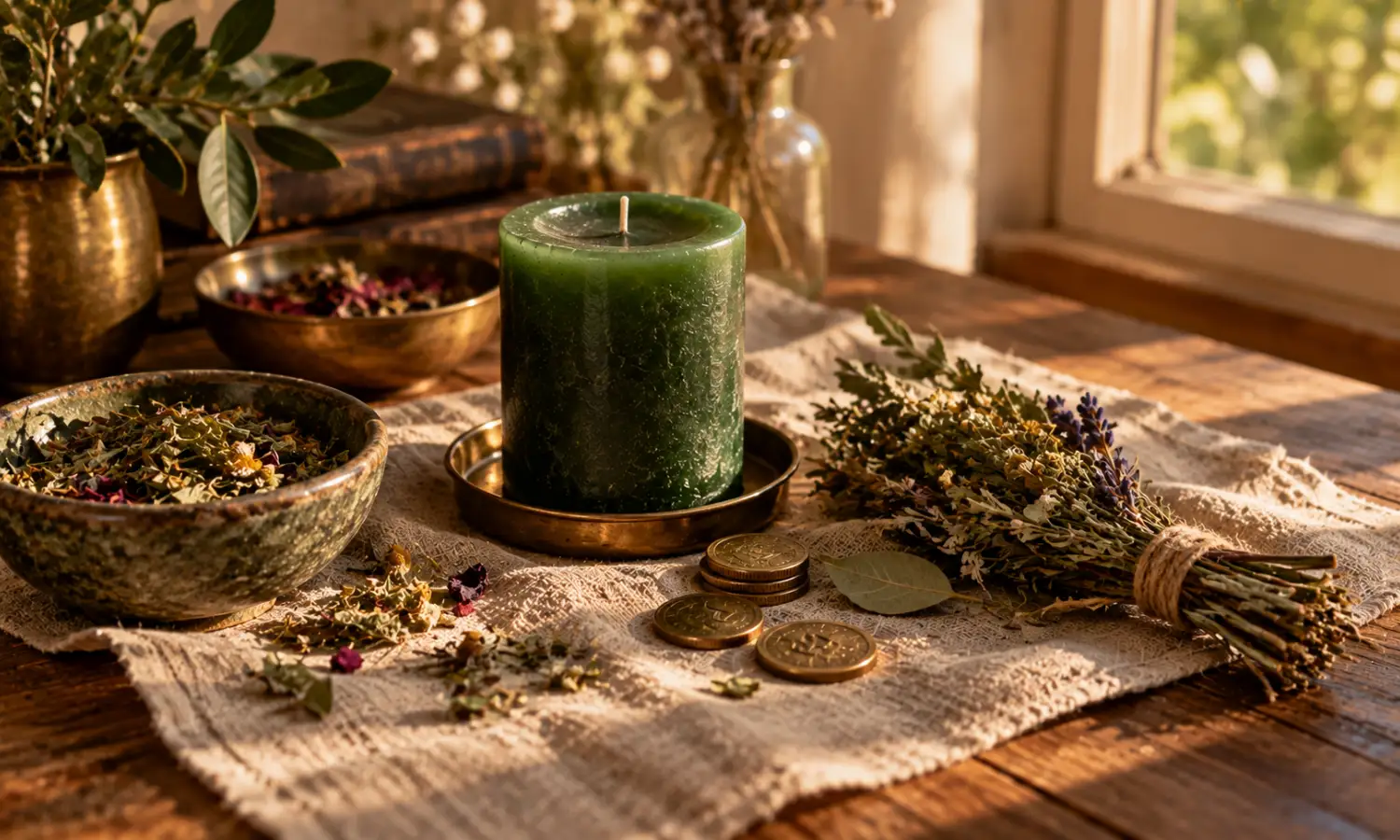
- Gather a notebook, a pen, one coin, a bay leaf or a pinch of cinnamon, and a candle in a safe holder if you choose to use one.
- Write the date and one specific financial intention at the top of a fresh page. Add a number and a deadline.
- Light the candle (or simply take three slow breaths if you are skipping the flame). Read the intention aloud.
- Place the coin on the page and the bay leaf or cinnamon beside it. Sit quietly for three to five minutes and picture the first action you will take, not the final result.
- Write that first action under the intention. Make it small enough to complete tomorrow.
- Snuff the candle. Keep the coin in your wallet and the bay leaf in the notebook as a bookmark.
- Return to the page every few days. Check off what you did, and rewrite the intention at the end of the month.
Fire safety matters more than any correspondence. If you cannot stay with the candle until it is out, use an LED candle or no candle at all. The practice does not depend on the flame.
A practical pairing
Every practice on this site comes with one real-world action, because reflection without action is just a pleasant evening. For a beginner’s money magic session, we suggest a single phone call or email that could bring money in.
That might be following up on a late invoice, asking a client whether they need more work this quarter, or calling your utility provider to ask about a cheaper plan. Make the call within 24 hours of the ritual while the intention is still fresh. Then write the result in your notebook under the intention.
Over a few months, the notebook becomes a record of calls made and small wins, and that is the most convincing evidence you will ever find that the practice is worth keeping.
Mistakes beginners make
Buying too much. Kits, rare oils and “charged” candles are not necessary. Start with what you have.
Chasing complexity. A twenty-step ritual that you do once is worth less than a two-minute practice you do every week. Even something as involved as the honey jar money spell is really just a jar you revisit.
Skipping the action. If the only thing that changes after a ritual is your mood, the ritual has done half its job. Finish the other half.
Trusting guarantees. Anyone promising that money magic “works 100%” or works overnight is selling something. Walk away.
Common questions
Is money magic the same as a money spell?
Roughly. “Money magic” usually refers to the whole category of prosperity practices, while a “money spell” is a single ritual within it. Our full explainer on money spells goes into the common forms.
Do I need to believe in it for it to work?
You need to take it seriously enough to do it carefully and follow through. Belief in a supernatural effect is not required. Many people practice money magic as a secular focusing tool and find it just as useful.
What is the best herb for money magic?
Basil and bay leaf are the most common in Western folk practice, and cinnamon is popular for its warm, energizing associations. We go deeper on the leaf in our guide to bay leaf spiritual meaning. The best one is the one you already have and will actually use.
How often should I practice?
Once a month for a full session, with a short daily check-in, is a comfortable rhythm for most people. The first of the month and the new moon are traditional starting points.
Continue your practice
Ready to try a full session? Our simple money ritual for beginners expands on the steps above, and the bay leaf intention ritual without burning is a safe way to use the leaf from this practice. You can read about our editorial approach on the Start Here page. If you want a gentle first practice, try our prosperity spell for beginners.