Money Spell Guide
Prosperity rituals, luck symbols & intention

Black-Eyed Peas on New Year’s: Why They Mean Luck and Money
Why Southern families eat black-eyed peas on New Year's Day, what the peas, greens and cornbread stand for, and how to make the tradition your own.
Share your love
Eating black-eyed peas on New Year’s Day is a Southern United States tradition meant to bring luck and prosperity for the year ahead. The peas are said to resemble coins and to swell as they cook, which makes them a natural symbol of growing wealth.
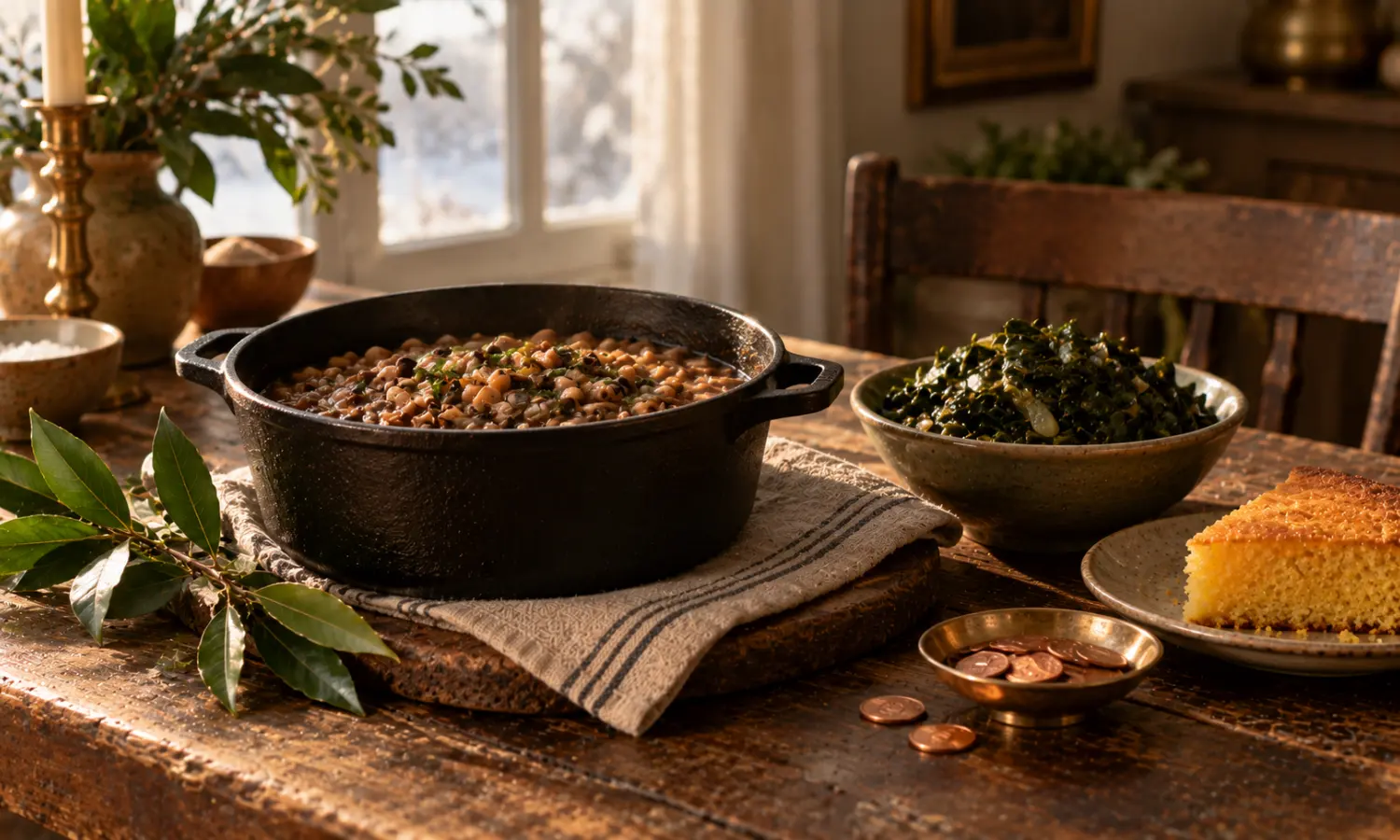
The full black eyed peas New Year plate usually comes with collard or other greens for paper money and cornbread for gold, and often a piece of pork. Many families serve the peas as Hoppin’ John, a dish of peas and rice.
Below we explain where the custom is commonly said to come from, what each part of the meal symbolizes, the variations families swear by, and a few myths worth clearing up.
This is folklore and personal belief, not a predictor of money or events; nothing here guarantees luck or financial results. It is, above all, a food tradition that brings people around a table at the start of a year.
Black-eyed peas New Year meal at a glance
| Food | What it symbolizes | How it is often served |
|---|---|---|
| Black-eyed peas | Coins, luck and growth, since they swell when cooked | Simmered with onion and smoked meat, or as Hoppin’ John with rice |
| Collard, mustard or turnip greens | Folded paper money | Slow-cooked with seasoning, served alongside the peas |
| Cornbread | Gold | Baked in a skillet and served warm |
| Pork | Progress, since pigs are said to root forward | Ham hock or bacon cooked into the peas or greens |
| Rice | Abundance and plenty | The base of Hoppin’ John |
| A coin under the plate or bowl | A wish for money all year | Placed beneath the dish, never cooked into the food |
Key takeaways
- Black-eyed peas on New Year’s Day are a Southern US custom for luck and money.
- The peas stand for coins, the greens for paper money and the cornbread for gold.
- The tradition draws on West African, African American and broader Southern foodways.
- Families have their own rules, such as eating a certain number of peas or leaving a few on the plate.
- It is a joyful food ritual, best paired with a real first-week-of-January money check.
Origins of the tradition
The roots of the custom are layered, and it is honest to say that historians do not agree on a single origin. Black-eyed peas came to the Americas from West Africa, and the knowledge of how to grow and cook them traveled with enslaved Africans. African American cooks shaped the Southern dishes, including Hoppin’ John, that carry the tradition today.
There are other threads too. Some writers point to Sephardic Jewish communities in the American South, whose own new year celebrations included black-eyed peas as a symbol of plenty. A popular story also links the peas to the aftermath of the Civil War, describing them as a humble food that helped families survive. That story is widely repeated but difficult to verify.
What is clear is that by the twentieth century, black-eyed peas on New Year’s Day had become a cherished Southern custom shared across communities. Like many prosperity customs, it uses a simple, affordable food as a hopeful image of abundance, a pattern we explore in our guide to symbols of abundance.
What black-eyed peas mean
The most common explanation is visual: the round peas look like small coins, so eating a bowlful is a wish for money. Many people also note that dried peas swell as they cook, an image of resources growing over the year.
There is also a humbler meaning. Black-eyed peas were for generations an inexpensive, filling staple. Eating them at the start of a year can be read as gratitude for having enough and a hope that there will always be enough.
The rest of the plate
Greens for money
Collard, mustard or turnip greens are the classic side. Their color and folded leaves are said to look like paper bills, so eating greens is a wish for cash in hand. The color green itself is widely linked with money, as our article on colors associated with money explains.
Cornbread for gold
Golden cornbread rounds out the plate as a symbol of gold. In many homes it is baked in a cast-iron skillet and served hot with butter.
Pork for progress
Pork, often a ham hock or bacon cooked into the peas, is commonly explained by the idea that pigs root forward with their snouts, a symbol of moving ahead in the new year. Some families avoid chicken on this day for the opposite reason, since chickens scratch backward.
Variations families swear by
Every household seems to have its own rule. Some say you should eat exactly 365 peas, one for each day of the year. Others say to leave three peas on your plate to keep luck, money and romance open. Some families insist the peas must be the first food eaten on January 1.
A popular custom is placing a coin under each person’s bowl or under the serving pot. A few families once cooked a coin into the pot as a prize for whoever found it, but we recommend keeping coins out of food entirely: it is a choking hazard and coins are not clean. Placing the coin under the dish keeps the symbol and drops the risk.
Vegetarian and vegan cooks often replace the pork with smoked paprika, mushrooms or liquid smoke, which keeps the deep, savory flavor without the meat.
How people keep the tradition today
Today, the black-eyed peas tradition reaches well beyond the South. Restaurants serve Hoppin’ John on January 1, grocery stores stock canned and frozen peas in late December, and families who moved away often keep the custom as a link to home.
The cooking itself is part of the ritual for many households. Dried peas are often soaked overnight on December 31 and simmered slowly the next morning with onion, garlic and a little smoked meat or smoked paprika, so the house smells of the meal by the time guests arrive. Busy cooks use canned or frozen peas and spend the saved time at the table instead, which is just as much in the spirit of the day.
Many people pair it with other small year-start rituals, such as writing goals or tidying the house. Our list of money rituals people practice at home includes ideas that fit naturally around a New Year’s Day meal.
Common misconceptions
One myth is that skipping the peas brings a bad year. In the tradition, the meal is a hopeful wish, not a test. A year without peas is simply a year without peas.
Another misconception is that the custom belongs to only one group. It has deep African American roots and has been shared and adapted by many Southern communities. Honoring those roots, for instance by learning the history of Hoppin’ John, is a meaningful way to take part.
A practical pairing
A meal about coins and greens is a perfect cue for a real money check. On January 1 or 2, while the leftovers are in the fridge, sit down for fifteen minutes and list every subscription and recurring payment you have. Cancel one you no longer use and move that amount into savings.
If you placed a coin under your bowl, keep it in your wallet or start a jar with it as a small, visible reminder of the year’s savings goal.
Common questions
Why do you eat black-eyed peas on New Year’s Day?
In Southern US tradition, black-eyed peas are eaten on New Year’s Day for luck and prosperity. They are said to look like coins and to swell when cooked, a symbol of growing wealth in the year ahead.
What do you eat with black-eyed peas for New Year’s?
The classic plate includes greens for money, cornbread for gold and often pork for progress. Many families serve the peas as Hoppin’ John, mixed with rice.
How many black-eyed peas should you eat for good luck?
Some families say 365, one for each day of the year, while others simply eat a generous spoonful. Any amount fits the spirit of the tradition.
Can you eat black-eyed peas on New Year’s Eve instead?
The custom is usually tied to New Year’s Day, but some families eat them after midnight on New Year’s Eve. Either way, what matters is sharing the meal with intention.
Continue your practice
For a year-long companion to that coin under your bowl, try our money jar spell, which pairs a symbolic jar with a realistic saving habit. You can also explore more pocket-sized symbols in our guide to lucky symbols for money.