Money Spell Guide
Prosperity rituals, luck symbols & intention
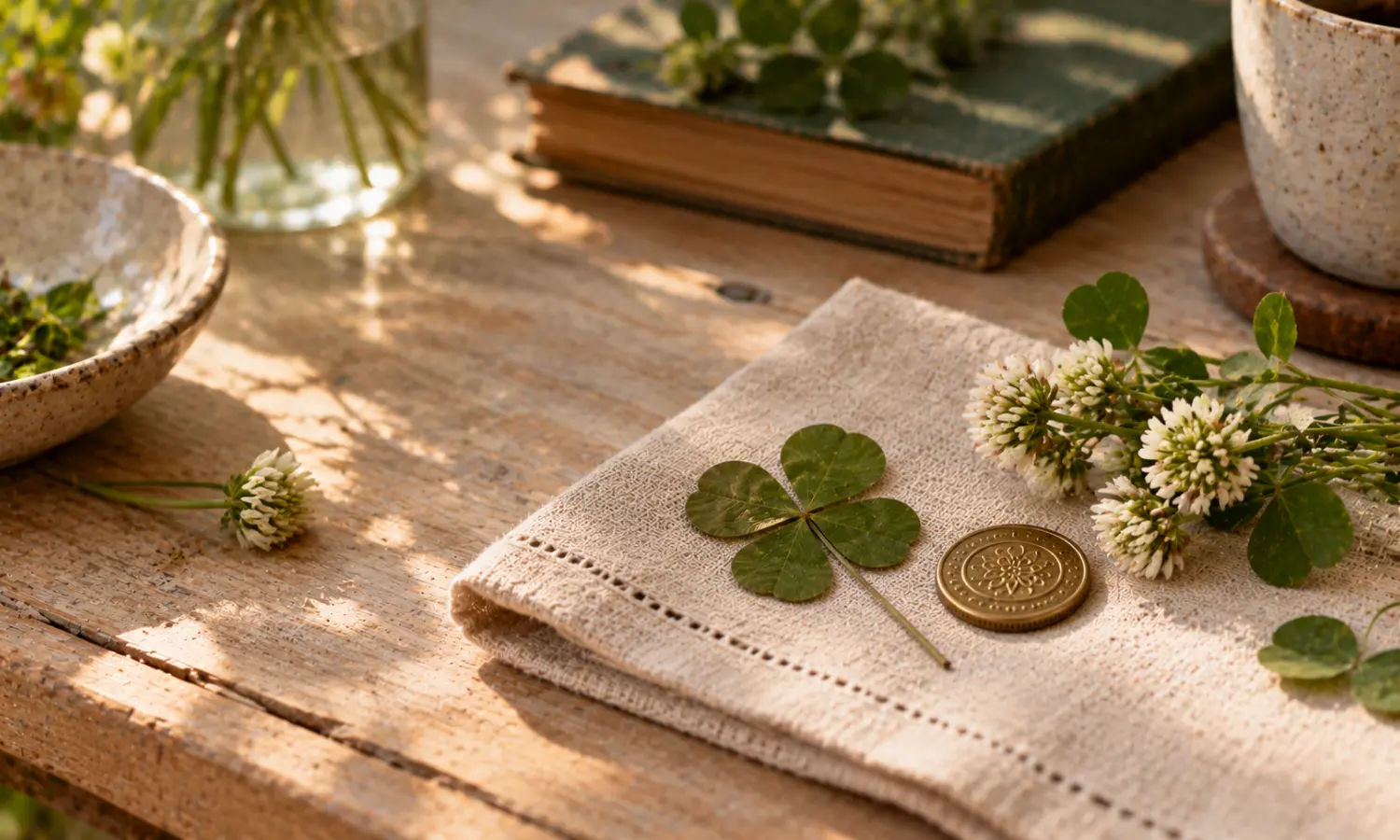

Four-Leaf Clover Meaning: Luck, Odds and the Four Leaves
Why the four-leaf clover became a luck symbol, what each leaf is said to mean, how rare it really is and how people keep one today.
Share your love
The four leaf clover meaning is simple at heart: it is one of the best-known good luck symbols in the Western world, prized because it is rare. In popular tradition, each of its four leaves stands for something, most often faith, hope, love and luck.
Finding one by chance in a lawn feels like a small gift, and that feeling is a big part of its charm. People press them in books, set them in jewelry, tuck them into wallets and give them to friends starting something new.
In this guide we look at where the symbol comes from, what the leaves are said to represent, how it differs from a shamrock, how rare it really is and how people use it today.
This is folklore and personal belief, not a predictor of money or events; nothing here guarantees luck or financial results. We share the tradition because it is meaningful to many people, and because small symbols can be useful reminders of what we hope for.
Four-leaf clover meaning at a glance
| Variant | Common meaning | Tip |
|---|---|---|
| Three-leaf clover (shamrock) | Irish heritage, faith, Saint Patrick’s Day | Not a “lucky find”; it is the ordinary form |
| Four-leaf clover | Luck, with leaves for faith, hope, love and luck | Press it flat between paper inside a heavy book |
| Five-leaf clover | Extra luck, sometimes linked with money | Even rarer; treat it as a keepsake, not a promise |
| Clover charm or jewelry | A wearable reminder of good fortune | Choose one you would wear for its own sake |
| Gifted four-leaf clover | Wishing someone well on a new start | Add a short handwritten note with your wish |
Key takeaways
- The four-leaf clover is a rare variation of the common three-leaf clover, which is why it became a symbol of luck.
- Its four leaves are commonly said to stand for faith, hope, love and luck.
- A shamrock has three leaves and carries a separate, mostly Irish and Christian, meaning.
- The odds of finding one are often quoted as roughly one in ten thousand, but estimates vary.
- Its real value today is as a reminder to notice small good things and act on opportunities.
Origins of the four-leaf clover as a luck symbol
Clover grows almost everywhere in temperate lawns and meadows, and most stems carry three leaflets. Every so often a stem produces a fourth. Because people walk past thousands of ordinary clovers, the unusual one stands out, and things that are rare and found by chance have long been treated as signs of good fortune.
The symbol is strongly associated with Ireland and with Celtic folklore, though the details of its early history are often overstated in popular retellings. Claims that ancient Druids used four-leaf clovers as charms appear in many articles, but the evidence for specific practices is thin, so we treat those stories as legend rather than history.
What is clear is that by the nineteenth and twentieth centuries, the four-leaf clover was firmly established across Britain, Ireland, Europe and North America as a lucky find. It appeared on greeting cards, postcards and charms, and it remains one of the most recognizable entries in any list of good luck symbols from around the world.
What the four leaves represent
The best-known version of the tradition gives each leaf a meaning:
- Faith: trust in something larger than yourself, or in your own path.
- Hope: looking forward with openness rather than fear.
- Love: care for others and for yourself.
- Luck: the fourth leaf, the rare one, which makes the clover special.
This reading is lovely because it suggests that luck sits alongside, not above, the other three. A three-leaf clover already holds faith, hope and love. The fourth leaf is the extra, the unexpected bit of fortune that arrives on top of an ordinary, well-lived life.
Four-leaf clover vs. shamrock
The two are often confused. A shamrock is a young three-leaf clover, and in Irish tradition it is linked with Saint Patrick. A well-known legend says he used its three leaves to explain the Christian Trinity, and the shamrock is now a national emblem of Ireland worn on Saint Patrick’s Day.
The four-leaf clover, by contrast, is not a religious emblem. It is a folk luck symbol. Both are cherished, but if you want to be precise, the shamrock speaks to heritage and faith, while the four-leaf clover speaks to fortune.
How rare is a four-leaf clover?
The odds of finding a four-leaf clover are often quoted as about one in ten thousand clovers. That figure is widely repeated, but it is an estimate rather than a fixed number, and the true rate can vary with the plant population, the growing conditions and the lawn you happen to be searching.
Some patches seem to produce several, which may happen because clover spreads by runners, so neighboring stems can be closely related. If you find one, it is worth looking nearby. Five-leaf and even more unusual forms exist too, but they are much rarer.
Be aware that some “lucky clover” plants sold in garden shops around the New Year and Saint Patrick’s Day are actually a different plant, a type of wood sorrel that naturally grows four leaflets. They are pretty and perfectly fine as a decoration, but they are not the rare find of the folk tradition.
Variations by culture, color and form
In much of Europe and North America, the four-leaf clover is given as a good wish for exams, weddings, new jobs and travel. Some people keep one in a passport or a wallet. Others favor green clover jewelry, since green is also widely tied to growth and money; our article on what colors attract money explains why green carries that association in many cultures.
The five-leaf clover is sometimes linked with money or extra blessings, but meanings for five-, six- and seven-leaf versions differ from source to source. There is no single authority, so treat these as playful additions rather than fixed rules.
How people use the four-leaf clover today
The most common modern uses are simple and personal:
- Pressing a found clover in a book, then framing it or laminating it as a bookmark.
- Wearing a clover pendant, ring or charm as a reminder of a hopeful intention.
- Giving a clover to someone at the start of a new chapter.
- Keeping a small clover charm in a wallet alongside other lucky symbols for money.
Some people also include a clover in a wider collection of charms, for example in a small dish by the front door. A few people pair it with a coin or a small green stone, choosing objects that each carry a personal meaning rather than collecting charms for their own sake.
Common misconceptions
“Every four-leaf clover is a shamrock.” Not quite. The shamrock is three-leaved, and its meaning is rooted in Irish heritage and faith rather than luck.
“Carrying one guarantees good fortune.” No symbol can do that. The clover is a reminder and a source of joy, not a mechanism. What it can do is put you in a hopeful, observant frame of mind.
“Store-bought four-leaf plants are the real thing.” Many are a different plant that grows four leaves naturally. They make a nice gift, but they are not the rare variation.
A practical pairing
The four-leaf clover is about noticing something most people walk past. Pair it with one practical action that does the same thing for your finances: spend fifteen minutes reviewing your last month of bank and card statements and look for one overlooked thing, such as an unused subscription, a fee you can ask to have waived or a small refund you never claimed.
Cancel or claim that one item, and move the amount you save into a savings account. Keep your pressed clover or clover charm near where you do this review. Over time it becomes a small symbol of paying attention, which is a habit that genuinely helps.
Common questions
Is a four-leaf clover good luck?
In folk tradition, yes. It is one of the most widely recognized good luck symbols in the Western world. As with any symbol, its value is personal and emotional rather than predictive; it does not cause events, but many people find it a joyful reminder of hope.
What does a four-leaf clover mean spiritually?
Spiritually, it is often linked with faith, hope, love and luck together. Some people see it as a sign to stay open to unexpected blessings, while others treat it as a reminder of gratitude for what they already have.
What should you do when you find a four-leaf clover?
Many people make a quiet wish, then press the clover flat between sheets of paper inside a heavy book for a week or two. Once dry, it can be kept in a frame, a locket, a notebook or a phone case.
Is it bad luck to give away a four-leaf clover?
There is no widespread belief that it is unlucky. In fact, giving one is a common gesture of goodwill. Some people say that sharing your luck multiplies it, which is a kind thought even if it is not a rule.
Continue your practice
To explore related signs, read our overview of symbols of prosperity across cultures or our guide to the most powerful good luck charms for money according to tradition. If you want to pair your clover with a simple intention, our guide to a spell for money and luck shows how people combine fortune and prosperity themes in a gentle, reflective way.