Money Spell Guide
Prosperity rituals, luck symbols & intention
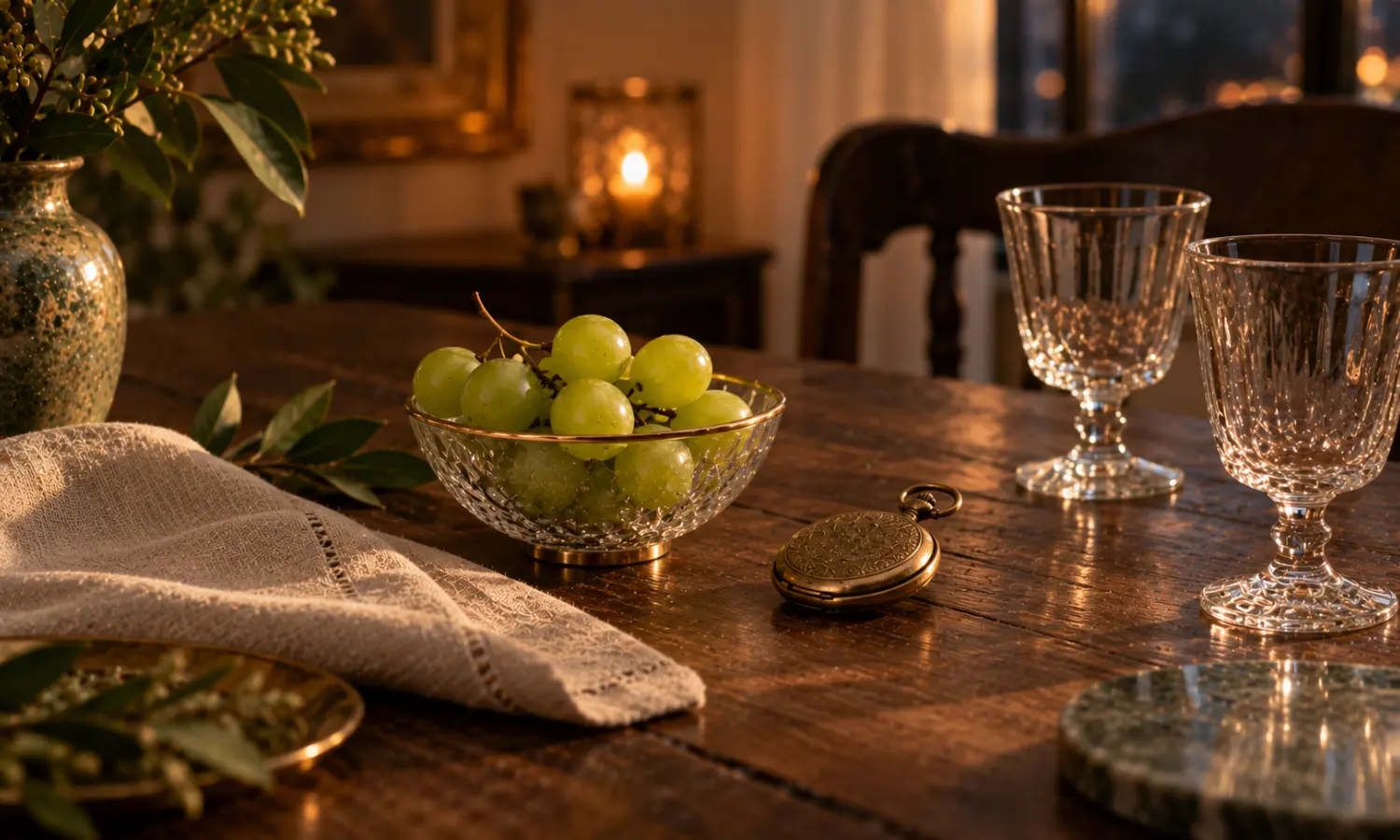

The 12 Grapes New Year Tradition: How to Do It
How the Spanish tradition of eating twelve grapes at midnight works, what it means, and how to do it at home without a scramble.
Share your love
The 12 grapes New Year tradition comes from Spain: at midnight on December 31, you eat one grape for each of the twelve chimes of the clock. Each grape stands for one month of the coming year, and finishing all twelve before the last chime is said to bring a lucky, prosperous year.
In Spain the custom is known as las doce uvas de la suerte, the twelve grapes of luck. It is also widely practiced across Latin America and in Spanish-speaking communities around the world.
Below we explain where the custom is commonly said to come from, what the grapes symbolize, how to do it smoothly at home, and the variations you may see at other tables.
This is folklore and personal belief, not a predictor of money or events; nothing here guarantees luck or financial results. Its real gift is a funny, shared moment that marks the start of a new year.
12 grapes New Year tradition at a glance
| Element | What it means | Tip |
|---|---|---|
| Twelve grapes | One wish or one month of good luck for each grape | Count them out in advance into a small bowl or cup |
| The twelve chimes | The countdown that sets the pace, one grape per chime | Practice the rhythm once before midnight |
| Seedless or peeled grapes | Make the challenge easier and safer | Choose small, seedless grapes, or buy peeled ones |
| Each month | Some say a sweet grape means a good month, a sour one a harder month | Treat this as a playful game, not a forecast |
| Sharing | Done together with family or friends | Raise a glass right after the twelfth grape |
Key takeaways
- The twelve grapes tradition is a Spanish New Year custom that has spread across the Spanish-speaking world.
- You eat one grape at each of the twelve chimes of midnight, one for every month of the year.
- Small, seedless grapes and a practice run make the challenge much easier.
- The custom is a hopeful, playful ritual, not a promise of luck.
- Children and anyone who struggles to swallow should have grapes cut up or skip the speed challenge.
Origins of the twelve grapes
The custom is closely associated with Madrid, where crowds gather in the Puerta del Sol square to eat their grapes as the clock on the old government building strikes midnight. The broadcast of those chimes on television is followed by households throughout Spain.
Accounts of how it began vary. One commonly told story describes families in Madrid in the late nineteenth century adopting grapes at midnight as a playful, more affordable version of upper-class New Year celebrations. Another popular account links the custom to grape growers in the early twentieth century who had a large harvest and promoted grapes as a New Year treat.
Historians generally accept that the tradition became widespread in the early twentieth century, and both stories may have played a part. Today it is one of the most recognized New Year customs in the world, alongside others in our guide to good luck symbols from around the world.
What the grapes mean
Each grape represents one month of the coming year. Eating all twelve in time is said to secure good luck for every month. Some people make a silent wish with each grape, often a mix of hopes for health, love, work and money.
A playful extra rule in some homes says that a sweet grape predicts a happy month, and a sour one a more challenging month. Most families laugh about this rather than take it seriously.
The grapes also carry a broader symbolism. Grapes are an old image of harvest and abundance, and eating them together at the turn of the year is a shared wish that there will be enough for everyone.
How to do the 12 grapes at home
Before midnight
Choose small, seedless grapes. Wash and dry them, then count twelve per person into a small bowl, cup or glass. In Spain, some people buy ready-prepared cans of peeled, seedless grapes made for the occasion.
Find a countdown you can hear clearly. Many people use a live broadcast of the Madrid chimes, while others use a countdown app or simply have one person tap a glass twelve times, roughly three seconds apart.
At midnight
When the chimes start, eat one grape per chime. Do not worry about chewing perfectly; the goal is to keep pace. When the twelfth chime sounds, you have finished your grapes and the new year has begun. Toast, hug and laugh at whoever has cheeks full of fruit.
Safety note
Eating quickly is part of the fun, but grapes are a known choking hazard. Cut grapes into quarters for young children, or let them eat at their own pace. Anyone who has trouble swallowing should skip the speed challenge, and everyone should stay seated while eating.
Variations around the world
In many Latin American countries, the grapes are eaten alongside other customs, such as wearing yellow underwear for luck or red for love, walking around the block with an empty suitcase for travel, or sweeping the house to clear out the old year. Our guide to colors associated with money explores the color symbolism behind some of these choices.
In Spain, red underwear on New Year’s Eve is also a popular custom for good luck, and some people drop a gold ring or a small piece of gold into their glass of cava for the toast.
In recent years, a newer custom of eating the grapes while sitting under the table, as a wish to find love, has spread on social media. Like the others, it is a lighthearted add-on rather than an old rule.
How people use the tradition today
For many families, the twelve grapes are as much about togetherness as luck. Grandparents teach grandchildren how to keep pace, friends film each other trying to finish, and people living abroad keep the custom as a link to home.
Some people also use the twelve grapes as a simple intention-setting exercise: they write down twelve hopes for the year before midnight, one for each grape. If you like that idea, our list of money affirmations for confidence and calm can help you phrase a few of them.
Common misconceptions
A common worry is that not finishing all twelve grapes means bad luck. In reality, most people laugh off a missed grape. The tradition is a hopeful game, not a test you can fail.
Another misconception is that the grapes must be green. Any grape works; green ones are simply the most common in Spain at that time of year.
A practical pairing
Twelve grapes for twelve months is a natural cue for a twelve-month money plan. In the first week of January, open a simple spreadsheet or notebook with twelve rows and write one small financial goal for each month: paying off one bill, building a starter emergency fund, asking for a raise, or saving for a trip.
Then set up the first one right away, such as an automatic monthly transfer into savings. When you look back next December, those twelve small steps will tell a clearer story about your year than any sweet or sour grape.
Common questions
What do the 12 grapes mean on New Year’s Eve?
Each grape stands for one month of the coming year. Eating all twelve on the chimes of midnight is a Spanish tradition said to bring good luck and prosperity for every month.
Do you eat the 12 grapes before or after midnight?
You eat them during the twelve chimes at midnight, starting on the first chime and finishing on the last. The new year begins as you swallow the twelfth grape.
Why do people eat 12 grapes under the table?
This is a newer custom that spread online, especially among people hoping to find love in the new year. It is a fun variation rather than part of the original Spanish tradition.
What countries do the 12 grapes tradition?
It is most closely associated with Spain, and it is also widely practiced in Mexico, much of Central and South America, and Spanish-speaking communities around the world, often blended with local New Year customs.
Continue your practice
For more small year-start customs, read our list of money rituals people practice at home. You can also explore the wider world of wealth imagery in our guide to symbols of prosperity across cultures.