Money Spell Guide
Prosperity rituals, luck symbols & intention

Money Plant Meaning: Pothos, Feng Shui and Where to Put It
Which plant is the "money plant," what it symbolizes in feng shui and Vastu, where people place it and how to keep it thriving.
Share your love
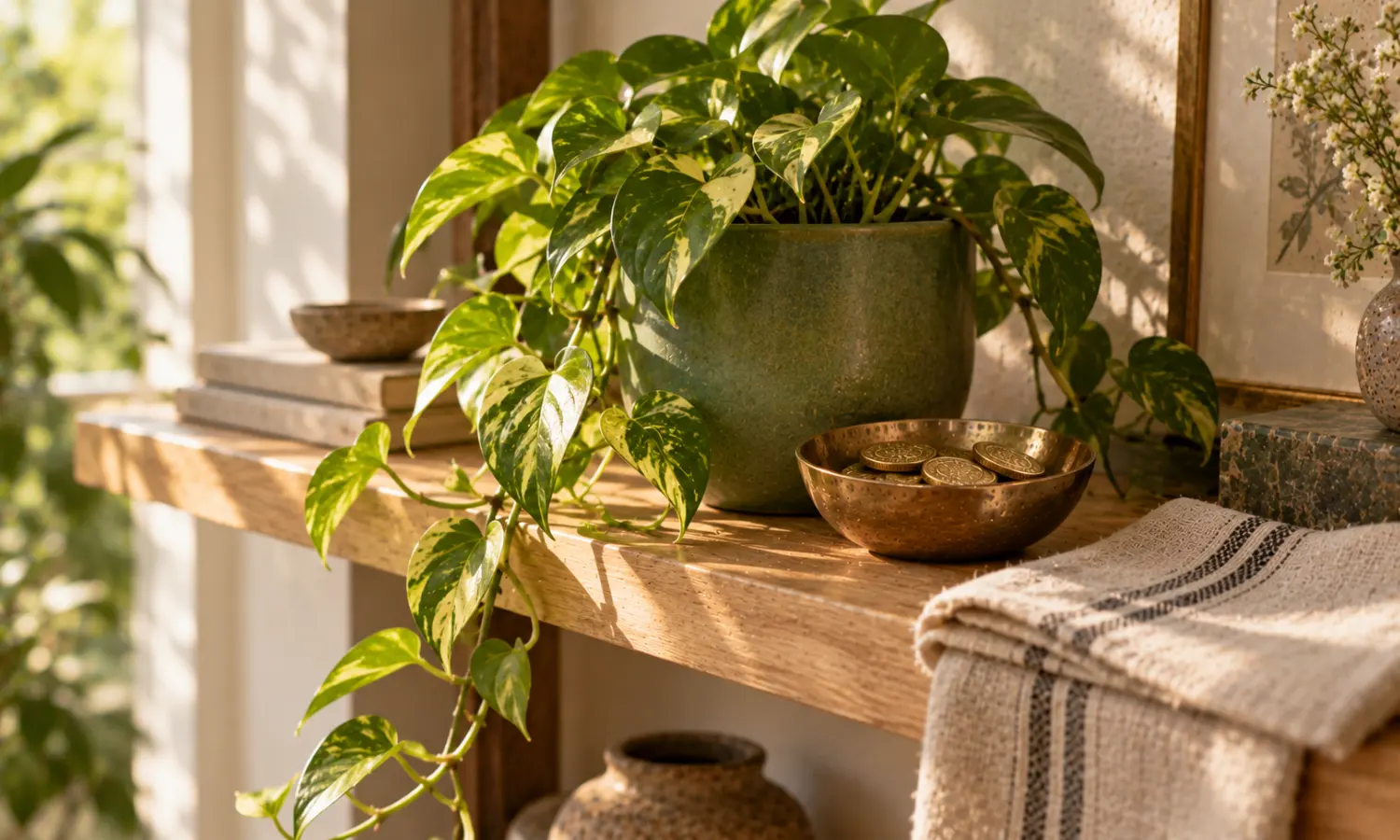
The money plant is a houseplant commonly associated with prosperity, growth and good fortune, and in most homes the name refers to golden pothos, a trailing vine with heart-shaped leaves. In feng shui and in Vastu, the Indian tradition of home design, it is often placed in the southeast corner of a room or home, the area linked to wealth.
The name can be confusing, because several different plants are sold as a “money plant” depending on where you live. Below we sort out which is which, explain what the plant is said to symbolize, cover the placement advice people follow, and share the simple care that keeps it lush.
This is folklore and personal belief, not a predictor of money or events; nothing here guarantees luck or financial results. We think of the money plant as a living reminder of patient growth, and a very forgiving plant for beginners.
Money plants at a glance
| Plant | Also called | Commonly associated with | Tip |
|---|---|---|---|
| Golden pothos | Money plant (especially in India), devil’s ivy | Growth, abundance, a lively home | Let it climb a support or trail from a high shelf |
| Jade plant | Money plant, friendship tree | Wealth and steady success | Give it bright light and water sparingly |
| Pachira aquatica | Money tree | Prosperity and good fortune in feng shui | Often sold with a braided trunk |
| Pilea peperomioides | Chinese money plant, pancake plant | Coins, sharing and friendship | Easy to share through small offshoots |
| Lunaria annua | Honesty, silver dollar plant | Silver coins and honesty | Grown outdoors for its papery seed pods |
Key takeaways
- “Money plant” is a nickname used for several plants, most often golden pothos.
- Its round, coin-like or heart-shaped leaves and easy growth are why it is linked to prosperity.
- The southeast is the placement most often recommended in both feng shui and Vastu.
- A healthy, upward-growing plant is considered more auspicious than a neglected one.
- Pothos is toxic to cats and dogs if chewed, so place it out of reach.
Which plant is the money plant?
In India and much of South Asia, “money plant” almost always means golden pothos (Epipremnum aureum), a hardy climbing vine that grows in soil or in a jar of water. In parts of the US, Europe and Africa, the same nickname is given to the jade plant, a succulent with thick, coin-shaped leaves. Chinese money plant (Pilea) and the braided money tree (Pachira) add to the mix.
All of them share the same simple appeal. They are easy to grow, they look green and generous, and their leaves suggest coins or abundance. If you are interested in the braided version specifically, our guide to the feng shui money tree covers it in detail. In this article, we focus mainly on pothos, with notes on the others.
What the money plant means
The money plant’s meaning comes from how it grows. Pothos is famously hard to kill, keeps putting out new leaves and climbs toward the light. That makes it a natural symbol for resilience, steady progress and an income that grows over time.
In feng shui, a healthy green plant represents the wood element, which is commonly associated with growth, vitality and new beginnings. Its rounded leaves are sometimes said to soften the energy of a room. In Vastu traditions, the money plant is popular as a symbol of prosperity and harmony in the home, and it is often recommended for families wanting a sense of stability.
Many people also simply find the plant calming. A green vine on a shelf brings life into a room, and caring for it becomes a small daily ritual.
Where to put a money plant
Placement advice varies between traditions, but a few points come up again and again.
- Southeast: in both feng shui and Vastu, the southeast is commonly associated with wealth. You can find this area in your own space with our guide to the feng shui money corner.
- Living room: a visible spot in the main living area is a common choice, especially near a window with indirect light.
- Home office: on a desk or shelf, the plant is often used as a cue for focus and growth in work.
- Climbing upward: many people prefer to let the vine climb a moss pole or trellis, since upward growth is read as rising prosperity.
There are also some common cautions. In Vastu, people often avoid placing the money plant in the northeast. Many households prefer that the vines not trail onto the floor, which is seen as letting growth sink. And in both traditions, a dying or dusty plant is best revived or replaced.
How people use the money plant today
In many homes in India, keeping a money plant in a glass bottle of water on a windowsill is a familiar sight, and gifting cuttings to friends is common. Some families keep the plant near the entrance to welcome good fortune, while others prefer the kitchen or living room.
There is also a well-known folk saying that a money plant brings more luck if the cutting is taken secretly from a neighbor’s plant. We would gently suggest a better version: ask your neighbor for a cutting. A plant shared with permission carries goodwill, and there is nothing lucky about awkwardness over the fence. For other plants with similar symbolism, see our list of plants to attract money.
How to care for a money plant
Pothos is one of the easiest houseplants there is, which is part of why it has such a cheerful reputation.
- Give it bright, indirect light. It tolerates lower light but grows more slowly and may lose its golden streaks.
- In soil, water when the top inch feels dry. Overwatering causes yellow leaves more often than underwatering.
- In water, change the water every week or two and keep the leaves above the waterline.
- Wipe the leaves now and then so dust does not block light.
- Trim long vines to encourage fuller growth, and root the cuttings in water to share.
- Keep it on a high shelf or hanging planter if you have cats or dogs, since pothos is toxic to pets if chewed.
Common misconceptions
“A money plant will make you rich.” No plant can do that, and no honest tradition claims it will. The plant is a symbol of growth that sits alongside real decisions.
“It must be stolen to work.” As above, this is a folk saying, not a requirement. A gifted or bought plant is just as meaningful.
“Yellow leaves mean money trouble.” Yellow leaves usually mean too much water, too little light or old soil. Adjust the care and the plant will usually recover.
A practical pairing
A money plant grows a little at a time, which is exactly how most real savings grow. Pair the plant with a small, automatic habit: set up a weekly transfer of a modest amount into a savings account, and check on it whenever you water the plant.
When you trim a vine and root the cutting, use that moment as a quarterly check-in. Has your savings balance grown alongside the plant? If not, adjust the transfer. It is a gentle, visual way to keep your intention and your actions in step.
Common questions
Where should I keep a money plant at home?
The southeast area of the home or living room is the placement most often recommended in feng shui and Vastu. Choose a spot with bright, indirect light where you will see the plant every day.
Is the money plant good luck?
In many traditions it is considered a lucky plant, commonly associated with prosperity and harmony. Like all symbols, its value is in what it reminds you to do.
Can I keep a money plant in the bedroom?
Many people do, and pothos is a pleasant plant to have nearby. Some feng shui practitioners prefer to keep lively, growing plants in active rooms, so if you follow that view, the living room or office is a better fit.
What is the difference between a money plant and a money tree?
A money plant is usually golden pothos, a trailing vine. A money tree is Pachira aquatica, a small tree often sold with a braided trunk. Both are linked to prosperity in folk tradition.
Continue your practice
To compare the money plant with other options, browse our list of feng shui plants for money. Our room-by-room guide on where to place a money tree is a helpful companion, and symbols of abundance explores the wider tradition of growing things as signs of plenty.