Money Spell Guide
Prosperity rituals, luck symbols & intention

Candle Color Meanings: A Calm Guide for Rituals and Intention
What each candle color is commonly associated with in folk practice, how to choose one for an intention, and how to burn it safely.
Share your love
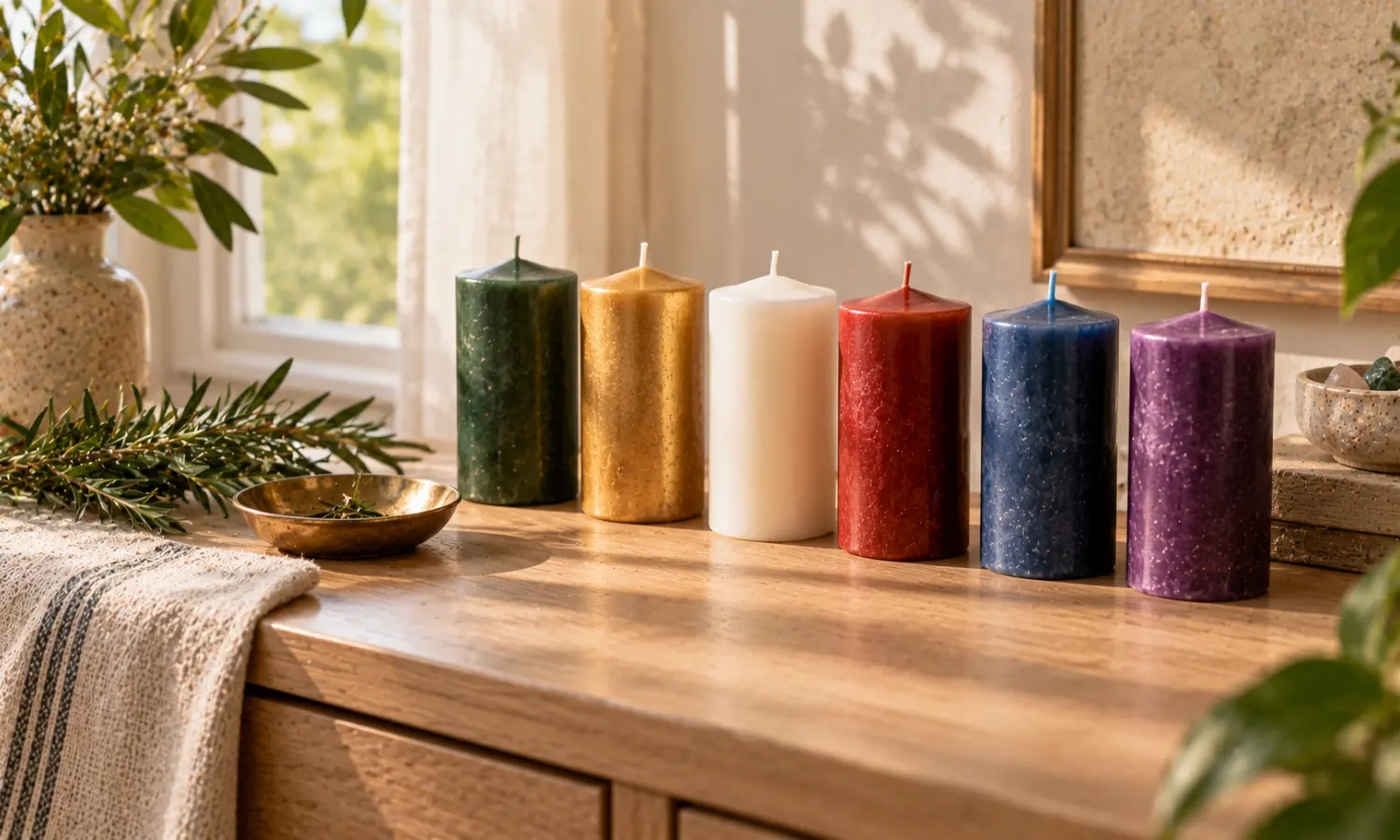
Candle color meanings are a shorthand that many folk traditions use to match a candle to an intention: green for money and growth, gold for success, white for clarity and new starts, red for courage and passion, blue for calm, purple for wisdom. Choosing a color is less about a rule and more about giving your attention a clear focus when you sit down to reflect.
In this guide we walk through the most common candle colors one by one, where these associations come from, how they differ between traditions, and how people use them at home today. We also cover the safety basics, because a candle is still an open flame no matter what color it is.
If you only need the short version, the table below gives you the essentials. The sections that follow add the context that makes the choice feel personal rather than mechanical.
This is a symbolic, reflective practice rooted in tradition; it is not a proven method for producing money, love or any other result. Candle colors carry meaning because people have given them meaning, and that meaning is a tool for focus, not a guarantee.
Candle color meanings at a glance
| Color | Commonly associated with | Good moment to use it | Grounded tip |
|---|---|---|---|
| Green | Money, growth, fertility, steady progress | Starting a savings goal or a new job search | Pair it with one real budget review |
| Gold or yellow | Success, confidence, recognition | Before a pitch, interview or launch | Write down one result you want to be known for |
| White | Clarity, cleansing, fresh starts | New month, new moon, after a hard week | Use it when you are unsure which color fits |
| Red | Courage, passion, energy, love | When you need to act on something you have delayed | Name the single action you keep postponing |
| Blue | Calm, honesty, healing, communication | Difficult conversations, stressful money weeks | Light it while you draft a careful email |
| Purple | Wisdom, intuition, ambition | Planning, studying, long-term decisions | Journal one question you want answered over time |
| Black | Release, boundaries, letting go | Closing a chapter or a habit | Pair it with cancelling one unused subscription |
Key takeaways
- Green is the classic money candle in most Western folk practice, but gold and white are common alternatives.
- Color associations vary by tradition, so there is no single correct chart.
- A plain white candle is widely treated as a universal substitute for any color.
- Never leave a burning candle unattended, and keep it on a heat-safe surface away from curtains and paper.
- The color sets the mood; the practical step you take afterwards is what moves real-life plans forward.
Where candle color meanings come from
Candle color correspondences draw on several streams at once. European folk magic, American hoodoo and rootwork, Catholic devotional practice, and modern Wicca and New Age writing each developed their own color habits, and over the twentieth century these lists blended together in popular books and shops.
Many associations follow everyday symbolism. Green links to money because of growing plants and, in the United States, paper currency. Red echoes blood, heat and the heart. White has long stood for purity and light in many cultures. Because these links are intuitive, they travel easily between traditions, even when the deeper practices behind them are quite different.
Color meanings are a shared language rather than a law of nature, so two respected practitioners may answer differently and both be acting in good faith.
The main candle colors and what they mean
Below is a closer look at each color, including how it is often described and when people tend to reach for it.
Green
Green is the color most often associated with money, prosperity, growth and fertility. It is the default choice for prosperity work in many American folk traditions, and we cover a full example in our green candle money spell guide. People light green when they want steady, patient growth rather than a sudden windfall.
Gold and yellow
Gold is commonly associated with success, achievement and visibility, while yellow is often linked to optimism, clear thinking and communication. Some people use gold alongside green when the intention is both financial and professional, such as landing a promotion or attracting better clients.
White
White is the all-purpose candle. It is often described as representing clarity, peace, protection and new beginnings. Many traditions say a white candle can stand in for any other color, which makes it a sensible choice if you are just starting out or simply do not have the color you want.
Red
Red is commonly associated with passion, love, courage and vitality. In a money context, some people use red when the obstacle is not opportunity but motivation: the invoice you have not sent, the call you keep avoiding. Red is about energy and action.
Pink
Pink is usually linked to affection, self-love, friendship and emotional healing. It is a softer alternative to red, often chosen for intentions about kindness toward yourself, including the way you speak to yourself about money.
Blue
Light blue is often associated with calm, healing and peace, while darker blue can represent truth, loyalty and wisdom. Blue is a helpful choice for anxious money weeks, when the most useful thing you can do is slow down and think clearly.
Purple
Purple is commonly linked to wisdom, intuition, spiritual growth and, in some systems, ambition and authority. People reach for it before planning sessions, study or major decisions that need long-range thinking.
Orange
Orange is often described as a color of creativity, enthusiasm and attraction. Some practitioners use it for new ventures, side projects and anything that needs a burst of momentum.
Brown
Brown is associated with the earth, stability, home and practical matters. It suits intentions about property, steady employment or simply building a calmer, more grounded relationship with everyday spending.
Black
Black is frequently misunderstood. In many traditions it represents absorption, release, boundaries and endings rather than anything sinister. People use it to mark letting go of a habit, a debt pattern or a chapter of life.
How traditions differ on candle colors
Hoodoo and rootwork, a tradition shaped by African American communities in the US South, has its own long-standing color customs and often pairs candles with prayer and psalms.
Modern Wiccan practice tends to tie colors to elements, deities and lunar timing. Catholic devotional candles focus less on color symbolism and more on the saint or prayer they accompany, though white, red and blue are common. Feng shui, which is a separate system altogether, works with color through the five elements and placement in the home rather than through burning candles; our guide to feng shui colors for money explains that approach.
The takeaway is simple: if you follow a particular tradition, its color chart takes priority over any general list, including this one.
How people use candle colors today
Most people today use candle colors in small, quiet ways. A green candle on the desk during monthly bill paying. A white candle lit at the start of a new moon. A blue candle beside the journal during a stressful week. The ritual is often five or ten minutes long.
A simple pattern many follow is: choose a color, clear a small space, write one sentence of intention, light the candle, sit with the intention for a few minutes, and then extinguish the flame with a snuffer. If you would like a full walk-through, see our candle spell for money with setup and safety notes.
Fire safety basics
Whatever the color, treat every candle as an open flame. Place it in a sturdy, heat-safe holder on a stable surface, away from curtains, paper, dried herbs and pets. Keep a snuffer or a lid nearby, never leave it unattended, and extinguish it before you sleep or leave the room. Do not burn candles near anything you have written on unless the paper is fully clear of the flame.
Common misconceptions about candle colors
The wrong color ruins the ritual. Most traditions treat color as helpful rather than essential, and white is widely accepted as a stand-in for any color.
Black candles are for harm. In most folk practice, black is about release, absorption and protection. It is a tool for endings, not for hurting anyone.
A candle can make money appear. Candle work is reflective and symbolic. It can help you focus and feel steadier, but it does not replace income, savings, negotiation or financial advice.
More candles mean more results. A single candle lit with attention is usually more meaningful than a crowded table you cannot safely watch.
A practical pairing
Here is the signature habit we encourage: pair your candle color with one concrete action that matches its meaning. With green, spend fifteen minutes on a budget check and move a small amount into savings. With gold, update one line of your resume or send one pitch email. With red, make the call you have been avoiding. With blue, draft a calm message to a creditor or landlord.
Light the candle, do the task while it burns, and snuff it out when you finish. The color gives the moment its tone; the action gives it real-world weight.
Common questions
What color candle is best for money?
Green is the most common choice for money and steady growth, with gold often used for success and recognition. White works as a universal substitute if you do not have either.
What do candle colors mean spiritually?
Spiritually, candle colors are a symbolic language. Each color is commonly associated with a theme, such as green for growth or blue for calm, and people use that theme to focus prayer, meditation or intention.
Can I use a white candle instead of a colored one?
Yes. Many traditions describe white as an all-purpose candle that can represent any intention. What matters most is your focus and safe use.
Is it bad luck to blow out a candle?
Some traditions prefer snuffing a candle over blowing it out, describing it as more respectful. This is a custom rather than a rule, and a snuffer is also simply a tidier, safer way to extinguish a flame.
Continue your practice
If you are drawn to color as a focus tool, read our guide on what colors attract money for the wider symbolism of green, gold and red. For a gentle first ritual that uses a single candle, try a simple money ritual for beginners, and to time your practice with the lunar cycle, see our new moon ritual.