
Money Spell Guide
Prosperity rituals, luck symbols & intention

Bagua Map: How to Use the Feng Shui Energy Map at Home
A step-by-step guide to laying the feng shui bagua map over your home, what each of the nine areas represents, and how to start gently.
Share your love
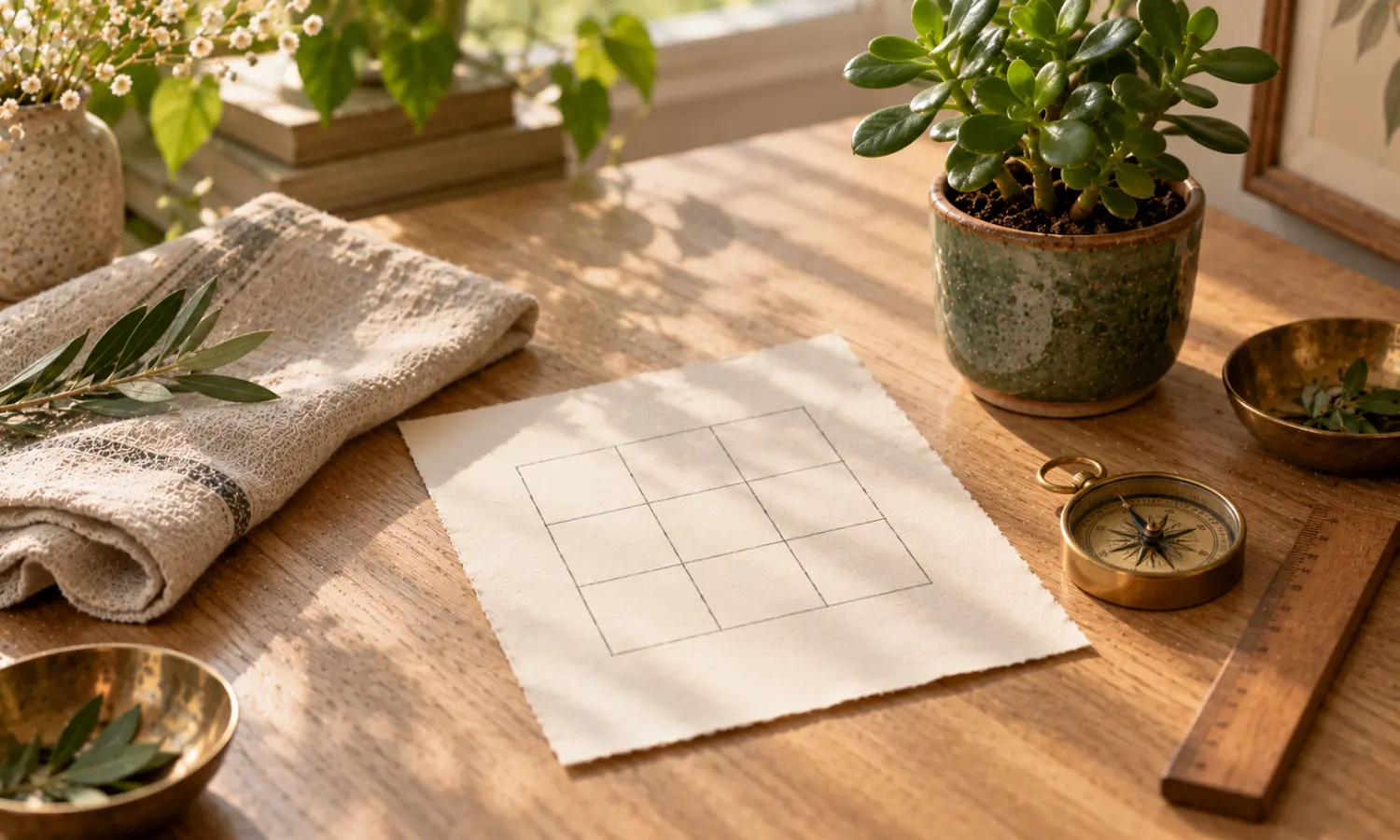
A bagua map is a feng shui tool that divides a home or room into nine areas, each linked to a part of life such as wealth, career, relationships and health. To use it, you lay a three-by-three grid over your floor plan, line up the bottom row with the wall that holds your front door, and then make small, thoughtful changes in the areas you want to focus on.
That is the quick version. Below we explain what the bagua map is and where it comes from, when people tend to use it, what you need to get started, a step-by-step method, an original intention you can say once you are done, and how to keep the space feeling fresh over time.
This practice is a symbolic, reflective exercise rooted in tradition; it is not a proven method for producing money. Feng shui is a rich Chinese tradition with several schools, and we describe its common uses here with respect, as a way to bring attention and care into your home.
Bagua map areas at a glance
| Area | Position from the front door | Element and colors | Simple enhancement |
|---|---|---|---|
| Wealth and prosperity | Back left | Wood; purple, green, gold | A healthy plant or a tidy money bowl |
| Fame and reputation | Back center | Fire; red, orange | Good lighting or something you are proud of |
| Love and relationships | Back right | Earth; pink, red, white | Pairs of objects, a calm and uncluttered corner |
| Health and center | Middle | Earth; yellow, earth tones | Keep it clear and open |
| Career and life path | Front center | Water; black, deep blue | A clean entrance and a welcoming door |
| Knowledge and self-cultivation | Front left | Earth; blue, green, black | Books, a reading chair or a study nook |
| Helpful people and travel | Front right | Metal; gray, white, silver | Photos of mentors or places you want to visit |
Key takeaways
- The bagua map is a nine-area grid that links parts of your home with parts of your life.
- In the widely used Western method, the bottom row of the grid aligns with the wall containing your front door.
- Wealth sits in the back left corner in this method, which is why it is often called the money corner.
- Small changes such as decluttering, lighting and a healthy plant are the usual starting points.
- The map works best as a way to bring attention to your home and goals, alongside real-world action.
What the bagua map is
The word bagua refers to the eight trigrams of classical Chinese thought, arranged in an octagon around a center. In feng shui, this octagon is often simplified into a square grid of nine sections: eight surrounding areas plus the center. Each area is linked to a life theme, one of the five elements and a set of colors.
There are two main ways to use it. Classical, or compass, feng shui orients the bagua using compass directions, so the wealth area is usually placed in the southeast of the home. The Western method, often associated with the Black Sect school, aligns the map with the front door instead. Both approaches are used respectfully by practitioners; the door method is simpler for beginners, so it is the one we walk through below.
When people use the bagua map
People often turn to the bagua map at moments of change: moving into a new home, starting a job, beginning a relationship, or at the start of a new year. It is also popular after a stressful period, when a home simply feels heavy and a reset seems welcome.
Some people use it for a single goal. If money is the focus, they look first at the wealth area, sometimes adding a healthy plant or a feng shui money bowl. If work feels stuck, they start with the career area near the front door. Others use the full map as a seasonal check-in, walking through all nine areas once or twice a year.
What you need
You do not need special equipment. A simple setup includes:
- A rough floor plan of your home or the room you want to map, drawn on paper.
- A ruler or straight edge to divide the plan into a three-by-three grid.
- A pencil and a notebook to record what you notice in each area.
- A bag or box for clutter you decide to remove, donate or recycle.
- Optional: a compass, if you would like to compare the door method with the classical compass method.
How to use a bagua map step by step
- Draw your floor plan. Sketch the outline of your home or a single room. If your home has an irregular shape, draw the main rectangle and note any missing or extended corners.
- Divide it into nine equal sections. Draw two lines across and two lines down so you have a grid of nine squares.
- Align the grid with your front door. Stand at the front door looking in. The wall with the door forms the bottom row: knowledge on the left, career in the middle, helpful people on the right.
- Label every area. Fill in the middle row (family on the left, health in the center, creativity and children on the right) and the back row (wealth on the left, fame in the middle, love on the right).
- Walk through each area. Visit each section in person and write down what is there: clutter, broken items, dim lighting, objects you love.
- Clear before you add. Remove clutter and repair or remove broken things first. Most feng shui teachers treat clearing as the most important step.
- Choose one or two areas to enhance. Add something meaningful that fits the area’s element or colors, such as a healthy plant in the wealth corner or better lighting in the fame area.
- Close with an intention. Stand in the center of the space and say a short intention, like the one below.
An intention for your space
Here is a short intention we wrote for this practice. Say it aloud or silently once your changes are done, and adapt the words so they sound like you:
“I give this home my care and attention. May each corner hold what helps me grow: steady work, honest love, good health and wise choices with what I earn. I clear what I no longer need and make room for what matters.”
Aftercare: keeping your bagua map alive
Feng shui is less about a single makeover and more about ongoing care. Water plants, dust surfaces, replace burned-out bulbs and keep pathways clear. Revisit your notes every season and update the map if you rearrange furniture or move.
If you have chosen the wealth area as your focus, keep it especially tidy and well cared for. Our guide to the feng shui money corner goes into detail on that one area, including what people commonly place there.
Pay attention to how the space feels as well as how it looks. If a change makes a room feel cramped or anxious, it is fine to undo it. The goal is a home that supports you.
A practical pairing
Our signature habit is to match each symbolic step with one real-world action. If you worked on the wealth area, sit down in that corner for fifteen minutes and review your monthly budget, then set up one small automatic savings transfer. If you focused on career, update your resume or send a pitch email before the week is out. If it was helpful people, write a thank-you note to a mentor or reconnect with a former colleague.
The bagua map draws your attention to an area of life; the action makes that attention count. Many people find the combination far more motivating than either step on its own.
Common questions
Where is the wealth corner on a bagua map?
In the Western door method, the wealth corner is the back left area of your home or room when you stand at the front door looking in. In the classical compass method, it is usually the southeast.
Should I use the bagua map for each room or the whole house?
Both are common. Many people start with the whole home, then apply the map to the room where they spend the most time, such as a bedroom or home office.
What if my home has a missing bagua area?
Irregular floor plans often leave an area outside the main shape. Practitioners commonly suggest balancing it with a plant, a mirror, lighting or a meaningful object on the nearest wall, or simply giving the adjacent space extra care.
Which colors go in the wealth area?
Purple, green and gold are commonly associated with the wealth area, along with wood-element items like plants. Our guide to feng shui colors for money covers these in more depth.
Continue your practice
To bring a living element into your wealth area, read our room-by-room guide on where to place a money tree. For other traditional objects people use in feng shui, see the feng shui money frog and our guide to feng shui plants for money.



