
Money Spell Guide
Prosperity rituals, luck symbols & intention
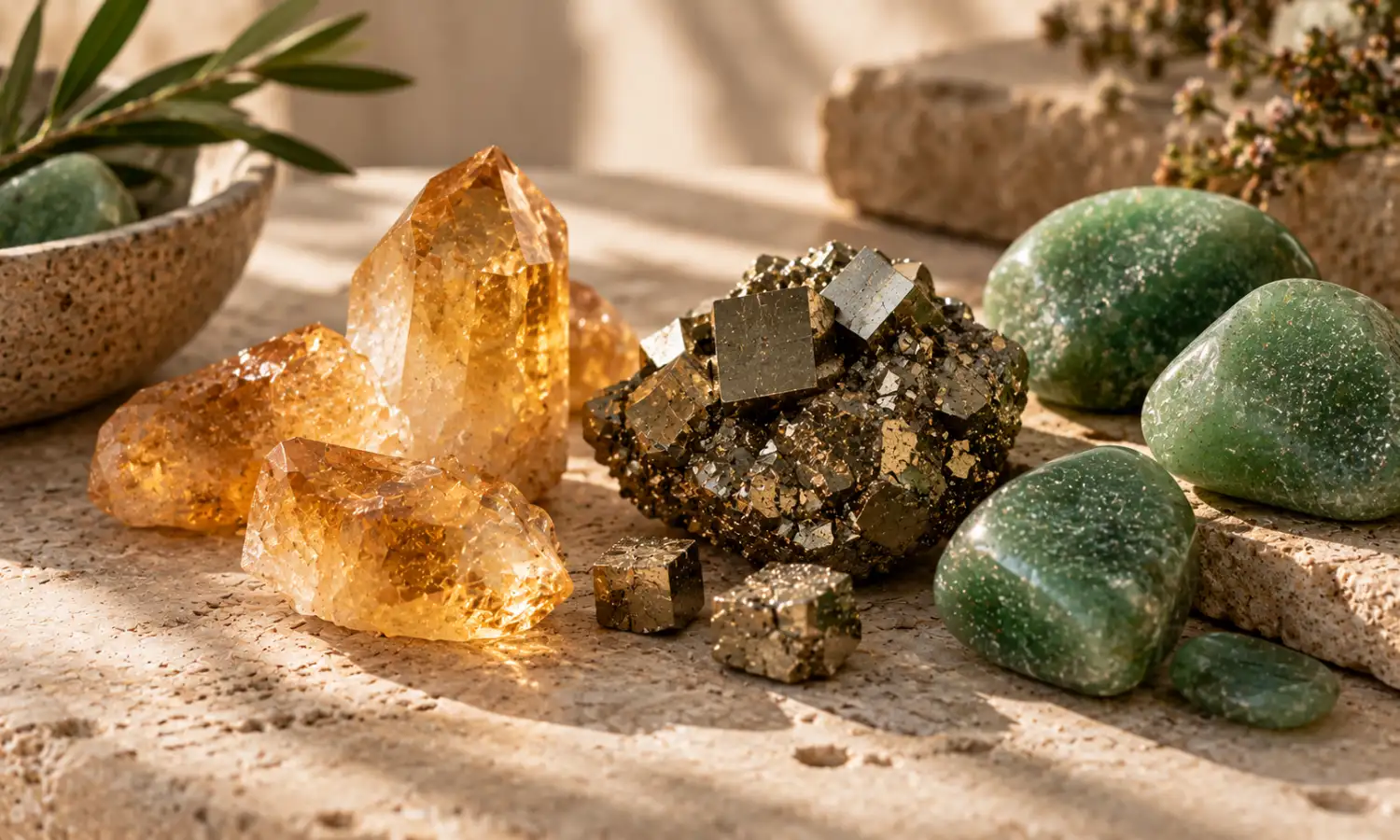

Crystals for Money: Citrine, Pyrite, Aventurine and How They’re Used
A grounded guide to crystals for money: the meanings practitioners give citrine, pyrite, aventurine and jade, how they are used, and what to expect.
Share your love
Crystals for money are stones that practitioners of crystal work associate with abundance, confidence and opportunity. The usual short list is citrine, pyrite, green aventurine and jade, with tiger’s eye, clear quartz and malachite close behind. People keep them on desks, in wallets, in a money bowl or in the wealth corner of a room as a daily reminder of a financial goal.
Quick answer: if you want one stone, most practitioners would point you to citrine, often called the “merchant’s stone,” or to pyrite, the “stone of wealth.” Both are inexpensive and easy to find. But before you buy anything, it helps to understand what these stones can and cannot do.
This guide covers the main crystals, the meanings given to them, how people use them in practice, and how to pair a stone with something that actually moves your finances.
Crystal work is a symbolic and reflective practice rooted in folk tradition and modern spirituality. It is not a proven method for producing money, and nothing here guarantees financial results.
Crystals for money at a glance
| Crystal | Color | Association | How to use and care for it |
|---|---|---|---|
| Citrine | Yellow to amber | The merchant’s stone: optimism, confidence, willingness to act | Cash drawer or wallet; rinse under water and dry |
| Pyrite | Metallic gold | The stone of wealth: ambition, discipline, protection | Small cube on a desk; wipe with a dry cloth, keep away from moisture |
| Green aventurine | Green with a sparkle | The stone of opportunity: luck and new ventures | Pocket or wallet; water-safe |
| Jade | Green | Steady, long-term prosperity | Beside a savings goal; water-safe |
| Tiger’s eye | Golden brown | Courage, clear thinking, confidence to negotiate | Carry to meetings and interviews; water-safe |
| Malachite | Banded green | Transformation and business success | Polished pieces only; dry cloth, never in water or elixirs |
Key takeaways
- Crystals for money are stones that practitioners associate with abundance, confidence and opportunity; citrine and pyrite are the usual first picks.
- The practice takes a minute a day to hold or notice the stone and a few minutes a month to clean it, using one or two tumbled stones, a small dish and a place you look at often.
- It is best for people who like a physical, tactile reminder of a goal; write the goal on a card and keep the stone on it where you make money decisions.
- There is no evidence that a crystal affects your finances; its purpose is a cue for focus and confidence, paired with a real money action.
- Give the stone a job in your actual cash flow: each time you see it, send one invoice, chase one late payment or move a set amount to savings.
How crystals fit into money practice
Stones have been carried as amulets for thousands of years, but the specific system of “crystal healing” with stone-by-stone meanings is largely a twentieth-century development, drawing on older lapidary traditions and New Age thought. There is no scientific evidence that a crystal affects your finances or your body. What a crystal can do is give an intention a shape you can hold, and that is how we suggest using it.
Most practitioners describe three uses: carrying a stone (in a pocket or wallet) to keep a goal in mind, placing it somewhere meaningful (a desk, a cash drawer, the southeast corner in feng shui), or holding it during a short daily moment of focus.
The main crystals for money
Citrine
A yellow to amber variety of quartz, commonly called the merchant’s stone because shopkeepers traditionally kept a piece in the cash drawer. Practitioners associate it with optimism, confidence and the willingness to act. Note that much commercial citrine is heat-treated amethyst; natural citrine is paler and less common. Either works as a symbol. Our full guide to citrine for wealth has more.
Pyrite
Iron sulfide, better known as fool’s gold. Its metallic shine made it a wealth symbol long before crystal shops existed. Practitioners describe it as a stone of ambition, discipline and protection against poor decisions. It is heavy, so a small cube or cluster on a desk is the typical use. Keep it dry; it can tarnish and degrade in moisture. We explore why it earned the name stone of wealth in our guide to pyrite’s spiritual meaning.
Green aventurine
A green quartz with a subtle sparkle, often called the stone of opportunity. It is associated with luck, new ventures and taking chances. Gamblers and entrepreneurs have both claimed it. It is one of the least expensive stones on this list and a common choice for a first piece.
Jade
Jade has deep roots in Chinese culture, where it is associated with virtue, longevity and prosperity. Both nephrite and jadeite are called jade. Practitioners describe it as a stone of steady, long-term wealth rather than quick gains, which makes it a fitting symbol for a savings goal. Jade sits alongside coins and the beckoning cat in our guide to good luck symbols from around the world.
Tiger’s eye
A golden-brown stone with a shifting band of light. It is commonly associated with courage, clear thinking and the confidence to negotiate. People often carry it to meetings and interviews.
Clear quartz
The all-purpose stone. Practitioners describe it as amplifying whatever intention it is paired with, so it is often placed beside citrine or pyrite in a money bowl. It is a good choice if you want a single stone for several purposes.
Malachite
A banded green copper mineral, associated with transformation and with business success in some traditions. It is beautiful but needs care: raw malachite dust is toxic, so buy polished pieces, keep them out of water, and do not use it in elixirs of any kind.
How people use crystals for money
- Choose one stone and one goal. Write the goal on a small card: a number and a date.
- Clean the stone. Rinse water-safe stones (quartz, aventurine, jade, tiger’s eye) under running water and dry them. Pyrite and malachite should be wiped with a dry cloth only.
- Set the intention. Hold the stone for a minute, read the card aloud, and name the first action you will take.
- Place it. Put the stone on the card where you make money decisions: your desk, by your laptop, in the cash drawer, or in a money bowl. Some people carry a small tumbled piece in a wallet instead.
- Notice it daily. Each time you see or touch the stone, ask whether you have taken today’s step. That is the whole mechanism.
- Refresh monthly. Wipe the stone, reread the card, and rewrite the goal if it has changed. Many practitioners do this at the new moon. Several of the money rituals people practice at home follow the same monthly rhythm.
Buying stones responsibly
Small tumbled stones cost a few dollars. You do not need a large specimen, a “charged” crystal or a certified anything. Be cautious with sellers who promise results, and be aware that mining practices vary widely; a few shops now disclose sourcing, and it is worth asking. Dyed stones and glass imitations are common for citrine, aventurine and jade, so buy from a seller who will tell you what you are getting.
A stone you found on a walk and decided to give a meaning is, for the purposes of this practice, as good as anything in a shop.
A practical pairing
Citrine earned its nickname from shopkeepers who kept it next to the day’s takings. Our pairing borrows that image: give your stone a job in your actual cash flow.
Place the stone next to wherever you handle incoming money, whether that is your invoicing app, your point-of-sale, or the envelope where you keep receipts. Each time you see it, send one invoice, chase one late payment, or log one sale. If you are employed rather than self-employed, let it mark the day you check your pay stub and move a set amount to savings.
Over a month, a stone that reminds you to send invoices promptly will do more for your finances than any property the stone is said to have, and that is a perfectly good reason to keep it.
Common questions
What is the best crystal for attracting money?
Citrine and pyrite are the most commonly recommended, followed by green aventurine and jade. There is no evidence that any stone attracts money. Choose the one whose story and appearance resonate with you, since you will be looking at it every day.
Where should I put crystals for money?
Where you make money decisions: a desk, a cash drawer, beside your laptop. In feng shui practice, the southeast area of a home or room is associated with wealth, and many people keep a stone there in a small dish. A wallet is the usual choice for a stone you want to carry. See our guide to stones to attract money for carrying tips.
How do I cleanse a money crystal?
For water-safe stones such as quartz, aventurine and jade, rinse under running water and dry. For pyrite, malachite and any stone that is soft or porous, wipe with a dry cloth. Some practitioners also leave stones in moonlight overnight. Cleaning is as much about attention as about the stone.
Can I keep money crystals in my wallet?
Yes. A small tumbled citrine, aventurine or jade is the usual choice. Avoid pyrite in a wallet, since it is heavy and can tarnish with moisture, and avoid raw malachite anywhere it will rub against skin.
Continue your practice
A stone works best as part of a small routine. Our simple money ritual for beginners shows how to build one, and intention journaling for work and opportunity gives you a place to record the invoices and transfers your stone reminds you to make. Our Start Here page explains the thinking behind every practice we publish.



