
Money Spell Guide
Prosperity rituals, luck symbols & intention
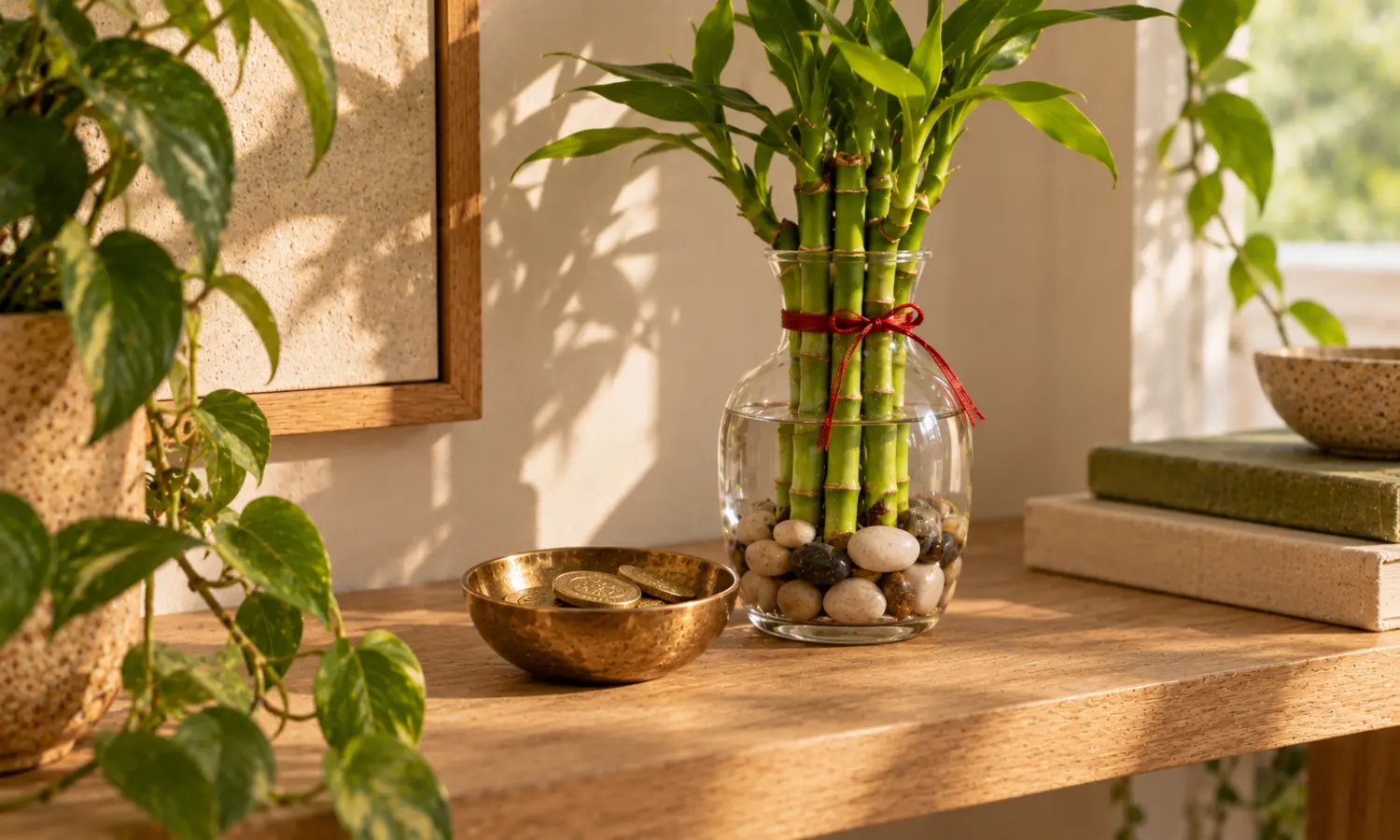

Lucky Bamboo Meaning: Stalk Numbers, Feng Shui and Care
What lucky bamboo symbolizes in feng shui, what each stalk number is said to mean, where to place it and how to keep it green.
Share your love
Lucky bamboo is a popular gift plant that, in feng shui, is commonly associated with growth, resilience and steady good fortune. Its meaning depends mostly on how many stalks you have: three is linked to happiness and long life, eight to prosperity, and four is usually avoided.
It is also one of the easiest plants to keep alive, which is part of its charm. A few stalks in water on a bright shelf can last for years with very little fuss. Below we cover what the plant is, what each stalk count is said to mean, where people place it, and how to keep it healthy.
This is folklore and personal belief, not a predictor of money or events; nothing here guarantees luck or financial results. We treat lucky bamboo the way many families do: as a living reminder of patience and growth, and a pleasant thing to care for.
Lucky bamboo stalk numbers at a glance
| Stalks | Commonly associated with | Tip |
|---|---|---|
| 2 | Love and partnership | A thoughtful gift for a couple or a new home |
| 3 | Happiness, wealth and long life | The classic all-purpose arrangement |
| 5 | Balance across areas of life, often linked to the five elements | Good for a shared living space |
| 6 | Luck and smooth flow | Popular for a desk or workspace |
| 8 | Prosperity and growth | Often chosen for a business or home office |
| 9 | Great good fortune | A generous gift for a milestone |
| 4 | Usually avoided, because the word sounds like “death” in Chinese | Add or remove a stalk instead |
Key takeaways
- Lucky bamboo is not true bamboo; it is a dracaena, a tough houseplant that grows well in water.
- Stalk numbers carry the meaning, with 3, 6, 8 and 9 the most popular for prosperity themes.
- Four stalks are traditionally avoided in Chinese culture because of how the number sounds.
- The east and southeast areas of a home are the placements most often suggested in feng shui.
- Clean water, indirect light and keeping it away from pets matter more than any symbolism.
What lucky bamboo actually is
Despite the name, lucky bamboo is not a bamboo at all. It is Dracaena sanderiana, a tropical plant from Central Africa that happens to have segmented, cane-like stems. Growers train and cut the stalks into straight columns, spirals, braids and towers, and sell them in water or shallow pebble beds.
The plant became closely tied to Chinese and wider East Asian gift culture, especially around businesses, new homes and Lunar New Year. In this tradition, bamboo-like plants are often described as symbols of resilience because they bend without breaking and keep growing. Lucky bamboo carries that same association in an easy, tabletop form.
You will often see it alongside other prosperity plants such as jade and the money tree. If you are building a small collection, our guide to feng shui plants for money explains how each one is used.
The meaning of lucky bamboo in feng shui
Feng shui works with five elements: wood, fire, earth, metal and water. A classic lucky bamboo arrangement is said to represent all five. The plant itself is wood, the water is water, the stones or pebbles are earth, a glass or metal container brings metal, and a red ribbon tied around the stalks stands for fire.
Because the plant is green, upright and always growing, it is most closely linked to the wood element, which in feng shui is commonly associated with growth, new beginnings, family and health. That is why lucky bamboo is a favorite for people starting something: a new job, a new business, a new chapter at home.
Its upward growth is also read as a gentle metaphor for progress. The point is not that the plant brings money by itself, but that it sits in your space as a daily reminder of the slow, steady growth you are working toward.
Stalk numbers and what they mean
Numbers matter a great deal in Chinese folk tradition, often because of how they sound when spoken. Lucky bamboo arrangements follow the same logic, and sellers usually label their bundles with the intended meaning.
Two and three stalks
Two stalks are commonly given to couples and are linked to love and doubled happiness. Three stalks are the most common arrangement and are often described as representing happiness, wealth and long life together. If you are unsure what to choose, three is the traditional safe choice.
Five, six and seven stalks
Five stalks are often linked to balance across the major areas of life, and sometimes to the five elements. Six is associated with luck and a smooth flow of things, since the word for six can sound similar to the word for flowing in Cantonese. Seven is less common and is sometimes linked to health.
Eight, nine and larger towers
Eight is the number most strongly associated with prosperity in Chinese culture, which makes eight stalks a favorite for offices and shops. Nine is linked to lasting good fortune. Large towers of 21 or more stalks are sometimes given as a grand blessing for a business opening.
Why four is avoided
The word for four sounds similar to the word for death in Chinese, so a four-stalk arrangement is traditionally avoided, especially as a gift. If one of your stalks dies and leaves you with four, many people simply remove another or add a new one.
Where to place lucky bamboo
In the Bagua, the feng shui map of a home, the east is commonly associated with family and health and the southeast with wealth and abundance. Both are wood-element areas, so they are the placements most often suggested for lucky bamboo. You can find the wealth area of your own space using our guide to the feng shui money corner.
- Home office or desk: a small arrangement on the left side of your desk is a popular choice for work focus.
- Living room: a visible spot near the entrance to the room welcomes guests and adds green life.
- Kitchen table: a modest bundle is often used as a symbol of family nourishment.
- Places to avoid: the bathroom, a cluttered corner, or right next to a heat source or cold draft.
Keep the plant out of harsh, direct sun. Bright, indirect light suits it best, and a north-facing window or a few feet back from a sunny one usually works well.
How to care for lucky bamboo
A healthy plant matters more than a perfect stalk count. A yellowing, neglected bamboo is not much of a symbol of growth, and in feng shui a dying plant is generally seen as stagnant energy you would rather clear out.
- Use filtered, distilled or rain water if you can, since tap water with chlorine or fluoride often causes brown tips.
- Keep the roots covered with an inch or two of water and change it about once a week.
- Rinse the container and pebbles every few weeks to stop algae from building up.
- Give it bright, indirect light and a stable room temperature.
- Trim yellow leaves, and remove any stalk that turns fully yellow so it does not affect the others.
- If you move it to soil, choose a well-draining mix and keep it lightly moist.
One important safety note: dracaena plants are considered toxic to cats and dogs if chewed. Keep lucky bamboo on a shelf your pets cannot reach.
Common misconceptions
“Lucky bamboo has to be a gift to work.” Some people believe the plant is luckier when received, and gifting it is a lovely custom. But buying one for yourself is common and perfectly fine.
“More stalks means more money.” Larger towers are a generous gesture, not a stronger charm. The meaning in this tradition comes from the specific number and from the care you give the plant, not from size.
“A dying plant means bad luck is coming.” A yellow stalk usually means too much sun, old water or chemicals in tap water. Fix the care, remove the stalk, and move on. For other plant options with similar symbolism, see our list of plants to attract money.
A practical pairing
Lucky bamboo is a plant about steady growth, so pair it with a steady habit. Each time you change the water, about once a week, take three minutes to move a small amount into savings or check one line of your budget.
Over a few months, that weekly rhythm becomes a real habit, and the plant becomes a cue for it. The symbolism and the action support each other: one reminds you of what you want, the other quietly builds it.
Common questions
How many lucky bamboo stalks are best for money?
Eight stalks are the arrangement most often linked to prosperity, with three, six and nine also popular. Avoid four. Choose the number that feels meaningful to you and that you can keep healthy.
Is lucky bamboo good luck in the bedroom?
Many feng shui practitioners suggest keeping lively, growing plants out of the bedroom, since the room is meant for rest. A small arrangement is not a problem for most people, but the living room, entry or office are more traditional spots.
What does lucky bamboo mean spiritually?
Spiritually, lucky bamboo is commonly read as a symbol of resilience, flexibility and patient growth. Its ability to bend and keep growing is often described as a lesson in adapting without giving up.
Why is my lucky bamboo turning yellow?
The usual causes are direct sun, chlorinated or fluoridated tap water, water that has not been changed, or too much fertilizer. Switch to filtered water, move it to indirect light and trim the yellow parts.
Continue your practice
To see how lucky bamboo fits into a wider tradition, read our overview of Chinese symbols for prosperity. For a companion plant, our room-by-room guide on where to place a money tree is a natural next step, and our notes on feng shui colors for money can help you choose a container and ribbon.



