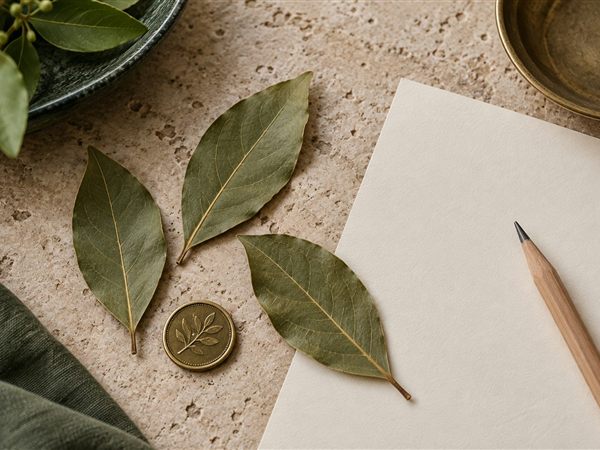

A bay leaf can be a simple visual prompt for an intention: small enough to sit beside your notebook, ordinary enough to use without buying a special kit. This quiet practice keeps the leaf whole and uses no burning.
The routine here is an original contemporary exercise. It does not claim a particular ancient origin or promise that a leaf will bring wealth. Its purpose is to make an intention easier to notice and revisit.
What you need
- One dry bay leaf, or a paper leaf if that is what you have.
- A small piece of paper and a pencil or pen.
- A notebook or envelope where you can keep the intention.
- Five to ten quiet minutes.
You do not need to write directly on the leaf. Dried leaves can be brittle, and a separate card gives you more room to use clear words. Treat the materials as symbols for reflection.
Choose what the leaf represents to you
Rather than assuming every symbol has one fixed meaning, decide what this object means in your own practice. You might use its shape as a reminder of growth, or its familiar presence in a kitchen as a reminder of everyday care.
Write that meaning down. “This leaf reminds me to give attention to what I am growing” is one example. It is an interpretation for this exercise, not a historical claim about every culture that has used bay leaves.
Write an intention you can work with
Choose a sentence about your approach, not an outcome you cannot control. Compare “I must get the job this week” with “I will prepare carefully and communicate clearly.” The second gives you something to practice even while a result remains uncertain.
For a prosperity theme, try “I will notice opportunities and take one considered step.” If that language does not suit you, use your own words. An honest sentence matters more than an elaborate phrase.
A bay leaf ritual without burning
- Arrange the materials. Put the leaf beside the paper in a comfortable place.
- Write your sentence. Keep it brief enough to read without effort.
- Read it slowly. Notice whether it feels realistic, kind and connected to something you value.
- Add an action. Below the sentence, write one step you can take today or this week.
- Keep a reminder. Place the paper and leaf in your notebook or an envelope. Give yourself a date to revisit the intention.
If a sentence feels demanding or vague, revise it before you close the notebook. The practice is yours to adapt. Nothing depends on performing every step perfectly.
Revisit the intention
On the date you chose, read the note and ask three questions: What did I try? What did I learn? What would a useful next step look like now? You can keep the same intention, write a new one or decide the exercise has served its purpose.
It is possible to feel encouraged by a reminder without assuming it changed outside events. A positive result may have many causes; a disappointing result is not evidence that you performed the ritual incorrectly.
Simple alternatives
Can I use a paper leaf?
Yes. The meaningful part of this exercise is the attention you give it. A paper shape, a sketch or a small card can work as the same reminder.
Must I burn the intention to release it?
No. This practice does not use fire. You can close the notebook, recycle the paper when you no longer need it or keep the note as a record of your reflection.
Can I carry the leaf?
You may prefer to carry the written card instead, since a dried leaf can crumble. Do what is convenient for your routine; there is no prescribed location.
Explore another practice
Pair your note with a simple money ritual for beginners, or turn it into a longer reflection with intention journaling for work and opportunity. Our editorial policy explains how we separate symbolic interpretation from evidence.